

How Much Does It Cost To Open a Cannabis Dispensary?
The cannabis industry generated $31.5 billion in combined adult-use and medical sales across the United States in 2025, and that figure is projected to reach $39 billion by 2029. It's one of the fastest-growing retail categories in the country. Yet only about 27% of dispensaries are currently profitable — compared to roughly 65% of small businesses in other sectors. That gap tells you everything you need to know about the hidden complexity behind opening a cannabis dispensary.
A dispensary is unlike any other retail business. Before you can sell a single gram, you must navigate a state licensing process that can cost anywhere from $5,000 to $300,000 depending on jurisdiction, build out a security-hardened facility with 24/7 surveillance, install cannabis-specific compliance technology that integrates with state tracking systems, and contend with federal tax law that can push your effective tax rate above 50% — even when you're running a profitable operation. Cannabis also remains federally illegal, which means most traditional banks won't work with you and most commercial landlords charge a significant premium to lease space to a cannabis business.
This guide gives you an unfiltered breakdown of what it actually costs to open a cannabis dispensary in 2026 — licensing, real estate, buildout, security, technology, inventory, and every financial challenge that makes this category unlike anything else in retail.
State Licensing & Legal Fees
Securing a cannabis retail license is the single most variable — and often the most expensive — step in opening a dispensary. Every state structures its licensing program differently: some charge modest application fees but impose strict operational requirements, while others use licensing as a significant revenue mechanism, charging fees that run into the hundreds of thousands of dollars. The state you choose to operate in will largely determine your total startup budget.
Colorado, one of the most established markets, charges a state application fee of $5,000 with an additional license fee of approximately $2,440. New York's adult-use retail license carries a $1,000 application fee and a $7,000 biennial license fee — modest by comparison. At the higher end, some states have charged licensing fees exceeding $100,000 as a barrier to entry. In limited-license markets where the number of dispensary permits is capped, the competition for available licenses often drives up the cost of consulting and legal help needed just to submit a competitive application.
Beyond the license itself, you'll need cannabis-specialized legal counsel throughout the application process, a cannabis-savvy CPA from day one, and potentially a compliance consultant if your state runs a competitive licensing process. These professional services can add $50,000–$250,000 to your pre-opening budget in complex markets.
Social equity programs: States including Illinois, New York, and California have established social equity licensing programs that offer reduced fees and priority application review to individuals from communities historically impacted by cannabis prohibition. If you qualify, these programs can significantly reduce licensing costs and improve your odds of approval in competitive markets.
| License / Legal / Filing | Cost Range |
|---|---|
| State Cannabis Retail License Application Fee | $5,000 – $150,000+ |
| State License Fee (Annual or Biennial) | $2,500 – $150,000+ |
| Local / Municipal Cannabis Permit | $1,000 – $25,000/yr |
| LLC or Corporation Formation | $50 – $500 |
| General Business License | $50 – $500/yr |
| Cannabis Attorney (Application & Compliance) | $10,000 – $100,000+ |
| Cannabis Compliance Consultant | $10,000 – $150,000+ |
| Cannabis-Specific CPA (Year 1) | $5,000 – $25,000 |
| Estimated Total (Varies Dramatically by State) | $33,600 – $600,000+ |
Location & Real Estate
Finding a viable dispensary location is harder than it sounds — and considerably more expensive than standard retail. Cannabis zoning regulations restrict where dispensaries can operate, typically requiring minimum distances from schools, churches, daycare centers, and other dispensaries. In many markets, that eliminates a majority of available commercial real estate before you've even started negotiating. The properties that remain in compliant zones command a significant premium: cannabis-zoned real estate routinely runs 2–3x the cost of comparable non-cannabis retail space, because landlords price in the perceived legal risk of leasing to a federally illegal business.
A standard dispensary footprint runs 1,000–3,500 square feet, depending on the state's requirements and the experience you want to create. High-traffic urban locations with strong walk-in potential will cost the most; secondary markets and suburban locations offer lower rent but may reduce organic foot traffic. Many operators find that a visible, accessible location near complementary businesses — coffee shops, health and wellness retailers, parking structures — performs best.
Verify zoning before anything else: Signing a lease on a space that later fails cannabis zoning review is one of the most costly mistakes new dispensary owners make. Confirm zoning compliance with your local municipality and have your attorney review the lease for cannabis-specific clauses before committing.
| Location Type | Annual Rent |
|---|---|
| Small market / secondary city (1,000–1,500 sq ft) | $18,000 – $60,000 |
| Suburban / mid-size market (1,500–2,500 sq ft) | $50,000 – $150,000 |
| Major metro / prime urban (2,000–3,500 sq ft) | $120,000 – $500,000+ |
| First-Year Rent + Security Deposit (Mid-Market) | $75,000 – $225,000 |
Note that many cannabis landlords require 6–12 months' rent upfront as a security deposit rather than the standard 1–3 months, due to the perceived risk of leasing to a cannabis operator. Budget for this accordingly before approaching landlords.
Facility Buildout & Security Infrastructure
A cannabis dispensary buildout goes far beyond standard retail construction. State regulations mandate specific security infrastructure — camera coverage of every area where cannabis is stored, handled, or sold; alarm systems with multi-zone monitoring and biometric access controls; and cash management protocols given the cash-heavy nature of the business. Specialized HVAC systems are also required to maintain consistent temperature and humidity for product quality and to prevent mold. Combined with the need for attractive, brand-aligned retail design, cannabis buildouts are among the most expensive per-square-foot in specialty retail.
State-Mandated Security Systems
Most states require 24/7 high-definition video surveillance covering every entry, exit, POS station, and product storage area, with footage retained for a minimum of 30–90 days. High-resolution camera systems meeting these requirements run $15,000–$50,000. Multi-zone alarm systems with motion sensors, panic buttons, and biometric or keycard access control add another $10,000–$30,000. Some states also require cash vaults and dedicated secure storage for cannabis products after business hours.
Facility Construction & HVAC
Beyond security, a dispensary buildout includes interior design, display case installation, reception and waiting area construction, a secure product storage room, and specialized HVAC systems for climate and air quality control. Cannabis-specific architects and designers who understand both state compliance requirements and retail aesthetics typically charge $15,000–$75,000 for design work alone. Total construction and buildout runs $100,000–$600,000 depending on square footage and finish level.
| Buildout / Security Component | Estimated Cost |
|---|---|
| Advanced Camera System (90-Day Retention) | $15,000 – $50,000 |
| Alarm, Access Control & Panic Systems | $10,000 – $30,000 |
| Cash Vault / Secure Product Storage | $5,000 – $20,000 |
| Security Monitoring Service (Annual) | $3,000 – $10,000 |
| Specialized HVAC & Environmental Controls | $15,000 – $50,000 |
| Retail Interior Design & Architecture | $15,000 – $75,000 |
| General Construction & Buildout | $50,000 – $400,000 |
| Total Buildout + Security | $113,000 – $635,000 |
Get state compliance specs first: Before contracting any construction work, obtain your state's exact facility compliance requirements and have your architect verify the design meets them. Building a beautiful dispensary that fails its compliance inspection before opening is an expensive and time-consuming setback.
Opening Inventory
Cannabis inventory is your largest single upfront variable cost and the category that most directly determines your day-one customer experience. Walk into a dispensary with thin, poorly curated shelves and customers will leave for a competitor. A well-stocked opening inventory covers the major product categories your state allows — flower, pre-rolls, edibles, concentrates, vapes, and topicals — with enough depth and variety to serve different consumption preferences and price points.
Flower & Pre-Rolls
Flower remains the highest-demand product category in most markets. Wholesale cannabis flower prices have fluctuated significantly — averaging $888–$1,096 per pound in 2025 — and building a credible flower selection with multiple strains across price tiers requires careful purchasing strategy. Pre-rolls are a high-margin, fast-moving category that complements your flower selection.
Edibles, Vapes & Concentrates
Edibles and vapes are where margins are strongest and where you can differentiate through brand curation. Concentrates serve a dedicated consumer segment willing to spend more per visit. Together, these categories typically account for 50–60% of dispensary revenue in mature markets and warrant significant opening inventory investment.
Product Testing & Compliance
In most states, all cannabis products sold at retail must pass third-party laboratory testing for potency, pesticides, and contaminants. Testing costs run $500–$2,500 per batch and are a recurring operational expense that factors into your ongoing cost of goods.
| Inventory Category | Estimated Cost |
|---|---|
| Flower (Multiple Strains, Price Tiers) | $20,000 – $80,000 |
| Pre-Rolls | $5,000 – $20,000 |
| Edibles (Gummies, Chocolates, Beverages) | $10,000 – $40,000 |
| Vape Cartridges & Disposables | $10,000 – $40,000 |
| Concentrates (Wax, Shatter, Live Resin) | $5,000 – $25,000 |
| Topicals, Tinctures & Accessories | $2,000 – $10,000 |
| Total Opening Inventory | $52,000 – $215,000 |
Purchasing from licensed vendors only: All cannabis products must be sourced exclusively from state-licensed cultivators, processors, and distributors. You cannot purchase from unlicensed sources under any circumstances — doing so risks immediate license revocation. Build vendor relationships early, as supply can be inconsistent in new markets.
Fixtures, Display Cases & Store Setup
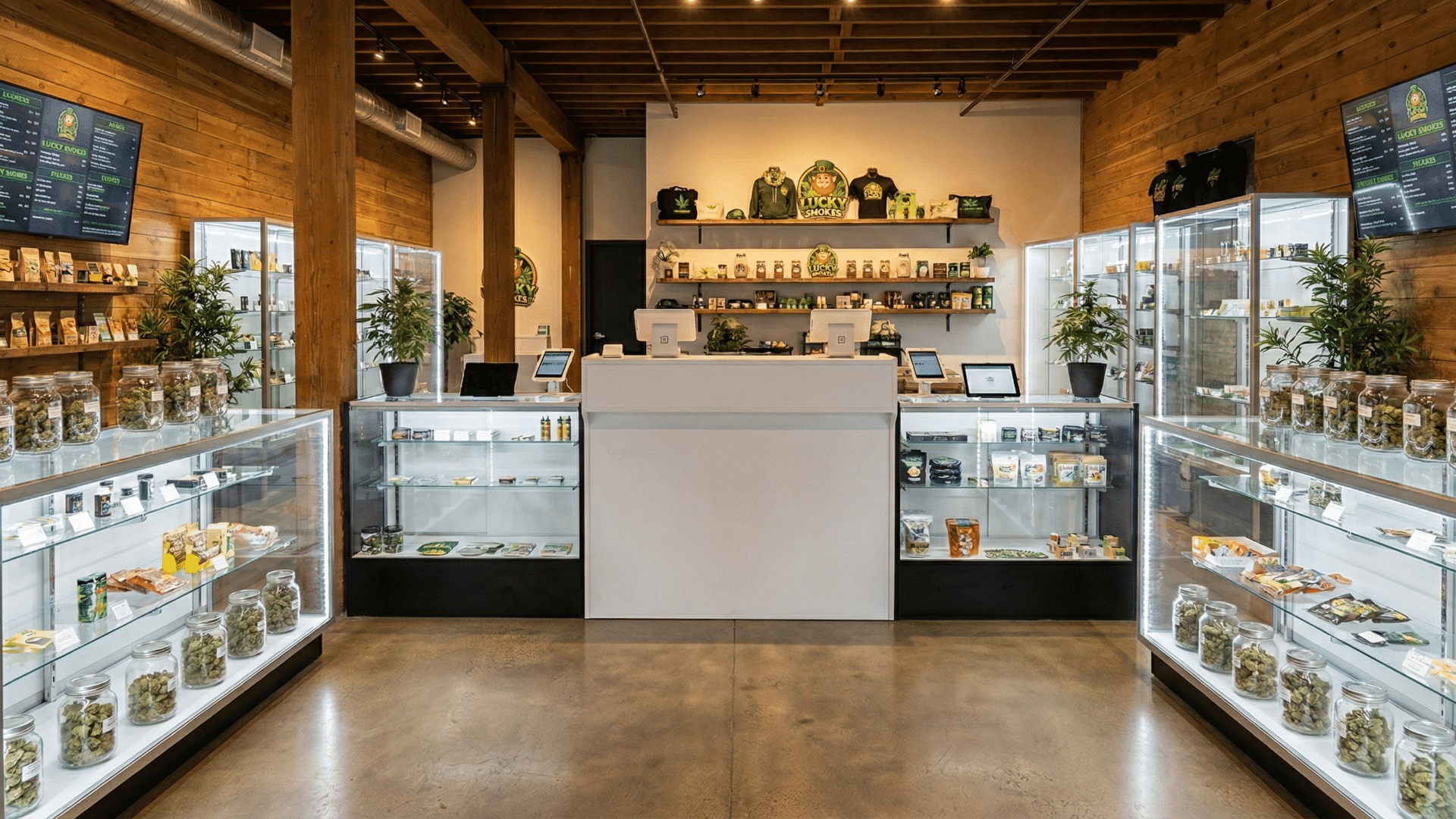
Dispensary retail design has evolved dramatically from the sterile, clinical environments of early medical dispensaries. Today's most successful cannabis retailers invest in store environments that feel premium, curated, and intentional — because the customer who's spending $60–$200 per visit expects an experience that matches that price point. Glass display cases that showcase flower jars, vape hardware, and edibles professionally are the centerpiece of any dispensary floor, and DISPLAYARAMA's free 2D store layout service can help you plan exactly what you need before committing to fixtures.
A well-designed dispensary typically features a dedicated reception or check-in area for ID verification, a main retail floor with product display cases organized by category, a consultation space or open floor layout for budtender-customer interaction, and a secure back-of-house for inventory storage. Many states require that products not be visible from outside the store, which shapes both the layout and the window treatment of the space.
| Fixture / Component | Estimated Cost |
|---|---|
| Locking Glass Display Cases (4–10 units) | $3,000 – $20,000 |
| Wall Display Shelving & Cabinets | $2,000 – $10,000 |
| Reception / Check-In Counter | $1,500 – $6,000 |
| Checkout / Budtender Counter | $1,500 – $6,000 |
| Waiting Area Furniture & Seating | $1,000 – $5,000 |
| Interior Signage & Branding | $2,000 – $10,000 |
| Display Lighting (Case + Ambient) | $1,500 – $8,000 |
| Total Fixtures & Store Setup | $12,500 – $65,000 |
Locking glass display cases are a compliance requirement, not just an aesthetic choice. In virtually every state, cannabis products must be stored in locked cases when not being handled by staff. Cases with LED lighting inside dramatically improve how product presents — flower jars, vape hardware, and packaged edibles all look more premium under proper lighting, which directly affects willingness to pay.
The check-in and reception area is where your customer's experience begins. ID verification happens here for every single customer, every visit. A well-designed check-in station that feels welcoming rather than bureaucratic sets the tone for the entire transaction.
DISPLAYARAMA has been supplying retail fixtures to specialty stores since 1980. We carry locking glass display cases, wall display cases, checkout counters, and more — everything needed to build a dispensary that looks premium and meets your state's display requirements from day one.
Our team can help you plan your layout and select the right fixture combination for your space and budget. Call us at 1-800-292-5227 or get your free layout plan below.
Get My Free Store Fixture Layout Plan →Technology, Compliance & Operations
Cannabis retail has one of the most demanding technology requirements of any retail category. A standard retail POS system is completely unusable here — you need a cannabis-specific platform that integrates in real time with your state's seed-to-sale tracking system (METRC is used in 24+ states; BioTrack and Leaf Data Systems are used in others). Every transaction must be reported to the state's tracking platform, every gram of product must be accounted for from the cultivator through the retail sale, and purchase limits must be enforced automatically at checkout. A failure in compliance reporting can trigger a license suspension.
Cannabis POS platforms like Flowhub, Cova, BLAZE, and Dutchie are purpose-built for this environment. Monthly software costs run $500–$1,500 per location, plus hardware costs. Cannabis insurance is also substantially more expensive than standard retail coverage — general liability, product liability, and property insurance for a dispensary typically run $10,000–$50,000 annually depending on inventory value and location.
Banking is a real challenge: The SAFER Banking Act has not yet passed as of 2026, meaning most traditional banks still decline cannabis business accounts. Many dispensaries pay $1,500–$2,500 per month in fees to the few financial institutions willing to serve them. Cash-heavy operations also require additional security investment. Budget for this from day one.
| Technology / Compliance / Operations | Estimated Cost |
|---|---|
| Cannabis POS System (Hardware + Setup) | $3,000 – $15,000 |
| Cannabis POS Monthly Software Fee | $500 – $1,500/mo |
| Seed-to-Sale Tracking (METRC Tags, etc.) | $500 – $2,000/yr |
| Cannabis Business Insurance (Annual) | $10,000 – $50,000 |
| Banking Fees (Annual) | $18,000 – $30,000 |
| Cannabis-Specific Payroll Service (Annual) | $3,000 – $8,000 |
| Website / E-Commerce / Online Menu | $2,000 – $8,000 |
| Utilities (Monthly Average) | $1,500 – $5,000/mo |
| First-Year Technology + Operations | $55,000 – $173,000+ |
The 280E Tax Challenge You Cannot Ignore
No guide to dispensary startup costs is complete without addressing the single most important financial reality in cannabis retail: IRS Section 280E. Because cannabis remains a Schedule I controlled substance under federal law, Section 280E of the Internal Revenue Code prohibits cannabis businesses from deducting most ordinary business expenses on their federal tax returns. That means rent, utilities, marketing, employee salaries, banking fees, and most other operating costs that every other business writes off — none of them are deductible for a cannabis retailer.
What this means in practice: a cannabis retailer can only deduct its Cost of Goods Sold (COGS) from gross revenue before calculating taxable income. Everything else — all the overhead that runs a real business — is taxed as if it's profit. The IRS Taxpayer Advocate has illustrated this with a straightforward example: a dispensary earning $1 million in gross revenue that spends $750,000 on COGS and $200,000 on operating expenses ends up with a federal tax burden five times larger than an equivalent non-cannabis retailer. Effective tax rates for dispensaries commonly reach 40–70% of gross profit.
There is meaningful movement on this front. In December 2025, President Trump signed an executive order directing the Attorney General to expedite the process of rescheduling cannabis from Schedule I to Schedule III. If finalized, that rescheduling would render 280E inapplicable — restoring the ability to deduct standard business expenses and dramatically improving profitability across the industry. However, as of mid-2026, rescheduling is not yet complete and 280E remains in force for most operators.
Work with a cannabis-specialist CPA from day one. 280E planning — maximizing your legally defensible COGS allocation, structuring your business correctly, and staying ahead of regulatory changes — is not something a general accountant can do effectively. The difference between a well-structured and poorly structured cannabis business under 280E can be tens or hundreds of thousands of dollars per year.
| 280E Impact Example | Cannabis Retailer |
|---|---|
| Gross Revenue | $1,000,000 |
| Cost of Goods Sold (Deductible) | – $750,000 |
| Taxable Income (per 280E) | $250,000 |
| Operating Expenses (Non-Deductible) | $200,000 |
| Federal Tax Burden (at ~30%) | $75,000 |
| Equivalent Non-Cannabis Tax Burden | $15,000 |
| Tax Burden Multiplier Under 280E | 5x Higher |
This example — drawn directly from IRS Taxpayer Advocate analysis — illustrates why profitability in cannabis retail requires significantly higher gross revenue than comparable non-cannabis businesses. Budget for 280E before you model your break-even, not after.
Total Startup Cost Summary
When all categories are accounted for, opening a cannabis dispensary in 2026 requires a minimum of $250,000 for the leanest operations in lower-cost markets, and a realistic mid-size storefront in a competitive state will typically run $500,000–$1,000,000 before opening day. Premium urban locations with full buildouts, deep inventory, and high-cost licensing markets can push well past $2 million.
| Expense Category | Estimated Range |
|---|---|
| State Licensing, Legal & Consulting | $33,600 – $600,000+ |
| Real Estate (First Year Rent + Deposit) | $30,000 – $300,000 |
| Facility Buildout & Security Infrastructure | $113,000 – $635,000 |
| Opening Inventory | $52,000 – $215,000 |
| Fixtures & Store Setup | $12,500 – $65,000 |
| Technology & Operations (Year 1) | $55,000 – $173,000 |
| Working Capital Reserve (6 months) | $50,000 – $200,000 |
| Total Estimated Startup Investment | $346,100 – $2,188,000+ |
Capitalization is everything. The dispensaries that close aren't always the poorly run ones — they're often the ones that opened with just enough capital to get through licensing and buildout but not enough to survive the months before profitability. Build your financial model around 280E, budget for banking fees, and secure enough working capital to cover at least 6 months of full operating expenses before you open your doors.
How to Maximize Revenue
In a category where only 27% of dispensaries are profitable, success depends on differentiation, operational efficiency, and building a loyal customer base that chooses you over the competition down the street. Here's how the best operators separate themselves.
Invest in Budtender Training
Knowledgeable budtenders are your most powerful sales asset. Customers who receive accurate, personalized product recommendations spend more per visit and return more often. Staff education is also a compliance requirement — it's a cost that pays dividends in revenue and license protection.
Build a Strong Loyalty Program
Cannabis customers are habitual — when they find a dispensary they trust, they return consistently. A points-based loyalty program with tiered rewards builds switching costs and drives repeat visits, which is especially critical in markets where you can't advertise freely.
Offer Online Ordering
Dispensaries that accept debit cards and offer online ordering earn measurably more revenue per transaction. Integrating your POS with a Leafly or Dutchie online menu and offering click-and-collect or delivery (where legal) extends your reach beyond walk-in traffic.
Curate a Differentiated Product Mix
Competing on price alone in a market with multiple licensed dispensaries is a race to the bottom. Curating exclusive products, local craft brands, and limited-run items gives customers a reason to choose you specifically — not just whoever is closest or cheapest.
Maximize Your COGS Allocation
Under Section 280E, your only real tax lever is your COGS. Work with a cannabis CPA to ensure every legitimately direct cost is properly allocated to cost of goods — including packaging, compliance labels, and direct labor. The difference is real money on your tax return.
Reduce Cash Dependence
Dispensaries accepting debit cards earn significantly more per transaction than cash-only operations. Integrated payment solutions reduce the security risk, bookkeeping burden, and banking friction that comes with heavy cash operations — and improve the customer experience simultaneously.
Why Your Fixtures Matter
In a category where advertising is heavily restricted and word-of-mouth carries outsized weight, the in-store experience becomes your primary marketing vehicle. Customers who walk into a beautifully designed dispensary with professional display cases and clear product organization feel confident in their purchase — and tell their friends. Customers who walk into a cluttered, clinical, or poorly lit store don't come back.
Your display cases are where product perception is created. A flower jar sitting in a well-lit, professionally organized showcase looks premium. The same product on a bare shelf looks like a commodity. In a category with thin profit margins and 280E bearing down on you, every dollar of average transaction value you can earn through excellent presentation matters. Prioritize these when planning your floor:
- Locking glass display cases organized by product category — flower, edibles, vapes, concentrates — so customers can navigate intuitively without staff assistance for every question
- LED lighting inside every display case — cannabis products, particularly flower and hardware, look dramatically better under proper lighting
- A welcoming, efficient check-in and reception area — ID verification is mandatory for every customer, and how that interaction feels sets the tone for everything that follows
- A professional budtender counter with enough workspace for consultation — budtender interactions are your most powerful conversion tool
- Clear category and pricing signage throughout — customers who can quickly orient themselves browse longer and spend more
DISPLAYARAMA has been outfitting specialty retail stores with professional-grade display fixtures since 1980. We carry locking glass display cases, wall display cabinets, checkout counters, and more — everything you need to build a dispensary that looks the part and meets your state's display compliance requirements from day one.
Our team can help you plan your store layout and select the right combination of fixtures for your square footage and budget. Bulk pricing is available for full buildouts.
Get My Free Store Fixture Layout Plan →Ready to Outfit Your Dispensary?
If you're opening a cannabis dispensary and need to source display cases and fixtures, start with DISPLAYARAMA's free 2D store layout service — a no-cost resource where our team creates a professional floor plan with specific fixture recommendations for your space. It saves hours of guesswork and gives you a clear picture of your fixture investment before you commit to anything. Request your free layout plan here.
Locking Glass Display Cases
Secure, professional showcases for flower jars, vape hardware, edibles, and concentrates. Meets state requirements for locked product display while presenting your inventory at its best.
Wall Display Cases & Cabinets
Wall-mounted display solutions for branded merchandise, accessories, and featured product categories — maximizing vertical space and creating a clean, organized perimeter.
Reception & Check-In Counters
Purpose-built front-of-house counters for ID verification and customer check-in — designed to make a compliance-required process feel welcoming rather than clinical.
Budtender / Checkout Counters
Professional sales counters with workspace for consultation, POS hardware, and transaction completion — the operational heart of your retail floor.
Custom Display Solutions
Need fixtures tailored to your brand aesthetic or specific state display requirements? DISPLAYARAMA offers custom solutions built to your exact dimensions and design vision.
Bulk Pricing Available
Outfitting a full dispensary? DISPLAYARAMA offers bulk pricing on display cases and fixtures. The more you order, the more you save. Call 1-800-292-5227 for a custom quote.
DISPLAYARAMA's free 2D store layout service gives you a professional floor plan with specific fixture recommendations for your dispensary — at no cost. It's designed to save you hours of guesswork and give you a clear picture of your fixture investment before you commit to a single order. We've been helping specialty retailers design their stores since 1980, and we offer bulk pricing for owners outfitting a full floor.
Submit your space dimensions and store type and we'll put together a custom layout plan with the exact displays that will work for your dispensary.
Get My Free Store Fixture Layout Plan →