

How Much Does It Cost To Open a Cell Phone Store?
Cell phones are the single most universally owned piece of personal technology in American life — and they break, age, need accessories, and occasionally need to be replaced on a predictable and continuous basis. The U.S. smartphone repair market was valued at over $5 billion in 2024 and is growing at a 9.1% CAGR through 2030, driven by consumers who would rather repair than replace when the cost is reasonable. Fifty percent of consumers say they'd repair a phone rather than buy new if the repair costs under $150. That's a massive addressable market for anyone operating a professional, trustworthy repair operation.
But the cell phone store landscape has changed dramatically. The era of opening a basic device sales store and living on new phone activations and commissions is largely over for independent operators — carrier margins on new devices have compressed to 5–10%, and the major carriers (Verizon, T-Mobile, AT&T collectively control over 98% of the U.S. wireless market) have built their own corporate and authorized dealer networks that compete directly with independents. The path to profitability for independent cell phone stores in 2026 runs through repair, refurbished devices, accessories, and the services that big-box wireless retailers don't offer well.
This guide gives you a complete, honest breakdown of what it actually costs to open a cell phone store in 2026 — every major expense category, the critical decision between independent operation and carrier-authorized dealer programs, and the margin reality behind each revenue stream in the business.
Choosing Your Business Model
Before setting a budget, the most consequential decision you'll make is which type of cell phone business you're building. Each model has fundamentally different economics, competitive positioning, and capital requirements — and choosing the wrong one for your market and skills is the leading cause of failure in wireless retail.
An independent repair and accessories store is where the strongest margins for independent operators live in 2026. Repair services carry 50–70% gross margins. Refurbished device sales carry 30–50% margins. Accessories (cases, chargers, screen protectors) carry 40–60% margins. None of these depend on carrier relationships or activation commissions. An authorized carrier dealer — becoming a TPR (third-party retailer) for T-Mobile, Verizon, or AT&T — provides brand association, consignment inventory, and training, but comes with significant financial requirements (T-Mobile requires a minimum net worth of $750,000 and $150,000 in liquid capital), strict operational standards, and revenue streams tied to activation commissions that depend on selling plans. Wireless Zone (Verizon's largest authorized dealer franchise) runs $202,000–$533,000 all-in. An independent multi-carrier store carries prepaid plans across multiple carriers (Cricket, Metro by T-Mobile, Boost Mobile) and sells new and used devices without an exclusive carrier agreement — lower financial requirements, but also less brand support.
| Business Model | Startup Range |
|---|---|
| Independent Repair + Accessories Kiosk | $15,000 – $50,000 |
| Independent Repair + Accessories Store | $50,000 – $120,000 |
| Multi-Carrier Prepaid + Accessories Store | $60,000 – $150,000 |
| Authorized Carrier Dealer (e.g., Wireless Zone) | $202,000 – $533,000 |
| Highest Independent Margins Come From | Repair + Accessories |
Repair is the profit engine: New device sales carry 5–10% margins. Carrier activation commissions are volatile and carrier-controlled. Repair services carry 50–70% gross margins, are not carrier-dependent, and grow as the installed base of smartphones expands. The most resilient independent cell phone businesses treat repair as the core and everything else as supplementary revenue.
Licenses, Permits & Business Formation
A cell phone store selling devices and accessories has a standard retail licensing footprint. Your primary requirements are business formation, a general retail license, and a resale certificate for purchasing inventory wholesale without sales tax. If you plan to buy used phones from customers — which is both profitable and common in repair/resale operations — research your local secondhand dealer permit requirements, as many municipalities require registration and transaction recordkeeping for used electronics purchases.
If you're pursuing an authorized carrier dealer agreement, expect a more extensive vetting process: background checks, credit checks, minimum net worth and liquidity verification, and in some cases proof of retail management experience. T-Mobile's authorized dealer program requires a minimum net worth of $750,000; Wireless Zone (Verizon) requires a minimum net worth of $300,000 with $100,000 in liquid capital. These aren't license costs — they're financial qualification thresholds that determine whether you're eligible for the program at all.
Right-to-Repair laws are expanding your opportunity: Right-to-Repair legislation has been introduced in over 30 U.S. states, and the movement is expanding access for independent repair shops to manufacturer parts and diagnostic tools. This regulatory tailwind specifically benefits independent repair operators and is reducing the access barriers that previously disadvantaged independents vs. manufacturer-authorized service centers.
| License / Permit / Filing | Cost Range |
|---|---|
| LLC or Corporation Formation | $50 – $500 |
| General Business License | $50 – $500/yr |
| Seller's Permit / Resale Certificate | $0 – $50 |
| Zoning / Occupancy Permit | $100 – $1,000 |
| Signage Permit | $100 – $500 |
| Secondhand Dealer Permit (if buying used devices) | $50 – $500/yr |
| Attorney / Legal Consultation | $500 – $2,000 |
| Estimated Total (Independent Store) | $850 – $5,050 |
Location & Rent
Cell phone store location strategy depends heavily on your business model. A repair-focused operation benefits most from high foot traffic — strip malls near grocery anchors, mall inline locations, or busy urban street corners generate the walk-in volume that drives repair revenue. A customer with a cracked screen isn't going to research their options extensively; they'll stop at the first credible repair shop they see on their route. Visibility and convenience are the most important location variables for a repair-forward business.
For an authorized carrier dealer, carrier brand guidelines typically dictate store size, signage, and sometimes location requirements. Carrier authorized retail locations are often concentrated in shopping centers and malls where carrier-branded stores already drive consumer expectations. A typical carrier retail store runs 800–1,200 square feet, while a full-service independent might operate in 600–1,000 square feet. A kiosk format — common in malls and large shopping centers — can start with a much smaller footprint and lower cost, though mall kiosk fees can be surprisingly high in premium locations.
Mall kiosks: lower buildout, higher per-square-foot cost: A mall kiosk can be launched for $15,000–$40,000 in setup costs but typically runs $2,000–$6,000/month in kiosk fees plus a percentage-of-sales component in many mall agreements. For repair operations in particular, kiosks provide excellent visibility and walk-in volume, making the math workable if your repair ticket average and daily volume are strong.
| Location Type | Monthly Cost |
|---|---|
| Mall / Shopping Center Kiosk | $2,000 – $6,000 |
| Strip Mall Inline (600–1,000 sq ft) | $1,500 – $5,000 |
| Standard Retail Store (1,000–1,500 sq ft) | $2,500 – $8,000 |
| Authorized Carrier Location (per brand spec) | $3,000 – $10,000+ |
| First-Year Rent Cost (Mid-Size Estimate) | $30,000 – $96,000 |
Buildout costs for a standard cell phone store run $10,000–$40,000 for a basic independent store, and $40,000–$100,000 for a carrier-branded authorized dealer location that must meet the carrier's interior design and fixture standards.
Inventory, Devices & Repair Parts
Inventory strategy is the most critical financial decision in opening a cell phone store — and where margin discipline either makes or breaks the business. The temptation is to stock the latest flagship devices, but new iPhones and Samsung Galaxy phones carry only 5–10% margins. The real money is in the categories that carry 30–70% gross margins: accessories, refurbished devices, and repair parts. Build your inventory plan around the high-margin categories first and use new device sales as a traffic driver rather than a primary profit center.
Accessories (Highest Margin, Fastest Turns)
Cases, screen protectors, chargers, cables, earbuds, and power banks carry 40–60% gross margins and turn over quickly. A well-curated accessories wall is the most reliable revenue-per-square-foot category in any cell phone store. Budget $5,000–$15,000 for a strong opening accessories inventory across the most popular device models.
Repair Parts & Tools
If repair is your primary service, your parts inventory is your cost of goods. Quality screen assemblies, batteries, charging ports, and the tool kit to install them need to be in stock — a repair shop that has to order parts for every job loses customers. Budget $5,000–$15,000 for an opening repair parts inventory across the most common device models and repair types.
Refurbished & Used Devices
Refurbished smartphones carry 30–50% gross margins and address a growing customer segment that prefers value over flagship pricing. Sourcing quality used devices, testing, grading, and reselling them is a genuinely profitable business within the store. Budget $10,000–$25,000 for an opening refurbished device inventory. New flagship devices can be added selectively for traffic, keeping in mind the thin margins.
| Inventory Category | Gross Margin | Budget |
|---|---|---|
| Accessories (Cases, Chargers, Cables) | 40–60% | $5,000 – $15,000 |
| Repair Parts & Tools | Cost of service | $5,000 – $15,000 |
| Refurbished / Used Devices | 30–50% | $10,000 – $25,000 |
| New Smartphones (Traffic Driver) | 5–10% | $5,000 – $20,000 |
| Prepaid Plans / SIM Cards | Commission-based | $500 – $2,000 |
| Total Opening Inventory | $25,500 – $77,000 |
Manage device obsolescence aggressively: New phone models typically lose 10–15% of their wholesale value within six months of a new release cycle. Devices that sit too long become heavily discounted liability. Track device inventory turns vigilantly and discount aging stock before the next model drop rather than after, when everyone else is doing the same thing.
Fixtures, Display Cases & Store Design
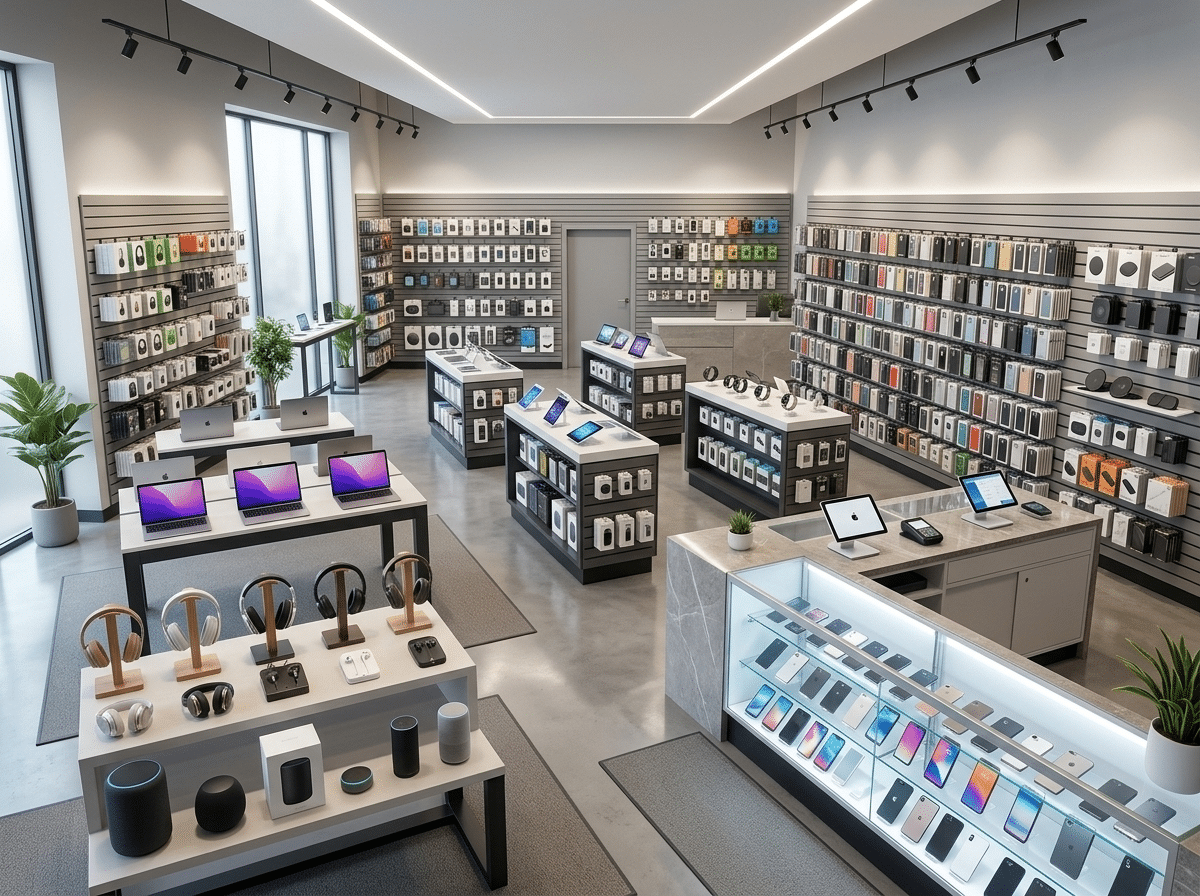
A cell phone store's fixture design needs to accomplish three things simultaneously: present devices and accessories professionally, secure high-value inventory against theft, and create a counter environment where repair transactions can happen efficiently and privately. The display case is the centerpiece of any cell phone store floor — it's where devices, premium accessories, and high-value items are shown and protected. DISPLAYARAMA's free 2D store layout service can help you plan your fixture configuration before you spend a dollar on cases or shelving.
Locking glass display cases for phones and premium accessories are the defining fixture of a cell phone store. A smartphone in a locked, well-lit display case looks like a precision device worth its price tag. The same phone on a pegboard hook looks like a commodity. The case configuration also serves as your primary theft prevention for the most valuable and most concealable items in the store.
Wall-mounted accessories displays — slatwall systems loaded with cases, cables, screen protectors, and earbuds organized by device compatibility — are your highest-revenue-per-square-foot real estate. Customers who come in for a screen protector often leave with a case and cable as well. Organized, labeled, and well-stocked accessories walls drive impulse add-on sales on virtually every repair and device transaction.
| Fixture / Component | Estimated Cost |
|---|---|
| Glass Display Cases (Phones + Premium Accessories) | $2,000 – $10,000 |
| Slatwall Panels (Accessories Wall) | $1,500 – $5,000 |
| Wall Shelving (Boxed Accessories, Devices) | $1,000 – $4,000 |
| Repair Counter / Workbench | $500 – $2,500 |
| Checkout Counter / Transaction Counter | $800 – $3,500 |
| Security Camera System | $1,000 – $5,000 |
| Interior + Exterior Signage | $1,000 – $5,000 |
| Lighting (Case + Ambient) | $800 – $3,000 |
| Total Fixtures & Store Setup | $8,600 – $38,000 |
The repair counter deserves special mention as a strategic design element. Customers dropping off or picking up a repair device are in the store for a service interaction — not just a transaction. A clean, professional repair counter communicates competence and care, which directly affects whether customers trust you with their device and whether they return for future repairs. A visible workbench area (appropriately secured) also communicates that real technical work happens here, which builds confidence in a category where trust is the primary purchase driver.
DISPLAYARAMA has been supplying retail fixtures to specialty stores since 1980. We carry locking glass display cases, slatwall systems, wall display solutions, checkout counters, and more — everything needed to build a cell phone store that presents devices professionally, secures high-value inventory, and drives accessory sales efficiently.
Our team can help you plan your layout and select the right fixture combination for your space. Call us at 1-800-292-5227 or get your free layout plan below.
Get My Free Store Fixture Layout Plan →Technology, Repair Equipment & Operations
A cell phone store requires a POS system purpose-built for the wireless retail and repair environment. General retail systems don't handle repair ticket management, device IMEI tracking (essential for used device compliance and anti-theft), part-level inventory for repair components, layaway and payment plan management, or carrier commission tracking. Purpose-built platforms like CellSmart POS and RepairShopr are designed specifically for this environment and handle all of these workflows natively.
If repair is part of your business — and it should be — your technician tools are a genuine capital investment. Quality micro-soldering equipment, screen testing devices, battery testers, IMEI checking tools, and a diagnostic tablet or device are the operational infrastructure of a professional repair operation. Cutting corners on repair tools results in longer repair times, higher parts waste, and lower customer confidence. Budget $3,000–$8,000 for a professional repair toolkit for a well-equipped single technician.
Insurance is critical in this category: A cell phone store carries high-value, highly portable inventory — iPhones, Samsung devices, and premium accessories are among the most shoplifted items in retail. Comprehensive commercial property and inventory insurance, including coverage for in-store theft and repair device loss, runs $1,500–$4,000 annually and is non-negotiable. A single uninsured theft incident can erase a month of profit.
| Technology / Equipment / Operations | Estimated Cost |
|---|---|
| Cell Phone / Repair POS (Hardware + Setup) | $1,500 – $5,000 |
| POS Monthly Software Fee | $50 – $200/mo |
| Repair Tools & Equipment (Full Kit) | $3,000 – $8,000 |
| IMEI Check & Device Testing Tools | $200 – $1,000 |
| Staff Wages (Monthly — Small Store, 1–3 Staff) | $4,000 – $12,000/mo |
| Business Insurance (Annual) | $1,500 – $4,000 |
| Website / Online Presence | $500 – $2,000 |
| Marketing / Grand Opening | $1,500 – $6,000 |
| Utilities (Monthly Average) | $300 – $1,200/mo |
| First-Year Technology + Operations | $68,650 – $197,400+ |
Total Startup Cost Summary
When all categories are totaled, opening an independent repair and accessories cell phone store in 2026 typically requires $30,000–$60,000 for a lean kiosk or small independent store and $80,000–$150,000 for a properly equipped mid-size repair and retail store. Authorized carrier dealer investments run significantly higher based on the carrier's requirements.
| Expense Category | Estimated Range |
|---|---|
| Licenses, Permits & Business Formation | $850 – $5,050 |
| First Month's Rent / Kiosk Fee + Deposit | $2,000 – $20,000 |
| Leasehold Improvements / Buildout | $10,000 – $40,000 |
| Opening Inventory (Devices, Parts, Accessories) | $25,500 – $77,000 |
| Fixtures & Store Setup | $8,600 – $38,000 |
| Technology, POS & Repair Tools | $4,700 – $13,000 |
| Working Capital Reserve (3–6 months) | $15,000 – $50,000 |
| Total Estimated Startup Investment | $66,650 – $243,050 |
Average repair revenue of $24,000/month for established shops means a well-run repair and accessories store can become profitable relatively quickly compared to other retail categories — but only if repair is genuinely the operational core, not an add-on. Shops that try to survive on new device margins alone in 2026 face a fundamentally challenging economics picture.
How to Maximize Revenue
The cell phone stores generating strong profits in 2026 have built diversified revenue stacks — repair services, accessories, refurbished devices, protection plans, and trade-ins — that are not dependent on any single carrier's commission structure. Here's how the best independent operators build durable businesses.
Lead With Repair — Always
Repair services generate 50–70% gross margins, are not carrier-dependent, and grow as the smartphone installed base expands. The average repair shop charges $80–$150 per repair and aims to complete 5–20 repairs per day. At 10 repairs daily at $100 average, that's $1,000/day in revenue at 60% margin — before selling a single accessory.
Expand Device Types You Service
Shops that repair only iPhones leave significant revenue on the table. Samsung, Google Pixel, tablets, laptops, gaming handhelds, and smart watches all have repair demand and parts availability. Each additional device category expands your addressable market without requiring additional square footage.
Sell Protection Plans
Device protection plans — covering accidental damage and mechanical failures for 12–24 months — generate recurring revenue, improve customer retention, and cover discounted repairs when they occur. Plans sold at $5–$15/month per device create predictable income that stabilizes cash flow during slow repair weeks.
Build a Trade-In Program
Buying used devices from customers, refurbishing them, and reselling them at 30–50% margins is a meaningful profit center that also solves a customer problem — they get value for a device they'd otherwise struggle to sell. A structured trade-in program with clear grading standards and transparent pricing builds trust and repeat business.
Maximize Every Repair Transaction
A customer dropping off a cracked screen is in the store for 5–10 minutes. A trained staff member who recommends a screen protector (to prevent the next break), a quality case, and a power bank adds $50–$100 to every repair transaction at 50%+ margin. Bundle upsells into your repair workflow as standard practice, not as a special effort.
Build Local Business Accounts
Small businesses, medical offices, real estate agencies, and property managers frequently need device repairs, upgrades, and setup help for their teams. A single SMB account that brings in 5–10 devices per quarter is a significant recurring revenue relationship. Proactively market to local businesses with a B2B service package and bulk repair pricing.
Why Your Fixtures Matter
In a cell phone store, your display cases and store environment are doing something specific: they're communicating technical competence and trustworthiness to a customer who is about to hand you their most personally important possession. A customer leaving their phone for repair needs to believe — before they walk out the door — that this is a professional operation that will handle their device carefully and return it in the condition promised. Your fixture environment either builds or undermines that confidence.
The cell phone store is also one of the highest-theft retail environments in the country. iPhones and Samsung devices are small, valuable, and highly resalable — everything that makes a product attractive to shoplifters. Your display cases are both a presentation tool and a security infrastructure. Prioritize these when planning your floor:
- Locking glass display cases for all phones and premium accessories — every device should be behind glass, well-lit, and accessible only with staff assistance
- Slatwall accessory walls organized by device compatibility — customers should be able to find a case for their specific phone model without asking for help, organized by brand (Apple, Samsung, Google, etc.) then by model
- A clean, professional repair counter that communicates competence — organized, uncluttered, with visible professional tools but no customer device confusion
- A security camera system with visible coverage of the entire store floor, especially the display cases — visible security is both a deterrent and a claims tool
- Clear exterior and interior signage communicating your services — Repair. Trade-In. Accessories. Unlocking. — so customers know what you offer from the parking lot
DISPLAYARAMA has been outfitting specialty retail stores with professional-grade display fixtures since 1980. We carry locking glass display cases, slatwall systems, checkout counters, wall display solutions, and more — everything you need to build a cell phone store that secures your inventory and presents it with the professionalism the category demands.
Our team can help you plan your store layout and select the right combination of fixtures for your square footage and budget. Bulk pricing available for full store buildouts.
Get My Free Store Fixture Layout Plan →Ready to Outfit Your Cell Phone Store?
If you're opening a cell phone store and need to source display cases and fixtures, start with DISPLAYARAMA's free 2D store layout service — a no-cost resource where our team creates a professional floor plan with specific fixture recommendations for your space. It saves hours of guesswork and gives you a clear picture of your fixture investment before you commit. Request your free layout plan here.
Locking Glass Display Cases
Secure, professional showcases for phones, tablets, and premium accessories — locked, well-lit, and built to present high-value inventory at its best while keeping it protected from theft.
Slatwall Panels
Flexible slatwall panels for accessories organized by device compatibility — cases, chargers, cables, and screen protectors displayed logically so customers can browse independently and buy multiple items per visit.
Checkout / Transaction Counters
Professional transaction counters built for the cell phone retail environment — organized for efficient checkout, repair drop-off and pickup, and device trade-in assessments in a clean, credibility-building workspace.
Gondola Shelving
Gondola shelving for boxed accessories, device bundles, and brand feature areas — turning your store's walls into active merchandising real estate that drives accessory discovery.
Custom Display Solutions
Need fixtures configured specifically for your store's layout and product mix? DISPLAYARAMA offers custom display solutions built to your exact dimensions and concept.
Bulk Pricing Available
Outfitting a full store? DISPLAYARAMA offers bulk pricing on display cases and fixtures. The more you order, the more you save. Call 1-800-292-5227 for a custom quote.
DISPLAYARAMA's free 2D store layout service gives you a professional floor plan with specific fixture recommendations for your cell phone store — at no cost. It's designed to save you hours of guesswork and give you a clear picture of your fixture investment before you commit. We've been helping specialty retailers design their stores since 1980, and we offer bulk pricing for owners outfitting a full floor.
Submit your space dimensions and store type and we'll put together a custom layout plan with exactly the fixtures that will work for your cell phone store.
Get My Free Store Fixture Layout Plan →