

How Much Does It Cost To Open a Book Store?
The independent bookstore is having a genuine revival. Between 2020 and 2025, the number of independent booksellers in the United States grew by 70%, and 2025 alone saw more than 420 new shops open their doors nationwide — a 31% increase over the prior year. The broader U.S. bookstore industry now generates approximately $37.1 billion in annual revenue, growing at a compound annual rate of over 4% since 2020. If you've been thinking about joining this movement, you're entering a market with real momentum behind it.
That said, opening a bookstore is not the same as opening a coffee shop or a boutique. Books carry slim margins by nature — new titles typically yield gross margins in the 40–50% range, and net profits for most independent stores land between 1% and 5% after all operating costs are covered. The path to profitability takes time, discipline, and smart decisions about location, inventory, staffing, and store design. Your fixture setup matters more than most aspiring booksellers realize — the right shelving, display tables, and checkout counter layout directly affect how long customers stay, how many books they browse, and how much they spend.
This guide breaks down every major cost category you need to plan for when opening a bookstore in 2026 — from your business formation filings to your opening inventory, from your retail lease to your fixture budget. Figures are drawn from current industry data and reflect real cost ranges for independent operators in U.S. urban and suburban markets. Whether you're planning a cozy 800-square-foot neighborhood shop or a full-service 3,000-square-foot destination with a café, you'll find the numbers you need here.
What Kind of Bookstore Are You Opening?
Before you sign a lease or order a single title, you need to decide which model you're building. Bookstores aren't one-size-fits-all, and the type of store you choose has a direct impact on your startup budget, your inventory strategy, your fixture needs, and your path to profitability. There are four distinct models that independent operators commonly pursue, and each carries very different economics.
The New Book Independent
This is the classic community bookstore — a curated selection of new titles across fiction, non-fiction, children's, and specialty categories. New-book stores command strong gross margins of 40–50% per title and allow you to work with major distributors like Ingram and Baker & Taylor. The tradeoff is that opening inventory is your single largest cost, with a competitive selection requiring anywhere from $20,000 to $100,000+ in stock depending on your size and title depth. These stores also require knowledgeable staff who can make genuine recommendations, which adds to payroll.
The Used & Secondhand Bookstore
Used bookstores offer some of the lowest startup costs in retail — a smaller operation can be launched for as little as $20,000 to $75,000 total, primarily because inventory acquisition is dramatically cheaper. When you're buying used books from customers, estate sales, or library clearances at $1 or less per title, your cost of goods is minimal, and used book gross margins often exceed 65%. The challenge is curation: your stock is unpredictable, quality control is manual, and building a deep enough selection to attract serious readers takes time and patience.
The Hybrid (New + Used)
Many successful independent stores blend new and used inventory, pairing a curated new-title section with a trade-in used books wall or back room. This model balances the margin upside of used books with the publisher relationships and distributor access of selling new. It also gives you flexibility to serve multiple customer types and price points under one roof. Startup costs for a true hybrid fall in the middle of the range, typically $80,000 to $200,000, depending on how deep you go on new titles at launch.
The Specialty or Niche Bookstore
Genre-focused or concept-driven stores — mystery bookshops, children's-only stores, cookbook specialists, romance-focused shops — have emerged as some of the strongest performers in recent years, outpacing the broader market by leaning into community identity and lifestyle branding. Romance-focused and cookbook-specialist shops have expanded particularly fast, partly fueled by BookTok's influence on genre discovery. Niche stores can often generate stronger customer loyalty and higher event revenue than general interest stores, though they carry concentration risk if their genre segment softens.
| Store Model | Typical Startup Range |
|---|---|
| Used / Secondhand Only | $20,000 – $75,000 |
| Small New-Book Independent (800–1,200 sq ft) | $50,000 – $100,000 |
| Mid-Size Hybrid or New-Book Store (1,500–2,500 sq ft) | $100,000 – $300,000 |
| Full-Service Store with Café or Events Space (2,500+ sq ft) | $300,000 – $500,000+ |
Independent operator insight: The most common mistake first-time bookstore owners make is over-investing in inventory before the store has proven its customer base. Start leaner than you think you need to — distributors like Ingram allow you to reorder quickly, and a tight, curated selection reads better on the floor than an overwhelming one that strains your cash flow.
Licenses, Permits & Business Formation
Getting your bookstore legal is one of the lower-cost steps in the startup process, but it's one you can't skip. Business formation and permitting for a retail bookstore is fairly straightforward compared to heavily regulated industries — there are no federal trade licenses or specialized credentials required to sell books. Still, you'll need the standard set of retail registrations before you open your doors, and some state or local requirements can add timeline delays if you don't plan ahead.
Business Formation
Most independent bookstore owners structure their business as an LLC (Limited Liability Company), which separates your personal assets from business liabilities and provides pass-through taxation. LLC formation costs vary by state — filing fees typically run $50 to $500 depending on where you're located, with additional costs for an operating agreement, a registered agent service, and any professional assistance. An EIN (Employer Identification Number) from the IRS is free and required for hiring employees and opening a business bank account.
Retail Permits & Tax Registrations
You'll need a general business operating license from your city or county, a seller's permit or resale certificate from your state (required to collect and remit sales tax on book sales), and a Certificate of Occupancy for your retail space once you've completed your buildout. Municipal operating permits and signage permits together typically cost $500 to $2,500 and require advance submittal time — budget at least four to six weeks for permitting review in most markets.
Fire, Building & Accessibility Compliance
Bookstores that occupy existing retail spaces often find that fire safety inspections, ADA accessibility requirements, and occupancy limits are covered through the CO process. If your space requires modifications for accessibility, add an additional $500 to $2,000 to your budget. Spaces being converted from non-retail uses may require more significant code compliance work — always have your planned space reviewed before signing a lease.
| License / Permit | Estimated Cost Range |
|---|---|
| LLC Formation (state filing fees) | $50 – $500 |
| Registered Agent Service (annual) | $50 – $150 |
| EIN (Federal) | Free |
| General Business Operating License | $50 – $400 |
| Seller's Permit / Resale Certificate | $0 – $100 |
| Municipal Signage Permit | $100 – $500 |
| Certificate of Occupancy | $200 – $1,000 |
| Accessibility / Code Compliance Upgrades | $500 – $2,000 |
| Estimated Total | $950 – $4,650 |
Location, Lease & Buildout Costs
Where you open your bookstore and what condition the space is in when you take it will likely represent your largest recurring monthly expense and one of your biggest upfront costs. Getting this decision right is critical — overpaying on rent in a low-traffic location is one of the fastest ways to kill an otherwise viable store before it gains momentum.
What Drives Bookstore Foot Traffic?
Unlike grocery stores or fast food, bookstores don't depend entirely on raw foot traffic volume. They rely more on the right kind of foot traffic — neighborhoods with higher education levels, younger demographics who engage with reading culture, walkable mixed-use districts, and proximity to schools, universities, or coffee shop clusters. A slightly lower-traffic side street in a culturally active neighborhood will almost always outperform a high-volume strip mall where your customer doesn't exist. Proximity to a complementary anchor — a coffee roaster, a record shop, an art gallery — also consistently generates cross-traffic for independent bookstores.
Typical Store Size & Rent Ranges
Independent bookstores commonly occupy spaces between 800 and 3,000 square feet, with the sweet spot for most new operators falling around 1,000 to 1,800 square feet. Across U.S. markets, retail lease rates typically range from $18 to $40 per square foot annually in suburban and secondary markets, with urban prime corridors running higher. At those rates, a 1,500-square-foot space will cost approximately $2,250 to $5,000 per month in rent before utilities and triple-net charges. Expect to also pay two to four months' rent as a security deposit before you open, which is a meaningful upfront cash requirement.
| Store Size / Location Type | Estimated Monthly Rent |
|---|---|
| 800–1,200 sq ft / Suburban | $1,200 – $2,500/mo |
| 1,200–2,000 sq ft / Mixed-Use Urban Neighborhood | $2,500 – $5,000/mo |
| 2,000–3,000 sq ft / Urban High-Traffic District | $5,000 – $10,000+/mo |
| Security Deposit (2–4 months) | $2,400 – $40,000 |
Buildout & Leasehold Improvements
Unless you're taking a turnkey retail space that was previously a bookstore (rare), you'll spend money preparing your location. A standard bookstore buildout — shelving installation, lighting upgrades to achieve the "cozy but well-lit" atmosphere readers expect, flooring touch-ups, paint, sales counter construction, backroom storage setup, interior and exterior signage, and basic HVAC review — runs $15,000 to $90,000 depending on the condition of the space and the finish level you're targeting. Budget builds using used fixtures and basic paint start around $5,000 to $25,000. High-spec concepts with custom millwork, lounge seating, a café counter, and custom shelving systems can push $100,000 or more. Keep 10% of your buildout budget reserved for last-minute code requests or landlord requirements that surface during construction.
Location negotiation tip: Many landlords will offer tenant improvement allowances (TI) as part of a multi-year lease deal — sometimes contributing $10 to $30 per square foot toward your buildout costs in exchange for a longer commitment. If you're willing to sign a three- to five-year lease, always negotiate for a TI allowance before accepting the space as-is.
Opening Inventory: What You Need on the Shelves
For most new bookstore owners, opening inventory is the single largest line item in the startup budget — and one of the most consequential decisions you'll make. Getting your initial mix wrong is expensive: overstock ties up cash in slow-moving titles, while too thin a selection makes the store feel sparse and signals to customers that you don't have what they're looking for. Unlike many retail categories, book inventory requires genuine curatorial judgment — knowing which titles to buy across dozens of genres before you've seen a single sale from your specific community.
New Books
New books are purchased through wholesale distributors — primarily Ingram Content Group and Baker & Taylor — at discounts of typically 40–48% off the cover retail price. Most independent bookstore owners open with somewhere between 2,000 and 15,000 titles across their selected categories, with a well-stocked mid-size store typically holding 10,000 to 15,000 unique titles. Wholesale book prices average $10 to $15 per title on the cost side, meaning a 5,000-title opening inventory runs approximately $50,000 to $75,000, and a 10,000-title selection can require $100,000 to $150,000 in initial stock investment. Genre allocation for most independent stores follows a pattern of roughly 25–30% fiction, 20–25% non-fiction, 15–20% children's and young adult, with the remainder spread across specialty categories like local interest, poetry, cooking, and reference.
Used Books
If you're incorporating a used section, initial inventory costs are dramatically lower — many used-only operators launch with $5,000 to $15,000 in stock built through buybacks and estate sale sourcing. Used books deliver gross margins of 65% or higher, since acquisition costs are minimal, but they require more labor per unit for sorting, grading, and pricing. If you're opening a hybrid store, plan your used section to complement the gaps in your new inventory rather than duplicate it — used is a powerful tool for building depth in long-tail backlist titles without paying full distributor cost.
Non-Book Sidelines
Stationery, greeting cards, literary gifts, bookmarks, tote bags, candles, puzzles, and locally themed merchandise have become essential revenue contributors for independent bookstores. Sideline items typically carry gross margins of 50–60% — significantly higher than new books — and they increase average transaction value without requiring the same curation depth. Industry data shows that successful bookstores with strong sideline programs see those categories contribute as much as 25% of total sales. Budget $3,000 to $15,000 for an opening sideline assortment depending on how prominent a role you want non-book merchandise to play in your store.
| Inventory Category | Estimated Opening Cost |
|---|---|
| New Books (small store, 2,000–5,000 titles) | $20,000 – $75,000 |
| New Books (mid-size store, 10,000–15,000 titles) | $100,000 – $225,000 |
| Used Books (supplemental or primary) | $2,000 – $15,000 |
| Non-Book Sidelines (gifts, stationery, gifts) | $3,000 – $15,000 |
| Estimated Total (mid-size, mixed model) | $40,000 – $120,000 |
Inventory discipline insight: Most book distributors allow returns on unsold new inventory within established windows — this is one of the retail industry's great advantages for booksellers. Use it aggressively: a disciplined returns policy keeps your cash from sitting in slow-moving titles and frees budget for reorders on what's actually selling in your store.
Fixtures & Store Design
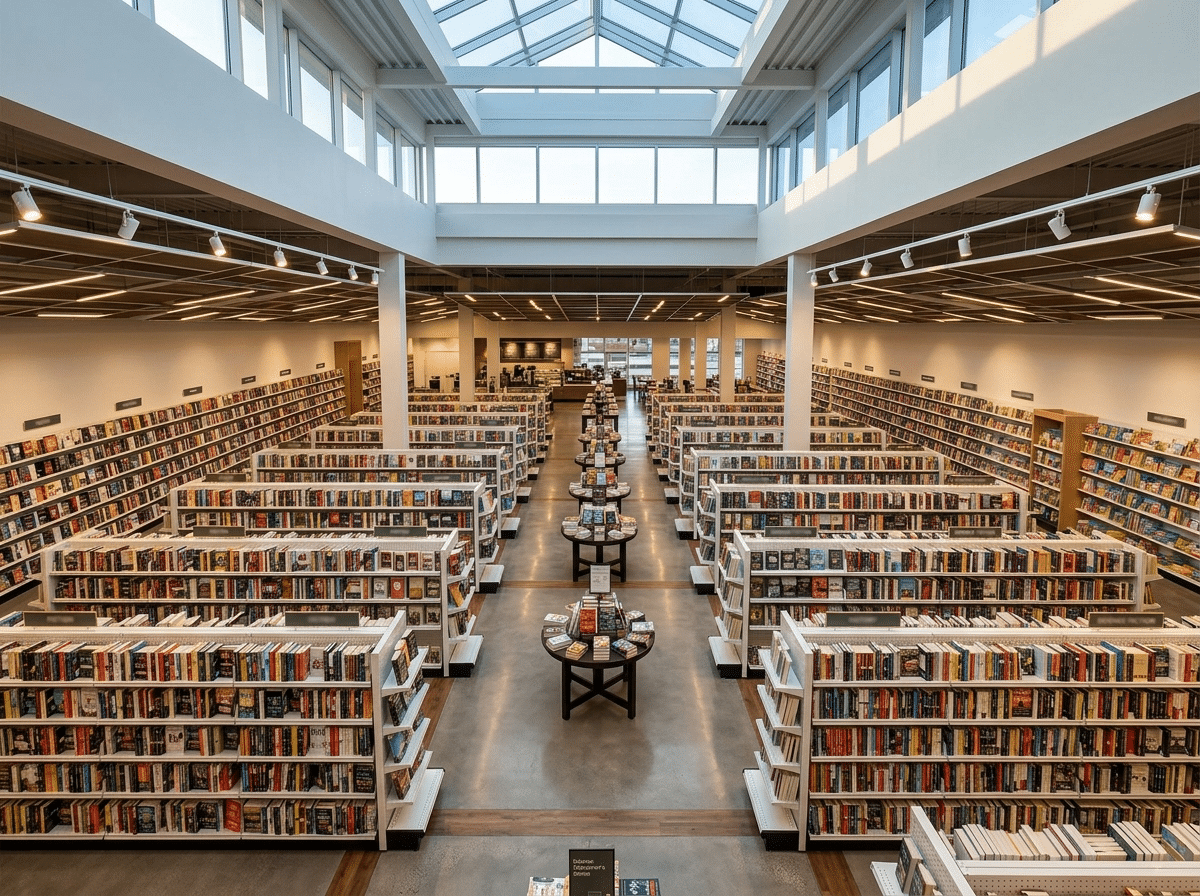
Bookstores are among the most fixture-intensive retail formats in existence. Every square foot of selling floor needs to be optimized for browsability — readers need to see spines clearly, pick up books easily, and move through the space without feeling cramped or disoriented. The quality and configuration of your shelving system is not just an aesthetic decision; it's a direct driver of dwell time and sales per customer visit.
For wall perimeter shelving in a bookstore, you have two primary options from DISPLAYARAMA: gondola wall shelving (single-sided metal units that mount flush against the wall with adjustable shelves, ideal for heavier book loads) or slatwall panels (wall-mounted 4×8 panels with horizontal grooves that accept shelves, hooks, and accessories — excellent for sideline merchandise like stationery, gifts, and totes). For center-floor aisles, double-sided gondola units let customers browse both sides and are the most space-efficient way to build out your main book sections. Feature display tables from DISPLAYARAMA's Allura collection run $220 to $525 per unit and are the highest-converting fixture type in a bookstore — position them at your entrance and at the end of major category sections for new arrivals, staff picks, and seasonal highlights. A professional free layout plan from DISPLAYARAMA can help you determine exactly how many units you need and where they go before you spend a dollar on fixtures.
| Fixture Category | DISPLAYARAMA Price Range |
|---|---|
| Gondola Wall Shelving — Single-Sided Units (perimeter walls) | ~$272 – $388 per unit |
| Double-Sided Gondola Shelving — Starter Units (center aisles) | ~$646 – $1,000+ per starter unit |
| Slatwall Panels — 4×8 (wall merchandising for sidelines) | $64.50 – $339 per panel |
| Feature Display Tables (Allura collection) | $220 – $525 per table |
| Checkout Counter / Cash Wrap (ledgetop or display-front) | $127 – $502 per unit |
| Glass Display Cases (for collectibles, signed editions, impulse items) | $397 – $622 per case |
| Seating (reading chairs, stools, benches) | $200 – $1,500 |
| Slatwall Accessories (shelves, hooks, brackets) | $3.10 – $140 per accessory |
| Signage Holders & Label Strips | $10 – $75 per holder |
| Estimated Total Fixture Budget | $5,000 – $50,000+ |
DISPLAYARAMA has been supplying retail fixtures to independent specialty stores since 1980 — including bookstores, gift shops, and multi-category retailers who need shelving that handles real daily load. From wall-mount systems to double-sided floor units and feature display tables, we carry the fixtures that give bookstore floors structure, browsability, and professional polish.
Not sure how many units you need or how to configure your floor plan? Our free 2D store layout service gives you a professional layout with exact fixture recommendations for your specific space dimensions and store type — at no cost. Call us at 1-800-292-5227 for bulk pricing on full-store fixture packages.
Get My Free Bookstore Layout Plan →Technology, Staffing & Operations
Running a bookstore requires a different operational setup than most retail categories. Managing tens of thousands of SKUs (each book is a unique ISBN), handling distributor returns, processing used book buybacks, and running a loyalty program or events calendar all place meaningful demands on your systems and your team. Getting your tech stack and staffing model right from day one prevents costly fixes later.
Point-of-Sale & Inventory Management
A bookstore-specific POS system is non-negotiable. You need software that tracks inventory by ISBN, integrates with Ingram and Baker & Taylor for reordering, supports staff recommendation features, manages a customer loyalty program, and handles publisher consignment if you carry any. Leading platforms used by independent bookstores include Anthology (formerly IndieCommerce/Booklog) and Lightspeed Retail. Plan $2,000 to $5,000 for combined hardware (terminals, barcode scanners, receipt printers) and initial software licensing. You'll also want an EAS (Electronic Article Surveillance) security system — book retail has measurable shrink, and a basic EAS tag/detection gate setup runs $500 to $2,000 installed.
Staffing
Bookstores are labor-intensive relative to their revenue. Knowledgeable booksellers who actually read and can make personalized recommendations are the primary competitive advantage an independent store has over online retailers, and that knowledge takes time to develop. A small neighborhood store typically needs one to two part-time booksellers plus the owner-operator at launch. A mid-size store with regular hours may need three to five staff members. Monthly payroll is commonly the single largest operating expense, often exceeding rent — industry data puts average bookseller wages at roughly $9,300 per month for a store operating with a small team of full and part-time employees.
Insurance, Marketing & Operating Reserves
General liability and commercial property insurance for a bookstore typically runs $150 to $400 per month depending on coverage level, location, and inventory value. Budget $500 to $2,000 for an opening marketing investment — local press outreach, social media setup, a grand opening event, and initial signage. Most importantly, set aside a working capital reserve covering at least three to six months of fixed operating costs before you open. Monthly fixed costs for a small independent bookstore typically run $14,000 to $18,000 — that means a three-month reserve of $42,000 to $54,000 is a realistic minimum buffer to have in the bank when you open.
| Technology / Operations | Estimated Cost |
|---|---|
| POS System (hardware + initial licensing) | $2,000 – $5,000 |
| EAS Security System | $500 – $2,000 |
| Computers, Networking & Wi-Fi | $1,000 – $3,000 |
| Website & Online Ordering Setup | $500 – $3,000 |
| Opening Marketing Budget | $500 – $2,000 |
| Business Insurance (first year) | $1,800 – $4,800 |
| Working Capital Reserve (3–6 months) | $25,000 – $60,000 |
| Estimated Total | $31,300 – $79,800 |
Total Startup Cost: What to Budget in 2026
Adding up every major cost category — formation and permits, lease deposits and buildout, opening inventory, fixtures, technology, staffing, and working capital reserves — paints a realistic picture of what it takes to open a bookstore in today's market. The honest answer is that the range is wide, because the type of store you're building determines almost everything. A lean used-book shop in a modest suburban space can open under $75,000. A fully stocked mid-size independent with a strong new-book selection, professional fixtures, and adequate working capital will typically require $150,000 to $300,000. A destination-style store with café service, a dedicated events space, and deep inventory in a prime urban location can easily top $400,000 to $500,000.
| Cost Category | Estimated Range |
|---|---|
| Business Formation & Permits | $950 – $4,650 |
| Lease Deposit (2–4 months rent) | $2,400 – $20,000 |
| Leasehold Improvements & Buildout | $5,000 – $90,000 |
| Opening Inventory (new books) | $20,000 – $225,000 |
| Used Books & Sideline Merchandise | $3,000 – $30,000 |
| Fixtures & Store Design (gondola, slatwall, display tables, checkout counter) | $5,000 – $50,000 |
| Technology & POS System | $4,000 – $10,000 |
| Marketing, Insurance & Operating Reserve | $27,300 – $66,800 |
| Total Estimated Startup Cost | $74,650 – $512,950 |
Profitability timeline reality: Most independent bookstores take 18 to 26 months to reach break-even, with the first year typically running at a loss as the store builds its customer base and community reputation. This is not a sign of failure — it's the industry norm. What separates stores that survive from those that don't is almost always whether the owner budgeted enough working capital to outlast the ramp-up period. Never open with less than three months of fixed costs in reserve, and six months is significantly safer.
6 Strategies to Build a Profitable Bookstore
The bookstores thriving right now aren't just selling books — they're building communities, curating experiences, and developing revenue streams that extend well beyond the cover price of a paperback. Here are six evidence-backed strategies that separate surviving bookstores from ones that truly grow.
Build a Sideline Program From Day One
Non-book merchandise — stationery, literary gifts, candles, tote bags, journals — generates gross margins of 50–60%, well above new books at 40–50%. Successful independents report sidelines contributing up to 25% of total sales. Shifting even a small portion of revenue to higher-margin sidelines meaningfully improves overall store profitability without adding significant complexity.
Host Ticketed Events & Author Signings
Paid events are one of the highest-margin revenue streams a bookstore can develop. A writing workshop with 12 attendees at $50 per ticket generates $600 in direct revenue with minimal cost of goods. Beyond the ticket revenue, book sales on event nights increase by 100–300% compared to a typical evening — events are both a revenue stream and a traffic engine.
Add a Café or Beverage Bar
Café integration has become one of the most effective diversification strategies for independent bookstores. Beverage and food items carry gross margins of 60–75%, far exceeding book margins. Stores with successful café components report food and beverage contributing 30–40% of total revenue while extending average customer dwell time — and longer dwell time directly correlates with more books purchased per visit.
Launch an Online Sales Channel
Bookshop.org's sales grew 55% in 2025 alone, demonstrating that online indie book sales are a viable revenue stream alongside physical retail. Platforms like Bookshop.org allow independent stores to earn commissions on online orders linked to their store profile, creating a passive revenue layer that doesn't require you to manage your own e-commerce fulfillment. Most established independent bookstores report online sales contributing 10–20% of annual revenue.
Develop a Paid Membership or Subscription Program
Recurring revenue through annual membership programs — which typically offer member discounts, early access to events, curated monthly picks, or exclusive merchandise — builds a predictable financial base that smooths the seasonal fluctuations bookstores experience. Holiday periods generate 30–40% of annual book sales for many stores; a membership program helps carry revenue through slower spring and summer months.
Optimize Your Fixture Layout for Revenue Per Square Foot
Profitable independent bookstores typically generate $150 to $300 in annual revenue per square foot. Your fixture layout directly determines this metric — feature display tables at entry, eye-level endcap placements for staff picks and new arrivals, and strategically placed sideline displays at the checkout counter all measurably increase average transaction value. Stores using modular adjustable shelving that can be reconfigured seasonally consistently outperform stores with static, fixed shelving.
Why Your Fixtures Are a Business Decision
In a bookstore, the fixture environment isn't decoration — it's the selling system. Books don't sell themselves off a shelf any more than wine sells itself off a restaurant menu. How your titles are displayed, how categories flow into each other, how much of the cover a customer can see, and how comfortably they can reach the lower shelves all determine whether a browser becomes a buyer. Research consistently shows that well-designed retail display configurations can increase dwell time by 30–40%, which in a bookstore directly translates to more titles discovered and more items added to a purchase.
The fixture needs of a bookstore are also more specialized than most retail categories. Shelving needs to support significant weight loads without sagging — a fully stocked 48-inch bookcase unit holds hundreds of books, and inadequate shelving leads to warping, customer frustration, and inventory damage. Feature display tables at strategic positions throughout the floor — near the entrance, at the end of category aisles, alongside the checkout counter — are where the highest-velocity sales happen. Slatwall panels are highly effective for sideline merchandising: stationery, gift items, totes, and accessories can be displayed in a fraction of the floor space compared to traditional freestanding fixtures, freeing your selling floor for more books.
- Gondola wall shelving (single-sided, ~$272–$388/unit) for core perimeter category sections — fiction, non-fiction, children's — with up to 500 lbs load capacity per shelf
- Double-sided gondola shelving for center-floor aisles to maximize browsable inventory in your selling floor footprint
- Feature display tables (Allura collection, $220–$525/unit) at entry and high-traffic zones for new arrivals, staff picks, and seasonal highlights
- Grade A slatwall panels ($64.50–$339 per 4×8 panel) for sideline merchandise walls — stationery, gifts, totes, and accessories without sacrificing floor space
- Checkout counter with display case front ($347–$397) or standard ledgetop ($127–$297) for final impulse items and a professional transaction experience
DISPLAYARAMA has supplied retail fixtures to specialty store owners since 1980, including bookstore operators who need shelving that holds its load, stays square over years of daily use, and presents inventory in a way that drives sales. From freestanding bookcase units and wall-mount systems to feature display tables, checkout counters, and Grade A slatwall panels for sideline displays, we carry the full fixture range a bookstore needs.
Unsure how many units to buy or how to configure your floor plan before you commit to a space? Our free 2D store layout service gives you a professional layout diagram with specific fixture recommendations tailored to your square footage and store concept — completely free of charge. Call us at 1-800-292-5227 for bulk pricing on full-store fixture packages.
Get My Free Store Fixture Layout Plan →Set Up Your Bookstore With the Right Fixtures
Once your budget is set and your space is signed, the next step is putting a fixture plan together — one that maximizes every inch of your selling floor and gives your inventory the presentation it deserves. DISPLAYARAMA offers a free 2D store layout service that takes your space dimensions and store concept and returns a professional floor plan with exact fixture recommendations. It saves hours of guessing and helps you buy only what you actually need.
Gondola Shelving — Wall & Double-Sided
Single-sided gondola wall units run ~$272–$388 per unit and anchor your perimeter book sections. Double-sided floor gondola units (~$646–$1,000+ per starter) build your center-aisle runs. Both hold up to 500 lbs per shelf and ship in white or black finishes.
Slatwall Panels (Grade A, 4×8)
DISPLAYARAMA Grade A slatwall panels range from $64.50 to $339 per 4×8 panel depending on size, color, and finish. 12+ colors including white, black, maple, cherry, and barnwood. Perfect for sideline merchandise walls — stationery, gifts, totes, and accessories.
Feature Display Tables (Allura Collection)
DISPLAYARAMA's Allura display tables run $220 to $525 per unit, from double-sided floor merchandisers to 3-tier display tables. Position at entry and in front of major category sections for new arrivals, staff picks, and seasonal highlights — the highest-converting fixtures in any bookstore.
Checkout Counters & Cash Wraps
Ledgetop counters from $127 (24″ register stand) up to $297 (72″ full counter). Display-case-front counters run $347–$397. Available in white, black, maple, and cherry — all include locking drawers and rear storage shelves.
Glass Display Cases
For signed editions, collectible books, or high-margin gift items, DISPLAYARAMA glass display cases run $397–$622 per unit. Extra vision models include LED lighting and mirrored doors. Sell independently from counters so you can configure your layout freely.
Bulk Pricing Available
Outfitting a full bookstore floor? DISPLAYARAMA offers bulk pricing on fixtures for full-store setups. Call 1-800-292-5227 for a custom quote on your complete fixture package.
DISPLAYARAMA's free 2D store layout service gives you a professional floor plan with specific fixture recommendations for your bookstore — at no cost. It takes the guesswork out of your fixture budget and prevents costly over-buying before you've opened a single door. We've been helping specialty retailers design their stores since 1980, and we offer bulk pricing for owners outfitting a full floor.
Submit your space dimensions and store type and we'll put together a custom layout plan with exactly the fixtures that will work for your bookstore concept.
Get My Free Store Fixture Layout Plan →