

How Much Does It Cost To Open a Department Store?
A department store is the most expensive format in specialty retail to open, and the reason is structural. You are not building one store — you are building six or eight small stores inside a single footprint, each with its own buyer, its own inventory position, its own fixture package, and its own margin profile. Apparel needs hangrails and fitting rooms. Fine jewelry needs locking glass. Housewares needs deep shelving. Cosmetics needs lit casework. The cost stacks up fast.
The U.S. department store industry is still a $227.1 billion business in 2026 according to IBISWorld, employing roughly 1.29 million people, even after two decades of headlines about its demise. What has actually changed is the shape of the opportunity. The 200,000-square-foot mall anchor is contracting. The 8,000 to 40,000-square-foot regional and neighborhood department store — the format that Macy's is testing with its own small-store concepts and that independent operators like Boscov's and Belk have run profitably for decades — is where realistic new entry happens.
This guide breaks down what it actually costs to open a department store in 2026: formation and licensing, rent and buildout, opening inventory, fixtures, technology, and staffing. Every dollar figure below is either sourced from published 2026 industry data or from DISPLAYARAMA's own current pricing. We also spend real time on the line item most first-time operators underestimate by an order of magnitude — custom display cases and custom checkout counters, which is where high-end department stores separate themselves and where budgets most often break.
What Kind of Department Store Are You Actually Opening?
"Department store" covers a range of business models that differ by a factor of fifty in startup cost. Before you price anything, decide which one you are building — because the concept determines your footprint, your footprint determines your buildout, and your buildout is usually the single largest number on the page.
The Neighborhood / Small-Format Department Store
Roughly 5,000 to 15,000 square feet carrying four to six curated departments — apparel, gifts, home, beauty, and seasonal. This is the format independents can realistically finance. It is also where the industry itself is moving: Macy's small-format stores in New York and Los Angeles run between 1,200 and 3,000 square feet, and Nordstrom's service-oriented Local stores average just under 2,000. A well-run 10,000-square-foot store with a tight assortment can outperform a sprawling one with dead zones.
The Mid-Size Regional Department Store
Roughly 20,000 to 50,000 square feet with eight to twelve departments, fitting rooms, and a service desk. For scale, Macy's Market by Macy's off-mall format runs from 22,000 to 58,000 square feet — about one-fifth the size of a traditional Macy's. This is a serious capital project requiring meaningful financing, but it is the format that supports a genuine multi-department shopping trip.
The Full-Line Anchor
80,000 square feet and up. Dillard's largest store runs 365,000 square feet, and its Dallas and Hurst flagships sit at 299,000 and 310,000. Macy's Herald Square carries roughly 1.25 million square feet of selling space. Realistically nobody opens one of these from scratch today — new full-line stores are built by existing chains with balance sheets, not by first-time operators.
The Luxury / High-End Department Store
Footprint matters less here than finish level. A 20,000-square-foot luxury store can cost more to open than a 60,000-square-foot mid-market one, because nearly every fixture is custom-built rather than pulled from a catalog. This is the model where custom display cases and custom checkout counters stop being an upgrade and become the entire merchandising strategy.
| Store Concept | Typical Footprint | Estimated Startup Range |
|---|---|---|
| Neighborhood / small-format | 5,000 – 15,000 sq ft | $450,000 – $1.5M |
| Mid-size regional | 20,000 – 50,000 sq ft | $2.5M – $7M |
| Luxury / high-end (custom fixtures) | 15,000 – 40,000 sq ft | $4M – $15M+ |
| Full-line anchor | 80,000 – 200,000+ sq ft | $10M – $30M+ |
These ranges are modeled from published 2026 per-square-foot benchmarks for retail fit-out, rent, and fixtures, combined with department-store inventory turn assumptions. They are planning ranges, not quotes.
The independent operator's edge: Department stores do not fail because they are too small. They fail because they carry more square footage than their assortment can justify. Cushman & Wakefield reported U.S. retail vacancy at 5.9% in early 2026 — well under the 7.4% historical average — which means good space is scarce and expensive. Take less of it, merchandise it densely, and put the money you saved into fixtures that make the store feel intentional.
Licenses, Permits & Business Formation
A department store's licensing burden is heavier than a single-category store's, because you inherit the requirements of every category you carry. Selling apparel is straightforward. Add a fine jewelry counter and you may need a precious metals dealer registration. Add packaged food or candy and you are in food handling. Add fragrance and you have flammable storage rules. Each department you open is a small regulatory decision.
Start with the standard stack: an LLC or corporation, an EIN, a state retail sales tax permit, a resale certificate so you buy wholesale without paying sales tax, a local business tax receipt, and a certificate of occupancy for the space. Then layer on category-specific items. Budget legal review of your lease separately — on a multi-million-dollar buildout commitment, a few thousand dollars of attorney time is the cheapest insurance you will buy.
| License / Permit | Cost Range |
|---|---|
| LLC or corporation formation (state filing) | $50 – $500 |
| EIN (federal) | Free |
| State sales tax permit & resale certificate | $0 – $100 |
| Local business tax receipt / city license | $50 – $500 |
| Certificate of occupancy & building permits | $2,000 – $8,000 |
| Architectural & engineering drawings | $3,000 – $10,000 |
| Category-specific licenses (jewelry, food, fragrance) | $100 – $1,500 each |
| Sign permit | $200 – $1,500 |
| Attorney & lease review | $2,000 – $10,000 |
| Estimated Total | $7,400 – $32,100 |
Do this before you sign: Permit fees and architectural drawings are frequently omitted from first-draft budgets and then land in the middle of construction. Contractors who track these projects put permits at $2,000 to $8,000 and drawings at $3,000 to $10,000 on typical retail buildouts — and a department store's multi-department layout sits at the higher end because of egress, fitting room, and occupancy calculations.
Location, Rent & Buildout
Department stores live and die on trade area, not on street corner. A specialty boutique can survive on a walkable strip with 400 daily passersby. A department store needs a population base large enough to support ten departments' worth of repeat purchasing, which in practice means a trade area with real household density and a car-accessible site with parking. Community shopping centers, converted junior anchors, and downtown blocks in secondary markets are where this format works best.
Rent has been climbing steadily. CBRE put average U.S. retail asking rent at $24.79 per square foot in the second quarter of 2026, up 2.4% year over year, while Cushman & Wakefield reported shopping center asking rents at $25.48 per square foot, up 2.3%. Anchor and power center in-line space generally runs $22 to $32 per square foot on a triple-net basis. Expect to add $2 to $4 per square foot for CAM, taxes, and insurance on top of base rent, and expect a percentage rent clause of roughly 5% to 8% of gross sales above a breakpoint in most shopping center leases.
| Store Size | Annual Base Rent (at $25/SF) | Monthly (incl. ~$3/SF NNN) |
|---|---|---|
| 8,000 sq ft | $200,000 | ~$18,700 |
| 15,000 sq ft | $375,000 | ~$35,000 |
| 25,000 sq ft | $625,000 | ~$58,300 |
| 50,000 sq ft | $1,250,000 | ~$116,700 |
Buildout is the number that shocks people
Cushman & Wakefield's 2026 retail fit-out guide puts the national average for an in-line store at $157 per square foot, up 1.4% from the prior year. Regional spread is enormous: Northern California runs $217, the Pacific Northwest $202, and New York City $181, while the Midwest sits at $120 and the Southeast at $126. Other 2026 contractor benchmarks break it down by finish level — basic retail tenant improvement at $40 to $90 per square foot, mid-tier retail and apparel at $90 to $180, and premium retail at $150 to $300. Shell condition alone swings the number by 30% to 50%.
On a 25,000-square-foot mid-size store in the Southeast at $126 per square foot, that is roughly $3.15 million in hard construction cost before soft costs and contingency. Add 8% to 15% for soft costs and another 5% to 10% for contingency. Then subtract your tenant improvement allowance, which typically runs $30 to $70 per square foot on second-generation space and $80 to $150 per square foot on first-generation white box — worth $750,000 to $1.75 million on that same store. Negotiating TI is the single highest-leverage conversation in the entire project.
Take second-generation space when you can get it: A previously built-out retail box with usable HVAC, electrical service, restrooms, and a finished ceiling can cut your construction budget by a third or more. Landlord TI allowances in core retail markets tightened 8% to 15% through the first half of 2026, so the concession you would have negotiated eighteen months ago may not be on the table now — which makes existing improvements worth more than they used to be.
Opening Inventory
Inventory is where department store economics get genuinely difficult, because you are funding a wide assortment before you have a single sale to tell you which departments actually work in your market. Department store gross margins sit in a fairly narrow band — Macy's reported a 39.5% gross margin rate in a 2025 quarter, with cost of sales at 60.5% of net sales — and the company's full-year 2024 net income of $582 million on $22.3 billion in net sales works out to roughly a 2.6% net margin. IBISWorld puts industry profit at about 6.0% of revenue for 2026. There is not much room for error.
Sizing your opening buy
Nordstrom generated roughly $439 in sales per square foot in a recent fiscal year, and that is a mature luxury operator with national brand recognition. A new independent should model something far more conservative — $150 to $250 per square foot in year one is a defensible planning assumption. On 25,000 square feet at $200, that is $5 million in projected annual sales, roughly $3 million in cost of goods at a 40% margin. Department stores typically turn inventory two to three times a year, which implies an average inventory position of $1 million to $1.5 million at cost.
You do not buy all of that on day one. Open at 60% to 70% of your planned inventory budget so you have cash to reorder what actually sells in the first 30 to 60 days. A floor that looks 75% full and moves is far healthier than one that looks 100% full and sits.
Leased and licensed departments
Department stores have a structural advantage no other format has: you can let someone else own the inventory. Macy's reports comparable sales on an "owned-plus-licensed" basis precisely because a meaningful share of its floor is operated by vendor partners. Fine jewelry, footwear, optical, salon services, and beauty counters are all commonly run as licensed or concession departments where the partner owns the stock and pays you a percentage. For a new operator, converting even two departments to this model can remove hundreds of thousands of dollars from your opening capital requirement.
| Inventory Category | Estimated Cost (25,000 SF Store) |
|---|---|
| Women's & men's apparel | $250,000 – $500,000 |
| Home, housewares & bedding | $120,000 – $250,000 |
| Beauty & fragrance | $60,000 – $180,000 |
| Accessories, handbags & footwear | $80,000 – $200,000 |
| Gifts, seasonal & impulse | $40,000 – $90,000 |
| Jewelry (if owned rather than licensed) | $75,000 – $300,000 |
| Estimated Opening Inventory | $625,000 – $1,520,000 |
The discipline that keeps you alive: Markdowns are the department store killer, not slow traffic. Macy's has repeatedly attributed gross margin compression to proactive markdowns taken to clear aging assortment. Set an open-to-buy budget by department before you place a single order, hold to it, and review sell-through weekly for the first two quarters. The store that reorders its winners beats the store that bought deep on a hunch.
Fixtures & Store Design
Fixtures are what turn an empty box into a department store. They are also the line item where the gap between a standard store and a high-end one is widest, and where budgets most often go wrong in both directions — some operators buy far too little and end up with a floor that reads as a warehouse, others commit to fully custom casework across the entire store when only the front third of it needed to be. Before you order anything, get a layout. DISPLAYARAMA's free 2D store layout service produces a floor plan with specific fixture recommendations for your square footage, which is the cheapest way to find out how many linear feet of casework you actually need.
Why department store fixtures cost more than any other retail format
A single-category store buys one fixture system. A department store buys six. Apparel departments need hangrails, faceouts, and nesting tables. Housewares needs gondola runs with adjustable shelving. Beauty and jewelry need locking glass with LED lighting. Seasonal needs floor merchandisers you can move in an afternoon. Perimeter walls need a flexible system — slatwall is the standard answer because a single wall run can be reconfigured from apparel to gifts to home without touching drywall.
| DISPLAYARAMA Fixture Category | Price Range |
|---|---|
| Slatwall panels (4' x 8', standard to specialty) | $52.50 – $599.00 per panel |
| Aluminum inserts for slatwall (add-on) | +$80 – +$160 per panel |
| Slatwall accessories (hooks, brackets, shelves) | Under $1.00 – $91.44 per piece |
| Glass display cases (standard to Extra Vision) | $297.00 – $1,047.00 each |
| Checkout counters & cash wraps (stock) | $127.00 – $2,640.00 each |
| Gondola shelving (double-sided starter unit) | $645.50 (multi-section runs $1,200 – $3,200+) |
| Display tables & floor merchandisers | $75.00 – $474.00 each |
| LED showcase light kits | $115.00 – $135.00 each |
The custom fixture number nobody budgets for
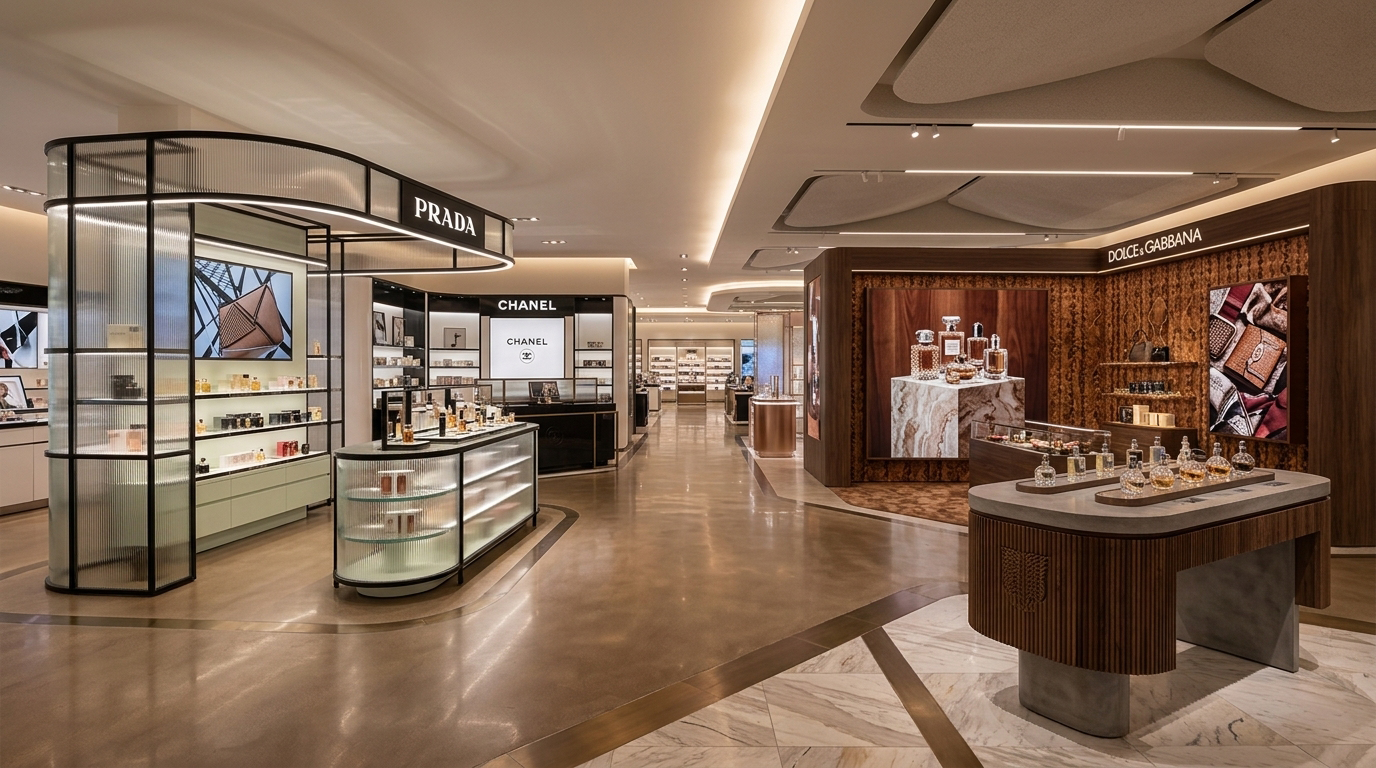
Here is the single most useful thing a first-time department store operator can learn: high-end department stores almost never use stock fixtures on their primary selling floor. Cosmetics islands, jewelry cases, the main cash wrap, and feature department casework are built to spec — sized to the space, finished to match the brand, and detailed with lighting, locking drawers, back-of-house storage, and integrated branding. That is not vanity. It is why a luxury floor reads as a luxury floor.
At DISPLAYARAMA, custom display cases and custom checkout counters run approximately $1,000 per linear foot. That figure sits squarely inside the published range for high-end commercial millwork, which industry fabricators put at $600 to $1,200+ per linear foot for fabrication alone before installation. What it means in practice is that a 40-foot custom jewelry case line is roughly a $40,000 fixture, and a 16-foot custom cash wrap with a logo panel, locking drawers, ADA-compliant transaction height, and rear storage is roughly a $16,000 fixture.
| Fixture Approach | Approx. Cost Per Linear Foot | 40 LF Case Run |
|---|---|---|
| Stock 72" ledgetop checkout counter | ~$50/LF | ~$2,000 |
| Stock 48" full-vision display case | ~$74 – $160/LF | ~$3,000 – $6,400 |
| Premium stock cash wrap (55", soft-close) | ~$575/LF | ~$23,000 |
| DISPLAYARAMA custom cases & counters | ~$1,000/LF | ~$40,000 |
| High-end custom millwork (industry, fab only) | $600 – $1,200+/LF | $24,000 – $48,000+ |
The multiple between stock and custom is roughly six to twenty times, which is exactly why this line item breaks budgets. The answer is not to avoid custom — it is to be deliberate about where it goes. Put custom where the customer stands still: the jewelry counter, the beauty island, the main cash wrap, and the one feature department you want people to photograph. Use stock cases, gondola, and slatwall everywhere else. A store with 60 linear feet of custom casework and a well-executed stock program throughout looks far more expensive than it cost.
Explore Custom Display Cases →Sample fixture budgets by store type
The table below models a complete fixture package — perimeter wall system, floor fixtures, casework, and checkout — for three department store concepts. Custom allocation is the variable that moves the total.
| Store Type | Fixture Budget |
|---|---|
| Small-format, all stock (8,000 SF) | $25,000 – $60,000 |
| Mid-size, stock + 40 LF custom (25,000 SF) | $110,000 – $250,000 |
| Mid-size, stock + 120 LF custom | $200,000 – $400,000 |
| Luxury, predominantly custom (25,000 SF) | $450,000 – $900,000+ |
DISPLAYARAMA offers bulk pricing on large fixture orders, and free crating is included on slatwall panel purchases — a real cost that many suppliers bill separately on a multi-pallet department store order.
Explore Custom Checkout Counters →DISPLAYARAMA has been supplying retail fixtures to specialty and multi-department retailers since 1980. We stock display cases, checkout counters, Grade A slatwall panels, gondola shelving, and floor fixtures — and we custom build display cases and checkout counters with logos, ADA-compliant designs, locking drawers, casters, and rear storage, delivered fully assembled.
Not sure how many linear feet of casework your floor plan needs? Start with the free layout plan and we will map it out. Call us at 1-800-292-5227 to talk through a custom build.
Get My Free Store Fixture Layout Plan →Plan your lead times backward: Custom millwork typically runs 12 to 18 weeks from approved shop drawings to first shipment, while a full retail buildout runs 8 to 14 weeks from design kickoff to opening. If you order custom casework after construction starts, your fixtures become the reason you open late. Lock the fixture plan at the same time you lock the construction drawings.
Technology, Staffing & Operations
A department store's point-of-sale requirements are meaningfully heavier than a single-category store's. You need department-level reporting, multi-register support, purchase order management across dozens of vendors, and — if you run any licensed departments — the ability to separate owned from licensed sales. Cloud retail POS platforms generally run $79 to $300 per month, with Lightspeed-class systems at $89 to $269 monthly; on-premise enterprise licenses can exceed $30,000 outright. Budget hardware separately for every register station you build into your cash wrap.
Staffing is the other structural difference. Department stores need floor coverage by department, not just a person at the register, and this is precisely where the industry's own turnaround data points. Macy's has concentrated investment — including higher staffing levels and store renovations — in the 125 locations it calls the Reimagine 125. In the third quarter of 2025 those stores posted comparable sales growth of 2.3% on an owned basis while the broader Macy's nameplate saw net sales decline 2.3%. Staffing and store environment are not overhead. They are the variable that separates the stores that grow from the ones that do not.
| Technology / Operations | Estimated Cost |
|---|---|
| Retail POS software (annual, multi-register) | $1,200 – $6,000/yr |
| POS hardware (per station: terminal, scanner, drawer, printer) | $800 – $3,500 each |
| Inventory management & purchase order system | $1,000 – $5,000/yr |
| Security system, cameras & EAS tags | $8,000 – $40,000 |
| General liability insurance | $500 – $1,000/yr |
| Commercial property insurance (inventory & fixtures) | $800 – $2,000/yr |
| Interior & exterior signage | $3,000 – $15,000 |
| Website & e-commerce setup | $2,000 – $25,000 |
| Pre-opening staffing & training (4–12 staff) | $25,000 – $120,000 |
| Grand opening marketing | $15,000 – $75,000 |
| Estimated Total | $57,300 – $292,500 |
Watch payment processing: Card processing generally runs 2.5% to 3.5% of credit card sales. On a store projecting $5 million in annual revenue, that is $125,000 to $175,000 a year — larger than most operators' entire technology budget. Choose a processor-agnostic POS so you can shop rates rather than being locked into whatever your terminal vendor charges.
What It All Adds Up To
The table below models total startup cost for a 25,000-square-foot mid-size department store in a Southeast market, assuming second-generation space with a negotiated tenant improvement allowance. Adjust the buildout line hardest — it is the number most sensitive to your market and your shell condition, and it can swing the total by millions.
| Cost Category | Estimated Range |
|---|---|
| Formation, licenses, permits & professional fees | $7,400 – $32,100 |
| Lease deposit + first 3 months occupancy | $175,000 – $250,000 |
| Buildout & construction (net of TI allowance) | $1,400,000 – $3,250,000 |
| Fixtures & store design | $110,000 – $400,000 |
| Opening inventory (60–70% of full position) | $625,000 – $1,520,000 |
| Technology, security, signage & staffing | $57,300 – $292,500 |
| Working capital reserve (3–6 months operating) | $300,000 – $800,000 |
| Estimated Total Startup Cost | $2,674,700 – $6,544,600 |
Plan for a long runway: With industry profit at roughly 6.0% of revenue and department store net margins in the low single digits, this is not a format that generates fast cash. Carry three to six months of full operating expenses in reserve beyond your opening budget, and model 18 to 36 months to sustained profitability rather than 12. The stores that fail rarely fail because of the concept — they fail because they spent their working capital on opening inventory and had nothing left when February arrived.
Six Ways To Make A Department Store Profitable
Surviving department stores and thriving ones do not differ much in assortment. They differ in how tightly they measure and how willing they are to reinvest in the floor itself. These six strategies come directly from what the operators who are actually growing right now are doing.
Manage Every Department As Its Own P&L
Track sales per square foot, gross margin, and inventory turn by department, not just store-wide. Nordstrom runs around $439 per square foot as a mature luxury operator; if one of your departments is producing $60, it is subsidizing nothing and needs to shrink or go.
License The Departments You Can't Run
Fine jewelry, optical, salon, and beauty are commonly operated as licensed or concession departments where the partner owns the inventory. Macy's reports comps on an owned-plus-licensed basis for exactly this reason. It removes six figures of opening capital and shifts markdown risk off your books.
Defend Gross Margin Before Chasing Volume
Macy's operates near a 39.5% gross margin and has repeatedly cited proactive markdowns as the cause of compression. A single point of margin on $5 million in sales is $50,000. Set open-to-buy limits by department and enforce them harder than you enforce sales targets.
Treat The Cash Wrap As Prime Real Estate
Every customer in the store passes your checkout counter, which makes it the highest-traffic square footage you own. A custom counter with integrated glass display fronts and impulse merchandising turns dead queue time into add-on units — which is why high-end stores spend real money there.
Reinvest In The Store, Not Just The Assortment
Macy's Reimagine 125 locations — the stores receiving renovation and staffing investment — posted 2.3% comparable sales growth in Q3 2025 while the broader nameplate declined 2.3%. The store environment is a measurable revenue lever, not a cosmetic one.
Build For Reconfiguration From Day One
Your department mix in year three will not match year one. Slatwall perimeter systems, adjustable gondola runs, and mobile floor fixtures let you move a department over a weekend. Fully built-in millwork everywhere means calling a contractor every time the market shifts.
Why Your Fixtures Matter More In A Department Store
In a single-category store, fixtures hold merchandise. In a department store, fixtures do something harder: they tell the customer where one department ends and the next begins. Without a deliberate fixture language, a multi-department floor reads as a jumble — apparel bleeding into housewares, no visual hierarchy, no sense of where to go next. Customers who cannot orient themselves leave early, and dwell time is the input that drives conversion.
This is also the mechanism behind the price gap between mid-market and luxury department stores. A luxury floor does not feel expensive because of the merchandise — the same handbag sits on a rack elsewhere. It feels expensive because the casework is sized to the space, lit properly, finished consistently, and detailed at a level a catalog fixture cannot match. That perception is bought with custom millwork, and it is why the fixture line on a high-end department store budget can run five to ten times what a comparably sized mid-market store spends.
- Perimeter wall system — Grade A slatwall gives you a wall that reconfigures between departments without drywall work, and holds far heavier loads than the Grade C panels sold at big-box stores
- Locking glass casework — required for jewelry, watches, fragrance, and any high-shrink category; LED lighting is what makes the merchandise read as valuable
- A cash wrap that fits your operation — register count, ADA transaction height, locking drawers, bag storage, and rear-facing storage all need to be designed in, not worked around
- Adjustable gondola runs — heavy-duty steel shelving for housewares, home, and consumables that adjusts as your assortment changes
- Mobile floor fixtures — nesting tables and double-sided merchandisers you can move for seasonal resets without a work order
DISPLAYARAMA carries Grade A rated slatwall panels, while most big-box competitors carry Grade C. Grade A panels use stronger aluminum inserts and tighter manufacturing tolerances, which means they hold heavier loads and hold their shape over years of reconfiguration — the difference matters most on long department store wall runs that get reset every season.
We stock over 12 core colors and finishes, carry custom Formica laminate and 3D textured panels, include free crating on panel purchases, and offer bulk pricing on the volume a full store requires. Call 1-800-292-5227 to price a full wall program.
Explore Custom Slatwall →Outfit Your Department Store
Whether you are opening 8,000 square feet or 50,000, the fastest way to get an accurate fixture number is to start with a layout. DISPLAYARAMA's free 2D store layout service gives you a floor plan and a specific fixture list for your space — including how many linear feet of casework you actually need before you decide what goes custom.
Custom Display Cases
Built to your dimensions, finish, and lighting spec at approximately $1,000 per linear foot. Custom laminates, LED and RGB lighting, locking drawers, and branded kickplates available.
Custom Checkout Counters
Cash wraps built with logos, ADA-compliant transaction heights, casters, locking drawers, and rear-side storage — delivered fully assembled. Stock counters also available from $127.
Grade A Slatwall Panels
Perimeter wall systems from $52.50 to $599 per 4' x 8' panel in over 12 colors and finishes, with optional aluminum inserts. Free crating included on panel orders.
Gondola Shelving
Heavy-duty double-sided island units from $645.50 and multi-section runs from $1,200 to $3,200+. Madix compatible, pegboard backs, up to 500 lbs per shelf for home and housewares departments.
Display Tables & Floor Fixtures
Nesting table sets, tiered merchandising tables, and double-sided floor merchandisers from $75 to $474 — the mobile fixtures that make seasonal resets a two-hour job.
Bulk Pricing Available
Outfitting a full store? DISPLAYARAMA offers bulk pricing on fixtures. Call 1-800-292-5227 for a custom quote.
DISPLAYARAMA's free 2D store layout service gives you a professional floor plan with specific fixture recommendations for your department store — at no cost. It tells you how many linear feet of casework, how many wall panels, and how many floor fixtures your square footage actually supports, before you commit a dollar to custom millwork. We've been helping specialty retailers design their stores since 1980, and we offer bulk pricing for owners outfitting a full floor.
Submit your space dimensions and department mix and we'll put together a custom layout plan with exactly the fixtures that will work for your department store.
Get My Free Store Fixture Layout Plan →