

How Much Does It Cost To Open an Electronics Store?
Americans still walk into stores to buy headphones, chargers, smart home gear and replacement phones, and they still want someone to show them which cable actually fits. IBISWorld sized U.S. electronics and appliance retailing at roughly $178 billion in 2025, and Circana expects consumer technology sales to hold near $112 billion in 2026 as average prices climb. The market is mature and essentially flat, which means a new independent store wins by picking the right niche, not by trying to out-stock Best Buy.
That niche decision drives almost every number that follows. A 900-square-foot accessories and repair shop opens on a very different budget than a full-line store carrying laptops, TVs and refurbished phones, and the licensing picture changes the moment you start buying used devices from customers. The good news is that the highest-margin parts of this business, accessories, repair labor and services, are also the cheapest to stock.
This guide walks through every major cost of opening an electronics store in 2026: the store concept, licenses and permits, rent and buildout, opening inventory, fixtures, technology and staffing. Every range comes from current industry data, so you can build a budget that holds up when you sit down with a landlord or a lender.
What Kind of Electronics Store Are You Opening?
"Electronics store" covers several very different businesses. The biggest variable is how much of your floor and your cash you commit to devices, because new phones, laptops and TVs tie up the most money at the thinnest margins. Industry estimates put the gross margin on new devices somewhere between 5% and 15%, while cases, chargers, cables and audio accessories routinely land between 50% and 70%. Repair labor sits in a similar 50% to 70% range. The concept you choose determines which side of that gap your store lives on.
| Store Concept | Estimated Startup Range |
|---|---|
| Accessories & mobile boutique (500–1,500 sq ft) | $20K – $75K |
| Repair-led shop with accessory retail | $27.5K – $127.5K |
| Full-line independent electronics store | $45K – $125K + buildout |
| Device-heavy store with refurbished and resale phones | $99K – $310K+ |
The accessories boutique is the leanest entry point because inventory is small, light and fast-moving. A repair-led shop adds tools and a parts inventory but earns labor revenue on every ticket, which smooths out slow retail weeks. The full-line store needs a wider assortment and more floor space, and the device-heavy model carries the largest inventory bill of all, with phones alone often running $50,000 to $150,000 before the doors open.
Independent advantage: Most successful independents build the store around accessories, repair and services, then carry a curated set of devices to drive traffic. That mix keeps cash out of slow-turning boxes and puts it into the categories that actually produce margin.
Licenses, Permits & Business Formation
Every electronics store starts with the same foundation: a legal entity, a sales tax permit so you can collect tax and buy wholesale without paying it, and a local business license. LLC filing fees run from $35 in Montana to $500 in Massachusetts, with a national average around $132, though some states add annual fees on top, such as California's $800 franchise tax. Seller's permits are free in many states, including California, Florida, Texas and Illinois, while a handful charge a small fee, such as $90 in Washington.
The electronics-specific licensing starts when you buy used devices. Many states and cities treat anyone who buys secondhand phones, tablets or laptops from the public as a secondhand dealer. In Florida that registration is inexpensive at $6 per location plus fingerprinting, while California's Department of Justice license costs $300 every two years plus Live Scan fingerprints, and some cities add their own permit fee. If you repair electronics in California, the state also requires an electronic service dealer registration, listed at about $190 per location, and New York City requires its own Electronics license, which runs $85 to $425 depending on when you file.
| License / Permit | Cost Range |
|---|---|
| LLC formation (state filing fee) | $35 – $500 |
| Sales tax / seller's permit | $0 – $90 |
| Local business license (annual) | $50 – $400 |
| Certificate of occupancy | $100 – $500 |
| Secondhand dealer license (if buying used devices) | $6 – $300+ |
| Repair registration (state-specific, e.g. California) | ~$190 |
| Typical Total | $185 – $2,000 |
Check before you buy back: Secondhand rules vary by city as well as state, and some require you to record serial or IMEI numbers and hold purchased devices for a set period. Confirm local requirements before you advertise trade-ins.
Location & Rent
Electronics accessories and repairs are convenience purchases, so visibility and parking matter more than prestige. A cracked screen or a dead charger sends people to whatever store is closest, which is why strip centers anchored by a grocery store or big-box retailer tend to work well. Most phone and accessory stores operate comfortably in 500 to 1,500 square feet, and a full-line store will want more room for demo tables and boxed goods.
Colliers reported a record national average retail rent of $25.69 per square foot per year in 2025, while unanchored strip centers averaged closer to $20.85. Prime metros sit far higher, with Miami near $49.69 and New York near $46.16. The table below shows what those rates mean for a 1,200-square-foot store.
| Location Type | Est. Monthly Base Rent (1,200 sq ft) |
|---|---|
| Neighborhood strip center (~$20.85/sq ft/yr) | ~$2,085 |
| National retail average (~$25.69/sq ft/yr) | ~$2,570 |
| High-cost metro (~$46–$50/sq ft/yr) | ~$4,600 – $5,000 |
Budget for a security deposit of $3,000 to $10,000 and remember that most retail leases are triple net, so taxes, insurance and common-area maintenance sit on top of base rent. Construction-heavy buildouts run roughly $40 to $180 per square foot, and landlords commonly offer tenant improvement allowances of $15 to $60 per square foot, which is worth negotiating hard. Taking over a former retail space that only needs paint, lighting and fixtures keeps this line small.
Location insight: Electrical capacity matters more for an electronics store than for most retailers. Demo walls, charging stations and repair benches add up, so confirm outlet placement and circuit capacity before you sign.
Opening Inventory
Inventory is the single largest line in most electronics store budgets, and it carries a risk most retailers never face: products lose value as new models launch. ZenBusiness estimates $30,000 to $80,000 in opening inventory for a general electronics store, while device-heavy stores can need far more. Wholesale suppliers typically ask for your resale certificate and a credit application, and some accessory suppliers accept opening orders as small as about $500, which lets you test categories before committing.
Accessories & Audio
Cases, screen protectors, chargers, cables, earbuds and speakers are the margin engine of the store. They are small, easy to merchandise on hooks and shelves, and they sell alongside nearly every device or repair ticket.
Devices
Phones, tablets, laptops and smart home hubs bring people in and build credibility, but they turn slowly at thin margins. Many independents carry a tight selection of best sellers rather than the full lineup.
Refurbished & Pre-Owned
Refurbished phones are a growing category. Counterpoint Research reported U.S. refurbished smartphone sales up 3.4% year over year in the first half of 2025, and Back Market reported 30% growth in the second quarter of 2025. Sourcing through trade-ins requires the secondhand licensing covered above.
Repair Parts
Screens, batteries and charging ports for the most common models typically cost $5,000 to $20,000 to stock at opening, alongside the tools and equipment to install them.
| Inventory Category | Estimated Cost |
|---|---|
| Accessories & audio | $10K – $50K |
| New devices (curated selection to full lineup) | $20K – $150K+ |
| Repair parts (if offering repairs) | $5K – $20K |
| Typical Opening Inventory (General Store) | $30K – $80K |
Inventory discipline: Buy devices close to demand and lean on accessories for depth. Track sell-through weekly and clear aging models before the next launch cuts their value.
Fixtures & Store Design
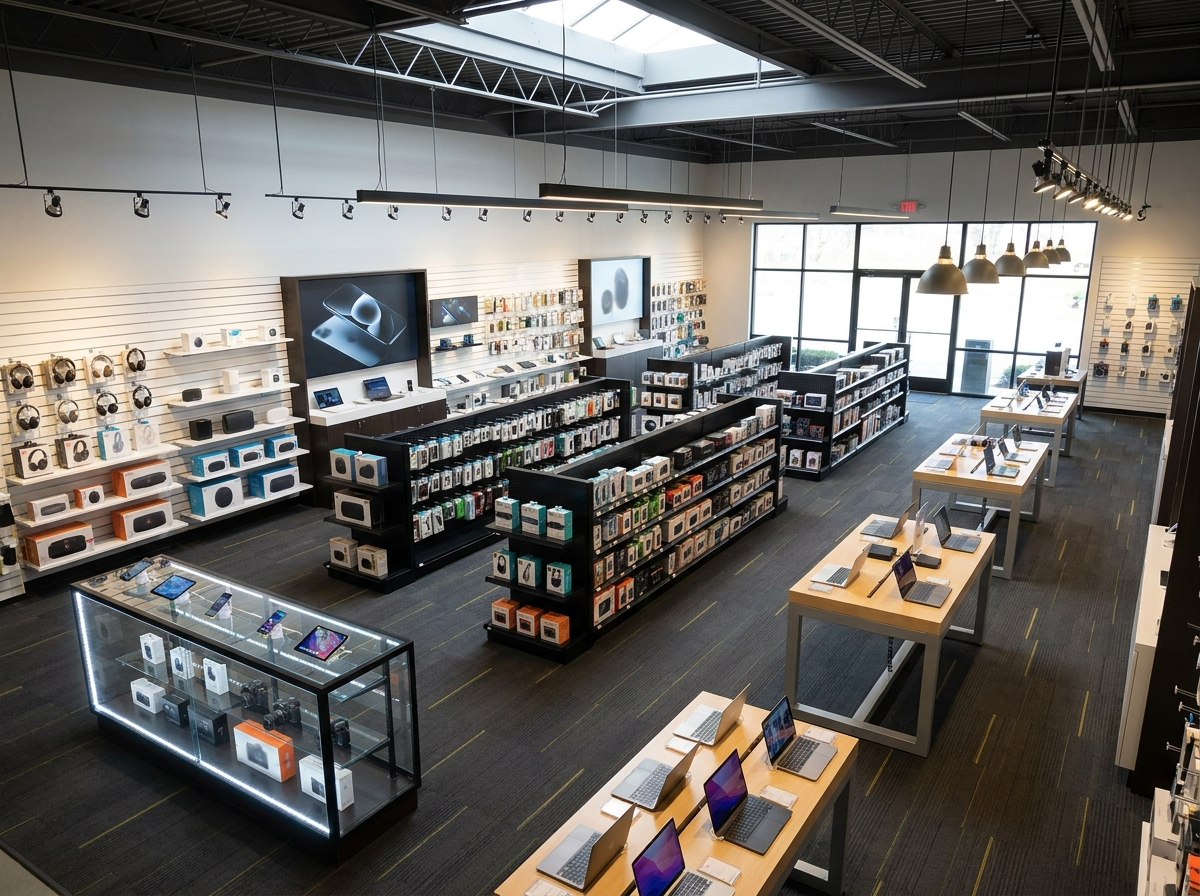
An electronics store needs two kinds of fixtures: secure cases for high-value devices and open wall merchandising for accessories. Locking glass cases keep phones, watches and earbuds visible without leaving them on an open shelf, and a lit case such as a 48" Extra Vision display case puts the product at eye level. Accessories belong on slatwall panels, where hooks and shelves can be rearranged every time a new phone launches and the case selection changes.
Research estimates fixture budgets of $5,000 to $15,000 for an independent electronics store. Using current DISPLAYARAMA pricing, a 1,200-square-foot store can cover its essentials on the lower end of that range. If you are not sure how many cases or panels your space needs, a free layout plan maps it out before you spend anything.
| Fixture | Estimated Cost |
|---|---|
| 6–12 slatwall panels (4'x8') | $520 – $1,200 |
| Slatwall hooks (100–200) | $55 – $110 |
| 2–4 Extra Vision glass display cases | $1,200 – $3,500 |
| 1–2 wall display cases | $850 – $1,700 |
| Glass-front checkout counter | ~$400 |
| Gondola unit for boxed goods (optional) | ~$1,300 |
| Estimated Fixture Package | $3,000 – $8,200 |
DISPLAYARAMA has supplied retail fixtures since 1980, from Extra Vision display cases with LED lighting to Grade A slatwall panels built for heavy accessory walls. Send us your floor dimensions and we will show you exactly where cases, wall merchandising and the checkout counter fit best.
Prefer to talk through your space? Call us at 1-800-292-5227.
Get My Free Store Fixture Layout Plan →Technology, Staffing & Operations
An electronics store needs a point-of-sale system that tracks serialized inventory, so every phone, tablet and laptop can be traced by serial or IMEI number. Repair-focused platforms such as RepairDesk run $79 to $149 per month and handle tickets, parts and serialized stock together, while general POS setups typically cost $1,500 to $4,000 upfront for hardware and software.
Security is the next priority. Camera systems run $2,000 to $6,000, and NRF data shows that while shoplifting incidents fell 12.4% in 2025, fraud and organized retail crime rose. Insurance is modest by comparison: a business owner's policy for a retail shop has a median cost of roughly $59 to $95 per month, and repair shops should add professional liability. For staffing, the Bureau of Labor Statistics puts the median wage for retail salespeople at electronics and appliance retailers at $17.45 per hour as of May 2025, and a skilled repair technician will cost more.
| Technology / Operations | Estimated Cost |
|---|---|
| POS hardware & software setup | $1,500 – $4,000 |
| Security camera system | $2,000 – $6,000 |
| Signage (exterior & interior) | $1,000 – $4,000 |
| Business insurance (first year, BOP) | $700 – $1,200 |
| Launch marketing | $2,000 – $5,000 |
| Repair tools & equipment (if offering repairs) | $5,000 – $20,000 |
| Total (without repair equipment) | $7,200 – $20,200 |
Total Cost To Open an Electronics Store
Adding up each category gives a realistic opening budget for an independent electronics store of roughly $75,000 to $190,000 before buildout, including three to six months of working capital. Working capital deserves its own line because it is what keeps the store open while sales ramp up, and phone store guides commonly recommend $30,000 to $60,000 for the first six months.
| Cost Category | Estimated Range |
|---|---|
| Licenses, permits & formation | $185 – $2,000 |
| Lease deposit | $3,000 – $10,000 |
| Opening inventory | $30,000 – $80,000 |
| Fixtures & displays | $3,000 – $15,000 |
| Technology, security, signage, insurance & marketing | $7,200 – $20,200 |
| Working capital (3–6 months) | $30,000 – $60,000 |
| Buildout (if needed) | $40 – $180 per sq ft |
| Total Before Buildout | ~$73K – $187K |
Timeline to profitability: ZenBusiness estimates 24 to 48 months to break even for an independent electronics store. Retail as a whole outlasts the average business: Bureau of Labor Statistics data shows 58.3% of retail establishments are still open five years after launch, compared with 50.6% across all industries. Enough working capital is what carries a store through that ramp.
How Electronics Stores Grow Revenue
Device sales alone rarely pay the rent in this business. The stores that thrive build revenue around what happens after the device purchase: protecting it, fixing it, trading it in and getting it set up.
Sell the Attach
Accessories earn 50% to 70% gross margin compared with 5% to 15% on new devices. Train staff to offer a case, screen protector and charger with every device and repair, and place those items within reach of the counter.
Add Repair Services
Repair labor carries margins of 50% to 70%, and right-to-repair laws in California, Colorado, Minnesota, New York and Oregon are making parts and manuals easier for independent shops to obtain.
Run a Trade-In Program
Assurant reported that U.S. consumers received more than $6.4 billion through mobile trade-in programs in 2025, up 42%. Store credit for trade-ins keeps that value in your register and feeds your refurbished inventory.
Sell Refurbished
Refurbished phones are one of the few growing hardware categories, with Back Market reporting 30% growth in the second quarter of 2025. Grade them clearly and back them with a store warranty.
Charge for Setup & Installation
Services made up 6% of Best Buy's domestic revenue in fiscal 2026. Data transfers, smart home installs and device setup add high-margin revenue without adding inventory.
Sell to Local Businesses
Small offices, schools and restaurants need phones, tablets, POS hardware and repairs. A simple business account program brings in repeat orders that are larger than a typical walk-in ticket.
Why Your Fixtures Matter
In an electronics store, fixtures do two jobs at once: they protect expensive inventory and they sell accessories. A customer who can see the newest earbuds behind clean, well-lit glass trusts the store more, and a wall of neatly hooked cases and chargers turns a ten-dollar repair visit into a forty-dollar ticket.
The layout also has to flex. Phone launches change which cases and screen protectors you carry several times a year, so wall systems that let you move hooks and shelves without tools save hours of resets. Plan the store so devices sit in locked cases near staff, accessories line the walls, and the counter is surrounded by small impulse items.
- Locking, LED-lit glass cases for phones, watches, earbuds and gaming accessories
- Slatwall with metal hooks for cases, cables, chargers and screen protectors
- Wall display cases to showcase premium headphones and speakers
- A checkout counter with a glass display front for last-second add-ons
- Gondola shelving for boxed goods if you carry small appliances or smart home kits
From Extra Vision display cases with built-in LED lighting to wall cases, glass-front counters and Grade A slatwall, DISPLAYARAMA carries the fixtures electronics retailers rely on, with bulk pricing for full store openings.
See the full lineup selected for electronics, cell phone and repair stores, or call 1-800-292-5227 to talk with our team.
Shop Electronics Store Fixtures →Opening an Electronics Store: Common Questions
How much does it cost to open an electronics store?
Most independent electronics stores need roughly $75,000 to $190,000 before buildout, including inventory, fixtures, technology and three to six months of working capital. A lean accessories and repair shop can open for about $50,000 to $75,000, while a device-heavy store can pass $250,000.
Is an electronics store profitable?
It can be, but profit comes mostly from accessories, repairs and services rather than devices. New devices typically earn 5% to 15% gross margin, while accessories and repair labor often earn 50% to 70%. Industry estimates put break-even at 24 to 48 months.
How much does an electronics store make in a year?
ZenBusiness estimates annual revenue of $400,000 to $1.5 million for an independent electronics store, depending on size, location and product mix. Net profit depends heavily on how much of that revenue comes from high-margin accessories and services.
What licenses do I need to open an electronics store?
You will need a business entity such as an LLC, a sales tax or seller's permit, a local business license and usually a certificate of occupancy. Buying used devices typically requires a secondhand dealer license, and some places require extra registration for repair shops, such as California's electronic service dealer registration or New York City's Electronics license.
Do I need a license to buy and sell used electronics?
In many states and cities, yes. Buying phones, tablets or laptops from the public usually falls under secondhand dealer laws. Florida's registration costs $6 per location plus fingerprinting, while California's license costs $300 every two years plus fingerprints. Some cities add their own permit and require you to record serial or IMEI numbers.
How much inventory do I need to open an electronics store?
A general electronics store typically opens with $30,000 to $80,000 in inventory. Accessory-focused shops can start lower, while stores carrying a full device lineup may need $50,000 to $150,000 or more in phones and computers alone.
How big should an electronics store be?
Phone and accessory stores commonly operate in 500 to 1,500 square feet. A full-line store with demo areas, boxed goods and a repair bench will want more space, and the right size depends on how much device inventory you plan to carry.
What fixtures does an electronics store need?
Most electronics stores need locking glass display cases for devices, slatwall with hooks for accessories, wall display cases for premium audio, and a checkout counter. Stores selling boxed goods add gondola shelving. A fixture package for a 1,200-square-foot store can start around $3,000 to $8,000.
Outfit Your Electronics Store
Once your concept and budget are set, the next step is turning an empty space into a floor plan. These are the fixtures most electronics stores open with, and our team can map them to your exact square footage with a free layout plan.
Glass Display Cases
Locking cases with LED lighting keep phones, watches and earbuds secure and visible. Extra Vision models add glass on three sides for maximum product exposure.
Wall Display Cases
Tall lit wall cases turn premium headphones, speakers and smartwatches into a feature wall while keeping them locked.
Slatwall Panels
Grade A slatwall lets you rearrange cases, cables and chargers in minutes whenever new models launch. Standard 4'x8' panels start under $100.
Slatwall Hooks & Accessories
Hooks, shelves and brackets build out an accessory wall for well under a dollar per hook, with bulk boxes for full walls.
Checkout Counters
Glass-front counters double as a display for small add-on items right where customers pay.
Bulk Pricing Available
Outfitting a full store? DISPLAYARAMA offers bulk pricing on fixtures. Call 1-800-292-5227 for a custom quote.
DISPLAYARAMA's free 2D store layout service gives you a professional floor plan with specific fixture recommendations for your electronics store at no cost, so you know exactly what to order before you spend a dollar. We have been helping retailers design their stores since 1980, and we offer bulk pricing for owners outfitting a full floor.
Send us your space dimensions and store type, and we will put together a custom layout plan with the fixtures that fit your electronics store.
Get My Free Store Fixture Layout Plan →