

How Much Does It Cost To Open a Golf Shop?
Golf is in the strongest stretch it has seen in twenty years. The National Golf Foundation counted 48.1 million Americans who hit a golf ball in 2025 — an all-time record, up roughly 50 percent over the past decade — with 29.1 million of them playing on an actual course for the eighth straight year of growth. Rounds played hit a record for the fourth time in five years, and the industry did it with about 2,000 fewer courses than it had during the Tiger Woods peak.
That demand is showing up at the register. Golf Datatech reported equipment sales through specialty retailers running about seven percent ahead of the prior year through August 2025. But strong category demand does not automatically make a golf shop profitable, because golf retail has an unusual math problem: the products customers walk in asking for — drivers, iron sets, putters — carry the thinnest margins in the store, and they go obsolete on a 12 to 18 month product cycle.
This guide breaks down what it actually costs to open a golf shop in 2026, from business formation and lease deposits through inventory, fixtures, fitting technology and working capital. Every figure comes from current industry data, published pricing or verified supplier costs, and the total is built line by line rather than pulled from a range someone guessed at.
Which Kind of Golf Shop Are You Actually Opening?
"Golf shop" describes at least four different businesses, and the gap between the cheapest and the most expensive version is roughly six times. Deciding which one you are building is the single largest cost lever you control, because it determines your square footage, your inventory depth, and whether you are buying a launch monitor.
The green-grass pro shop
Operating the retail shop at an existing golf course, either as a concession or under a management agreement. The space, foot traffic and utilities come with the deal, so your capital goes almost entirely into inventory. The Association of Golf Retailers puts average golf shop merchandise sales in the $200,000 to $300,000 range. The catch is that you inherit the course's traffic and its seasonality, and you rarely control the space.
The independent retail golf shop
A standalone storefront in a strip center or retail plaza, typically 1,500 to 2,500 square feet, carrying clubs, balls, apparel, shoes and accessories with a club repair bench in back. This is the classic model and the one most people picture. It carries full rent and buildout exposure but gives you a year-round customer base independent of any single course.
The fitting and repair studio
A smaller footprint — often 800 to 1,200 square feet — built around a launch monitor, a bending machine and a grip station, with a tight merchandise assortment rather than a full floor. Service work carries dramatically better margins than club sales, which is why this model can be viable in expensive markets where a full retail footprint cannot pencil out.
The retail and simulator hybrid
Retail floor plus two to four bookable simulator bays, generating hourly rental, membership and league revenue alongside merchandise. The NGF has tracked at least 1,500 commercial simulator businesses nationwide, roughly triple the count from 2022, with the typical facility running three to four bays. It is the highest-ceiling model and by a wide margin the most capital-intensive.
| Store Concept | Estimated Startup Range |
|---|---|
| Green-grass pro shop (concession or management) | $30,000 – $90,000 |
| Fitting & repair studio (800–1,200 sq ft) | $73,000 – $150,000 |
| Independent retail golf shop (1,500–2,500 sq ft) | $120,000 – $260,000 |
| Retail + simulator hybrid (3,000–5,000 sq ft) | $250,000 – $553,000+ |
The insight most first-time owners miss: service revenue is where independent golf shops actually make money. Mitchell Golf's published shop economics put loft and lie adjustment at under $2 in materials against a $20 to $45 per-club charge — roughly a 91 percent gross margin — while the driver on your wall carries a 20 to 30 percent markup. Build the service capability first and let merchandise follow it.
Licenses, Permits & Business Formation
Golf retail is refreshingly light on regulation compared to categories like firearms or tobacco. There is no federal or state license specific to selling golf equipment. What you need is the standard retail stack, plus a category-specific hurdle that catches new owners off guard.
Start with an LLC filed through your Secretary of State, which runs roughly $50 to $500 depending on the state, then an EIN from the IRS at no cost and a business bank account. Layer on a local business or occupational license, a seller's permit or resale certificate so you can buy wholesale without paying sales tax, and a certificate of occupancy plus a sign permit from your municipality. Budget $500 to $2,000 for the local licensing layer if your city is on the expensive end.
The hurdle nobody warns you about is manufacturer authorization. Selling current-model clubs from the major brands requires an authorized dealer account, and those applications are not automatic. TaylorMade's published distribution policy, for example, evaluates whether a retail outlet is suited to the display and presentation of its products, and explicitly assesses the store's facade, floor covering, walls, ceiling, furniture and fixtures. Your buildout is not just a customer experience decision — it is part of what determines which brands you are permitted to carry.
If you plan to offer fitting and repair, formal training is worth budgeting. Mitchell Golf runs two-day and five-day performance schools covering basic repair, loft and lie work, and full custom building to swing weight and frequency spec.
| License / Permit | Cost Range |
|---|---|
| LLC formation (Secretary of State filing) | $50 – $500 |
| EIN (federal tax ID) | $0 |
| Local business / occupational license | $50 – $2,000 |
| Seller's permit / resale certificate | $0 – $100 |
| Certificate of occupancy & sign permit | $50 – $500 |
| Business owner's policy (year one) | $1,100 – $2,700 |
| Club repair / fitting certification (optional) | $0 – $2,500 |
| Formation & Licensing Total | $1,250 – $8,300 |
Insurance reality check: retail is one of the cheaper categories to insure. Published 2026 data puts a retail business owner's policy — bundling general liability with commercial property and business income — near $95 to $221 per month, with retail-specific general liability running about $39 to $215 monthly. If you add simulator bays, expect to re-rate the policy, since operators of indoor golf facilities typically report liability and property premiums closer to $1,200 to $2,500 per year.
Location, Rent & Buildout
Golf shops do not live on impulse traffic. Your customer drives to you specifically, which means the mall-adjacent premium most retailers pay for foot traffic is money you can redirect into inventory and fitting equipment. What actually matters is proximity to courses and practice facilities, easy parking for someone carrying a full bag, and a trade area with the household income and course density to support repeat equipment spending.
National retail rent averaged roughly $24.69 to $26.02 per square foot annually in 2026 depending on which brokerage report you read, with Cushman & Wakefield putting shopping center asking rents at $25.48 after 2.3 percent year-over-year growth. The real spread is enormous — closer to $15 per square foot in a market like Phoenix and north of $85 in Manhattan. Most golf shop operators land between $18 and $45 per square foot in suburban corridors near courses.
Read the lease structure carefully. Most retail leases are triple-net, which adds roughly $2 to $4 per square foot for common area maintenance, taxes and insurance on top of base rent, so a rule of thumb is to add 15 to 30 percent to any quoted NNN rate to get your true occupancy cost. Percentage rent clauses of 5 to 8 percent of gross sales are also common, meaning you pay whichever is higher between base rent and the percentage.
| Store Size & Format | Estimated Monthly Base Rent |
|---|---|
| 900 sq ft — fitting & repair studio | $1,350 – $3,400 |
| 1,500 sq ft — compact retail shop | $2,250 – $5,600 |
| 2,500 sq ft — full independent retail shop | $3,750 – $9,400 |
| 4,000 sq ft — retail + simulator hybrid | $6,000 – $15,000 |
Buildout is the line item that swings hardest. As of mid-2026, basic retail tenant improvement runs $40 to $90 per gross square foot, mid-tier retail and apparel-grade finish runs $90 to $180, and premium retail reaches $150 to $300 — all for second-generation space in an average shell. Taking a second-generation space instead of a raw shell saves roughly $20 to $40 per square foot before you touch anything else. In practical terms, a retail buildout on 800 to 2,500 square feet typically lands somewhere between $25,000 and $120,000, and a lightly renovated second-generation suite can come in under $10,000 if the bones are right.
Check the ceiling before you check the rent: if there is any chance you will add a hitting bay or simulator, you need at least nine feet of clear ceiling height and roughly 200 to 300 square feet per bay, with a typical bay footprint around 15 feet wide by 21 feet deep by 13 feet high. Signing a great lease in a space you cannot hit a driver in permanently caps your revenue model. Also note that landlord tenant improvement allowances in core retail markets came down 8 to 15 percent over the first half of 2026 — the concession package on the table today is thinner than it was a year ago.
Opening Inventory
Golf inventory behaves like fashion inventory with a technology overlay, and it is the fastest way to bury a new shop. Manufacturers refresh driver lines roughly every 12 to 18 months, faster than the 24-month cadence typical elsewhere in sporting goods, which means last season's hero product becomes markdown inventory on a predictable schedule. The industry standard is to open with roughly 90 days of anticipated sales in stock and manage the rest through open-to-buy, not to fill every peg on day one.
Clubs and hardgoods
The lowest-margin, highest-cash category in the store. Equipment typically carries a 20 to 30 percent markup, so a $30,000 club investment generates far less gross profit than the same dollars in apparel. Many independents solve this by carrying a fitting cart and demo heads rather than deep stocked inventory, then special-ordering the built set. It slows the sale by a few days and cuts your capital requirement substantially.
Balls, gloves and consumables
The turn engine. Consumables such as balls and gloves grew about three percent in specialty retail through mid-2025, and they bring customers back on a schedule rather than once every few years. Accessories are also where the margin hides — logoed and small-goods items routinely carry markups above 100 percent.
Apparel and footwear
Apparel carries at least a 52 percent markup, roughly double what clubs return, and in a typical golf shop merchandise plan men's and women's apparel together account for about a third of planned sales. The trade-off is size, color and season risk, so start narrow and deep on core items rather than wide and shallow across brands.
Pre-owned and trade-in
The global pre-owned club market has been valued around $3 billion, and trade-in programs from services like iGolf Value Guide and Golf Stix let a shop run the category with little or no inventory on its own books while still capturing revenue and, more importantly, driving new-club purchases funded by trade credit.
| Inventory Category | Estimated Opening Cost |
|---|---|
| Clubs & hardgoods (drivers, irons, wedges, putters) | $12,000 – $70,000 |
| Balls, gloves & consumables | $4,000 – $15,000 |
| Apparel & footwear | $6,000 – $35,000 |
| Bags, headcovers, gifts & small goods | $3,000 – $9,000 |
| Pre-owned / trade-in float | $0 – $12,000 |
| Opening Inventory Total | $25,000 – $141,000 |
The discipline that separates survivors: track aged inventory at 90, 180 and 365 days from the week you open, and mark down anything sitting past 90 days rather than waiting for it to sell at full price. Golf shop operating expenses typically run 30 to 35 percent of sales, which means any item earning less than that in gross margin is losing you money the moment it rings up.
Fixtures & Store Design
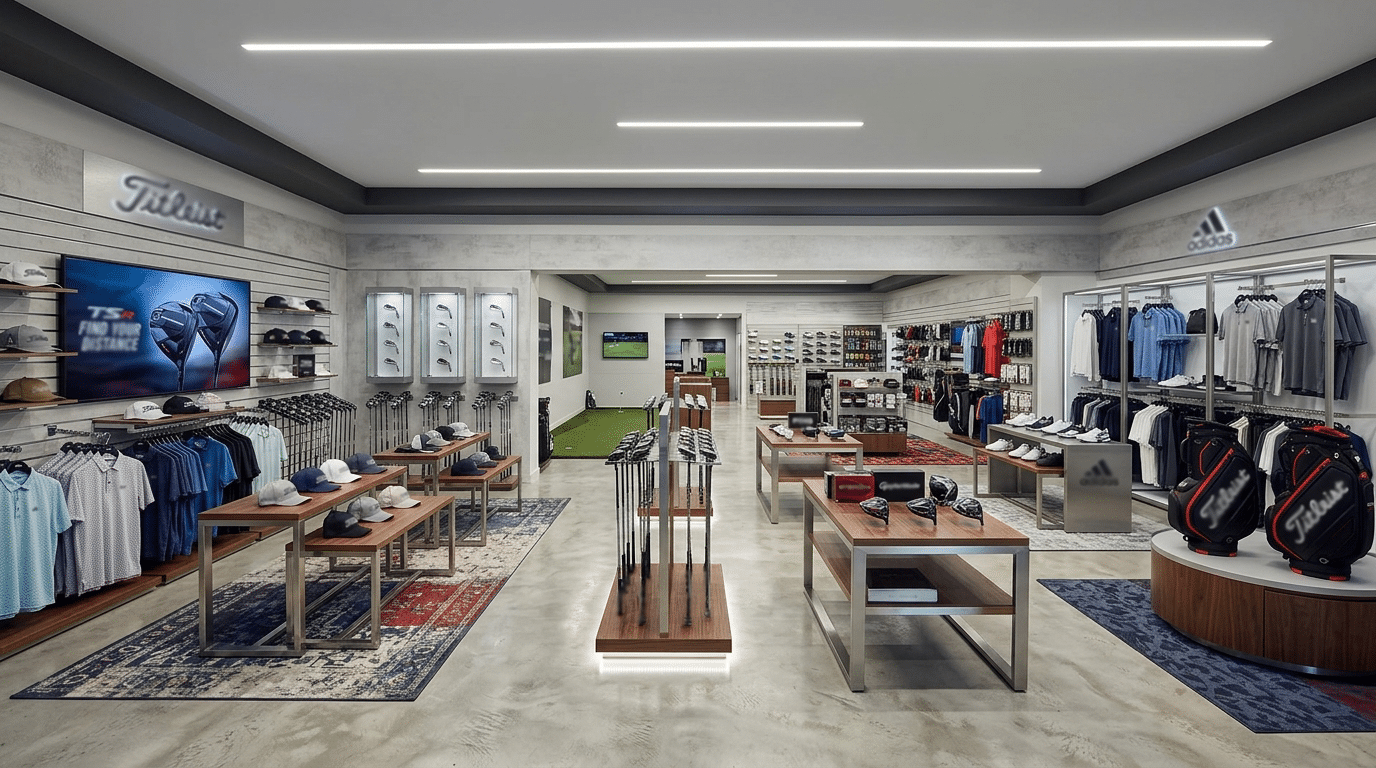
Golf shops have a fixture problem that most retail categories do not: the merchandise is long, heavy and awkward. A full bag weighs 25 to 35 pounds, iron sets hang in multiples, and a wall of clubs puts far more load on a fixture system than a wall of t-shirts ever will. Meanwhile your highest-value small goods — rangefinders, GPS watches, premium putters, gloves — are exactly the items that need to be visible, secured and lit. Before you buy anything, DISPLAYARAMA's free 2D layout service will map your actual square footage and tell you which fixtures fit where, which is a faster path than measuring a floor plan against a catalog yourself.
Slatwall is the backbone of a golf shop floor because it does every job at once. The same wall run holds club faceouts, bag hooks, glove and ball shelving, apparel hangrails and accessory pegs, and it reconfigures in an afternoon when the seasonal assortment changes. For club and bag walls specifically, aluminum inserts matter — they take the load that bare MDF grooves will eventually deform under.
Glass display cases handle the second half of the equation. Putters, rangefinders, watches and premium accessories are small, expensive and theft-prone, and a lit case does more for average transaction value than any signage will. Cases with LED kits and lockable doors are the standard configuration for that merchandise class.
Round out the floor with a checkout counter that doubles as a display case front, and one or two nesting or tiered tables for folded apparel and stacked ball inventory. If you are running a deep ball and accessory program, a single-sided gondola wall run gives you volume shelving that slatwall alone will not.
| Fixture | DISPLAYARAMA Cost |
|---|---|
| Slatwall panels (12–20 panels, 4' x 8') | $780 – $4,300 |
| Aluminum inserts for club & bag walls | $480 – $1,600 |
| Slatwall accessories (hooks, brackets, shelves, faceouts) | $200 – $800+ |
| Glass display cases (2–4 units) | $594 – $4,200 |
| LED showcase light kits | $115 – $135 each |
| Checkout counter / cash wrap | $247 – $2,640 |
| Display & nesting tables | $150 – $1,900 |
| Gondola wall shelving (optional ball run) | $645 – $3,200 |
| Fixture Package Total | $3,100 – $18,600 |
DISPLAYARAMA has been supplying retail fixtures to specialty stores since 1980. Our slatwall panels are Grade A rated — stronger aluminum inserts, tighter manufacturing tolerances and higher load capacity than the Grade C panels most big-box suppliers carry. On a wall holding iron sets and stand bags, that difference is the difference between a fixture that holds and a groove that spreads.
Panels run from $52.50 to $339.00 depending on finish, with aluminum inserts available as an add-on. Free crating is included with slatwall panel orders, bulk pricing is available on full-store buildouts, and we offer a price match guarantee.
Our team can help you plan your layout and select the right fixture combination for your space. Call us at 1-800-292-5227 or browse the full slatwall line below.
Shop DISPLAYARAMA Slatwall Panels →Technology, Staffing & Operations
Two pieces of equipment define a modern golf shop: the point of sale that manages a variant-heavy inventory, and the launch monitor that makes you a fitter instead of a rack.
Point of sale
Golf inventory carries shaft flex, loft, lie, length, hand, size and color as variants, which breaks simple POS systems fast. Retail-grade platforms start around $60 to $89 per month at the entry tier and run to roughly $149 to $289 for plans that add ecommerce sync, loyalty and advanced reporting. Hardware bundles start near $600, and card processing typically runs about 2.6 percent plus 15 cents on in-store transactions. Budget for the tier that gives you category-level sales reporting — you cannot manage the margin mix without it.
Launch monitor and fitting
This is the widest price band in the entire buildout. Entry-level photometric units like the Bushnell Launch Pro sit near $2,499, the Foresight GC3 around $7,000 to $7,500, and the four-camera Foresight GCQuad between roughly $14,500 and $18,499. Trackman 4 sits at the top, quoted between $21,495 and $25,495 depending on configuration, with an annual software subscription in the $1,000 to $1,100 range. If you are building bookable simulator bays rather than a single fitting station, all-in cost runs $10,000 to $70,000 per bay, with the commercial sweet spot generally cited at $20,000 to $35,000 and industry averages landing near $45,000 per bay for fully specified builds.
Club repair bench
The cheapest high-return investment in the shop. Mitchell Golf's verified 2026 pricing puts a fully equipped repair and fitting bench at roughly $4,566 to $6,916, with an entry-level iron bending machine at $1,899.99 and the model that also handles hybrids and metal woods at $3,199.99. At $35 per club across eight-club sets, a shop bending five sets a week generates roughly $1,400 weekly — the entry machine pays for itself in about 14 weeks.
Staffing
A lean shop runs on the owner plus one or two part-time staff. The person who matters most is whoever runs the fitting bay, because that role converts browsers into full-set purchases and generates the service revenue that carries your fixed costs. Payroll percentage is worth watching from week one — it is typically the largest controllable expense inside that 30 to 35 percent operating cost band.
| Technology / Operations | Estimated Cost |
|---|---|
| POS software (year one) + hardware bundle | $1,300 – $4,500 |
| Launch monitor (entry photometric to tour-grade radar) | $2,500 – $25,500 |
| Simulator bay build-out (optional, per bay) | $10,000 – $70,000 |
| Club repair & fitting bench (full equipment) | $4,500 – $7,000 |
| Exterior signage | $3,000 – $15,000 |
| Architect drawings & permit fees | $5,000 – $18,000 |
| Launch marketing & grand opening | $2,000 – $5,000 |
| Technology & Operations Total | $18,300 – $145,000 |
What It Actually Costs To Open
Adding every line item together, a golf shop opens somewhere between roughly $73,000 and $553,000. The low end assumes a compact fitting-led studio in a clean second-generation space with a tight assortment and an entry launch monitor. The high end assumes a full retail floor with multiple simulator bays, premium finishes and deep inventory. Most independent operators building a conventional retail shop with a repair bench land in the $120,000 to $260,000 band.
| Cost Category | Estimated Range |
|---|---|
| Formation, licensing & insurance | $1,250 – $8,300 |
| Security deposit & first three months rent | $5,400 – $60,000 |
| Buildout & construction | $8,000 – $120,000 |
| Opening inventory | $25,000 – $141,000 |
| Fixtures & store design | $3,100 – $18,600 |
| Technology, fitting equipment & launch | $18,300 – $145,000 |
| Working capital reserve (3–6 months) | $12,000 – $60,000 |
| Total Startup Investment | $73,050 – $552,900 |
Plan your runway, not just your opening: operators across the indoor golf and simulator sector commonly report reaching break-even somewhere between 6 and 18 months, and the consistent advice is to hold at least six months of operating expenses in reserve before you open the doors. Golf is also seasonal in most of the country. If you open in spring you get a full selling season to build cash; if you open in fall you need to fund a winter before the market comes to you.
Six Ways To Actually Make Money
The shops that survive are rarely the ones with the best club selection. They are the ones that understand where gross margin actually comes from and build the floor, the schedule and the buy around it.
Sell Services Before Clubs
Loft and lie work costs under $2 in materials and bills at $20 to $45 per club — roughly a 91 percent gross margin against 20 to 30 percent on hardgoods. Five iron sets a week at $35 per club is about $1,400 weekly from bending alone.
Fix Your Margin Mix
Equipment returns 20 to 30 percent, apparel at least 52 percent, and small accessories frequently more than 100 percent. With operating expenses at 30 to 35 percent of sales, anything below that line loses money — so let clubs drive traffic and let soft goods and accessories carry profit.
Run a Trade-In Program
The global pre-owned club market has been valued near $3 billion. Third-party trade-in services let you offer credit with little or no inventory risk of your own, and trade credit is one of the most reliable triggers for a new full-set purchase.
Merchandise For the Off-Course Golfer
19 million Americans participated in golf exclusively off-course in 2025, and NGF research has found that a majority of simulator users do not play traditional on-course golf. That customer still buys clubs, gloves, balls and apparel — just not from a pro shop.
Stock For Women and Juniors
More than 8 million women and girls played on course in 2025, a 46 percent increase since 2019, and they now make up 28 percent of on-course golfers. Junior participation is up 58 percent over the same period. Most independent shops still allocate almost no floor space to either.
Kill Aged Inventory Early
Track stock at 90, 180 and 365 days and mark down at the first threshold, not the last. With driver lines refreshing every 12 to 18 months, inventory that sits through one product cycle rarely recovers full margin — and it ties up the cash you need for the next buy.
Why Your Fixtures Matter More In Golf
In most retail categories, fixtures are a presentation decision. In golf they are a structural and commercial one. Your wall has to carry iron sets and stand bags without deforming, your cases have to secure four-figure putters and rangefinders, and your floor has to leave a clean sightline from the entrance to the fitting bay — because the fitting bay is what converts a browser into a $2,000 sale.
There is a second reason that catches new owners by surprise. Manufacturer distribution policies explicitly evaluate the quality of a retailer's store environment, including fixtures and finishes, when deciding whether to grant authorization to carry current-model hard goods. The fixture package you install is part of the case you make to your brand reps.
- Load-rated slatwall with aluminum inserts for club faceouts, hangrails and bag hooks
- Lockable, LED-lit glass cases for putters, rangefinders, GPS watches and premium gloves
- A checkout counter with a display front so the last five feet of the store still sell
- Nesting or tiered tables for folded apparel and stacked ball inventory
- An unobstructed sightline from the door to the fitting bay or hitting net
DISPLAYARAMA supplies Grade A slatwall panels, glass display cases, checkout counters and merchandising tables to specialty retailers across the country. Our slatwall is rated a full two grades above the Grade C panels most big-box suppliers stock, with aluminum inserts available for the heavy club and bag walls that define a golf shop floor.
Free crating is included on slatwall panel orders, bulk pricing is available for full-store buildouts, and we back our pricing with a price match guarantee.
Not sure what your space needs? Call 1-800-292-5227 and our team will walk your floor plan with you.
Get My Free Store Fixture Layout Plan →Outfit Your Golf Shop
Fixtures are one of the smaller line items in a golf shop buildout and one of the highest-leverage. Below are the categories most golf retailers order from DISPLAYARAMA, and if you are still working out what fits in your space, the free 2D layout plan will answer that before you spend anything.
Grade A Slatwall Panels
The backbone of a golf shop wall. Holds club faceouts, bag hooks, hangrails and accessory pegs, and reconfigures in an afternoon when the season changes.
Aluminum Slatwall Inserts
Added load capacity for the walls carrying iron sets and stand bags. Available as an add-on to most panel finishes.
Glass Display Cases
Lockable, LED-lit cases for putters, rangefinders, GPS watches and premium accessories — the merchandise that needs to be seen and secured.
Checkout Counters & Cash Wraps
Ledgetop counters, slatwall-front counters and glass-front counters that keep the last five feet of your store selling.
Display Tables & Merchandisers
Nesting sets, tiered tables and floor merchandisers for folded apparel, stacked ball inventory and seasonal promotions.
Bulk Pricing Available
Outfitting a full store? DISPLAYARAMA offers bulk pricing on fixtures. Call 1-800-292-5227 for a custom quote.
DISPLAYARAMA's free 2D store layout service gives you a professional floor plan with specific fixture recommendations for your golf shop — at no cost. It answers the club wall, case placement and fitting bay sightline questions before you spend a dollar on fixtures. We've been helping specialty retailers design their stores since 1980, and we offer bulk pricing for owners outfitting a full floor.
Submit your space dimensions and store type and we'll put together a custom layout plan with exactly the fixtures that will work for your golf shop.
Get My Free Store Fixture Layout Plan →