

How Much Does It Cost To Open a Grocery Store?
Grocery retail is one of the most recession-resistant businesses you can open. People eat every day regardless of the economy — and with the average American household spending nearly $10,000 per year on groceries and shopping for food 1.6 times per week, the demand floor never drops. For entrepreneurs who understand the operational complexity involved, an independent grocery store can become a genuine community cornerstone with a loyal, repeat customer base that's hard to replicate in other retail categories.
But grocery is also one of the most capital-intensive and operationally demanding businesses you can enter. Thin margins — typically 1–3% net after all expenses — mean that volume, efficiency, and cost control are everything. Commercial refrigeration alone can run $35,000–$100,000. Buildout, shelving, inventory, staffing, and compliance with health department requirements all add up quickly. Getting your budget right before you sign a lease isn't optional — it's survival.
This guide gives you a complete, honest breakdown of what it actually costs to open a grocery store in 2026 — from licenses and health permits to refrigeration equipment, shelving, inventory, and the technology needed to run a compliant, efficient operation from day one.
Licenses, Permits & Business Formation
Grocery retail sits at the intersection of food safety law and standard retail licensing — which means your compliance picture is more complex than most businesses. Beyond forming your legal entity and obtaining a general business license, you'll need a food facility permit (also called a retail food establishment permit or health department permit) issued by your local county health authority. This permit authorizes you to sell food to the public and requires your facility to pass a health inspection before opening.
If you plan to sell prepared foods, operate a deli counter, or offer any hot or ready-to-eat items, additional food service permits and HACCP (Hazard Analysis and Critical Control Points) compliance may be required. At least one manager or supervisor must typically hold a Food Protection Manager Certification (ServSafe or equivalent), and in most states all employees handling food need food handler cards within 30 days of hire.
If you plan to sell alcohol, you'll also need a beer and wine or full liquor retail license — a separate and often costly process that can take months to complete depending on your state.
Plan ahead: Health department permits require submitting floor plans, equipment specifications, and passing a physical inspection before you open. Start this process 60–90 days before your target opening date — delays are common and can push your launch back significantly.
| License / Permit / Filing | Cost Range |
|---|---|
| LLC or Corporation Formation | $50 – $500 |
| General Business License | $50 – $500/yr |
| Food Facility / Health Department Permit | $200 – $1,000/yr |
| Food Handler Cards (Per Employee) | $5 – $30 each |
| Food Protection Manager Certification | $100 – $150 |
| Seller's Permit / Sales Tax License | $0 – $50 |
| Zoning / Occupancy Permit | $100 – $1,000 |
| Signage Permit | $100 – $500 |
| Beer & Wine / Liquor License (if applicable) | $300 – $14,000+ |
| Estimated Total (without alcohol license) | $605 – $3,730 |
Location & Rent
Location strategy for grocery differs from most retail categories in one key way: parking matters more than foot traffic. According to USDA data, the average American drives four miles to reach their preferred grocery store. That means a slightly less central location with ample parking and easy in-and-out access often outperforms a more prominent location with parking challenges. Strip mall end caps, standalone buildings, and community shopping centers with anchor tenants all work well for independent grocers.
Square footage requirements vary dramatically by store type. A neighborhood corner market or specialty grocery can operate in 1,000–3,000 square feet. A full-service independent grocery store typically needs 5,000–15,000 square feet to accommodate adequate shelving, refrigeration, storage, and checkout lanes. The average commercial retail rent across the U.S. runs approximately $24–$29 per square foot annually, though this varies enormously by market.
Don't forget: You'll need at least 1,000 sq ft of backroom storage for refrigerated cases, a loading dock area, and daily delivery handling — this space is non-negotiable for any store carrying fresh produce, dairy, and meat. Factor it into your square footage calculation before signing.
| Store Type / Location | Monthly Rent |
|---|---|
| Small corner market / specialty (1,000–2,000 sq ft) | $2,000 – $6,000 |
| Neighborhood grocery (2,000–5,000 sq ft) | $5,000 – $15,000 |
| Mid-size independent store (5,000–10,000 sq ft) | $10,000 – $30,000 |
| Full-size independent (10,000–15,000 sq ft) | $20,000 – $50,000+ |
| First-Year Rent (mid-size neighborhood store) | $60,000 – $180,000 |
Grocery-specific buildout — HVAC upgrades for refrigeration loads, plumbing for produce misters, electrical for commercial cases, and flooring — typically adds $20,000–$150,000 on top of standard tenant improvements, depending on the condition of the space.
Equipment & Refrigeration
Commercial refrigeration is the single largest equipment expense in grocery retail — and a non-negotiable one. Dairy, meat, produce, deli, and frozen foods all require different temperature zones, and the equipment to maintain them is both expensive to purchase and costly to operate. Refrigeration is also the highest energy consumer in any grocery store, typically accounting for 40–60% of total utility costs. Choosing energy-efficient, Energy Star-rated units from the start reduces your long-term operating burden.
Refrigeration & Freezer Cases
Open-face refrigerated display cases for dairy, deli, and beverages run $3,000–$8,000 per unit new. Reach-in coolers, walk-in refrigerators, and walk-in freezers — the backbone of any grocery backroom — run $8,000–$30,000 each depending on size. A mid-size grocery store might need $35,000–$100,000 in total refrigeration investment.
Shelving & Display Fixtures
Commercial gondola shelving is the workhorse of grocery retail. A complete shelving setup for a 3,000–5,000 sq ft store, including gondola runs, end caps, and perimeter shelving, typically runs $15,000–$40,000 depending on quantity and configuration. Used commercial shelving can cut this cost by 30–50%.
Checkout & Supporting Equipment
Grocery-specific POS systems with deli scale integration, self-checkout support, and inventory management run $5,000–$20,000 depending on the number of lanes. Shopping carts, hand baskets, produce scales, and bagging stations add $2,000–$8,000.
| Equipment Category | Estimated Cost |
|---|---|
| Walk-In Cooler / Refrigerator | $8,000 – $30,000 |
| Walk-In Freezer | $8,000 – $25,000 |
| Open-Face Display Refrigeration Cases | $15,000 – $50,000 |
| Reach-In Coolers / Freezer Chests | $3,000 – $15,000 |
| Gondola Shelving (Full Store) | $15,000 – $40,000 |
| Grocery POS System (Multi-Lane) | $5,000 – $20,000 |
| Shopping Carts, Baskets & Produce Scales | $2,000 – $8,000 |
| Security System / Cameras | $1,500 – $5,000 |
| Total Equipment Budget | $57,500 – $193,000 |
Buy used strategically: Commercial refrigeration cases and gondola shelving have strong secondary markets. Used equipment from grocery liquidations or restaurant supply dealers can cut your equipment costs by 30–50% — just ensure refrigeration units are certified and meet current energy and health code standards before purchasing.
Opening Inventory
Grocery inventory is unlike almost any other retail category — a significant portion of it is perishable, which means waste management is baked into your cost structure from day one. You cannot open a grocery store that looks half-stocked. Customers expect full shelves, and empty or sparse sections signal a business that isn't thriving. At the same time, over-buying perishables before you understand your actual sell-through rate is equally dangerous.
Shelf-Stable Goods
Canned goods, dry goods, snacks, beverages, cleaning products, and household staples are your baseline inventory. These are purchased through wholesale distributors like UNFI, KeHE, or regional broadline distributors and typically run $20,000–$60,000 to open a mid-size store with full shelves.
Perishables (Produce, Dairy, Meat, Deli)
Fresh categories drive foot traffic and repeat visits but carry the highest shrink risk. Opening perishable inventory should be bought conservatively — order based on realistic first-week volume, not ideal capacity. Budget $10,000–$30,000 for opening fresh inventory across produce, dairy, meat, and deli.
Frozen Foods
Frozen is a high-turnover, lower-shrink category that complements fresh well. A solid opening frozen selection runs $5,000–$15,000 depending on the number of freezer doors you're stocking.
| Inventory Category | Estimated Cost |
|---|---|
| Shelf-Stable / Dry Goods | $20,000 – $60,000 |
| Produce (Fresh Opening Stock) | $3,000 – $10,000 |
| Dairy & Refrigerated Items | $3,000 – $10,000 |
| Meat & Deli | $4,000 – $12,000 |
| Frozen Foods | $5,000 – $15,000 |
| Beverages & Specialty Items | $3,000 – $8,000 |
| Total Opening Inventory | $38,000 – $115,000 |
Start lean on perishables: Many experienced grocers recommend opening with 60–70% of your full fresh inventory target, then scaling up as you establish actual sell-through patterns. Over-buying perishables in week one is one of the most common and costly opening mistakes in grocery retail.
Fixtures, Shelving & Store Setup
A grocery store's fixture layout directly impacts how much customers spend per visit. Decades of retail research have established that shoppers veer right upon entering a store, so impulse and high-margin items belong on the right side of the entrance. Staples like dairy and meat belong at the back, drawing customers through the entire floor. High-traffic end caps command premium placement and drive incremental sales above the base shelf. The right fixtures make all of this work — and DISPLAYARAMA can help you plan your layout before you spend a dollar on shelving. Get started with our free 2D store fixture layout plan.
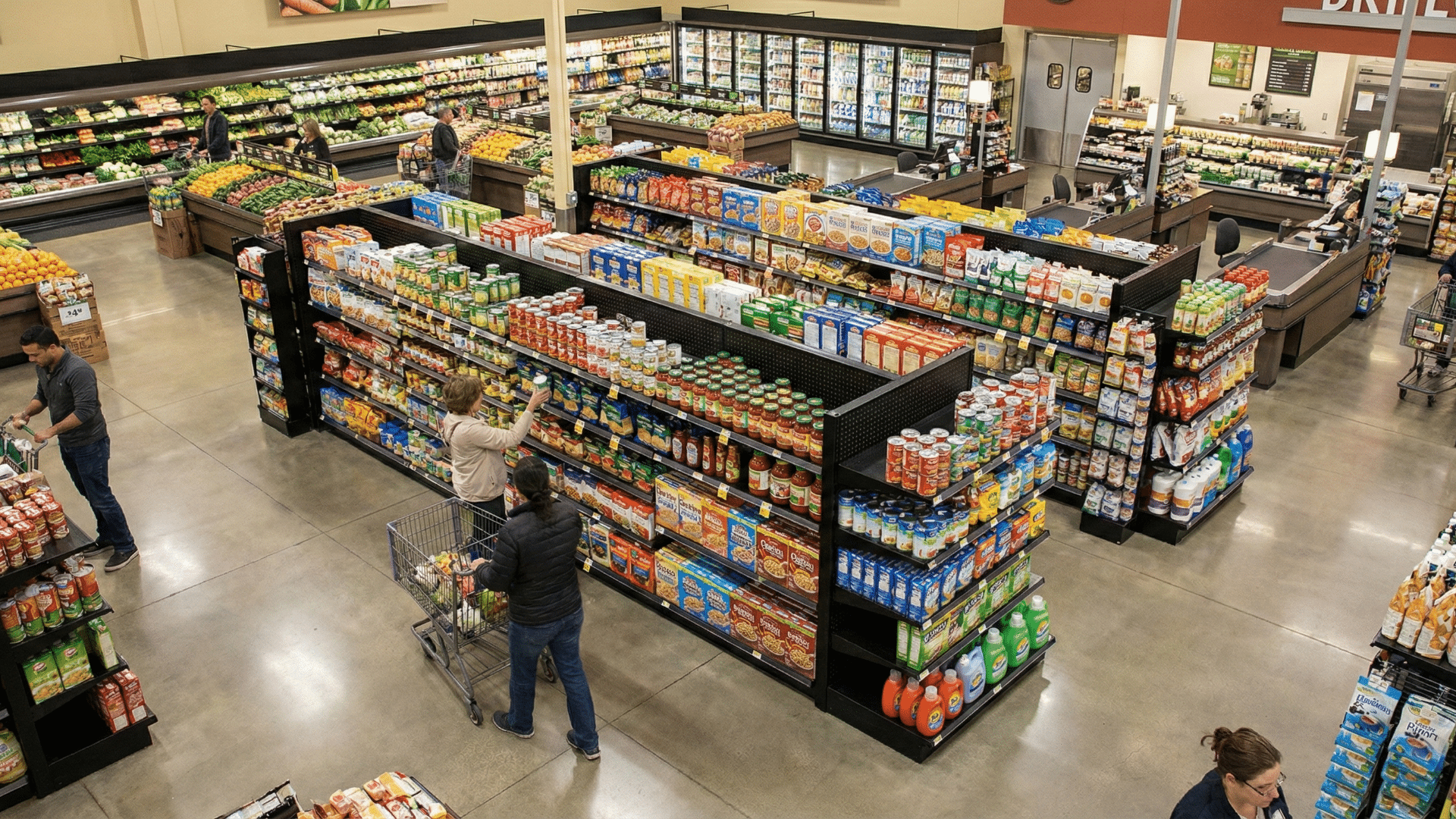
Gondola shelving is the foundation of any grocery floor — the double-sided, freestanding units that form your store's interior aisles. Wall shelving handles perimeter categories like beverages, canned goods, and household products. Checkout counters need to handle high transaction volume, integrate with your POS and scale systems, and manage bagging efficiently. The store layout you choose now affects customer flow, average basket size, and restock efficiency for years.
| Fixture / Component | Estimated Cost |
|---|---|
| Gondola Shelving (Aisle Runs + End Caps) | $15,000 – $40,000 |
| Wall Shelving (Perimeter) | $3,000 – $10,000 |
| Produce Display Tables & Bins | $2,000 – $8,000 |
| Checkout Counters (2–4 lanes) | $3,000 – $12,000 |
| Signage (Aisle, Department, Exterior) | $2,000 – $8,000 |
| Lighting Upgrades | $2,000 – $10,000 |
| Flooring | $3,000 – $15,000 |
| Total Fixtures & Store Setup | $30,000 – $103,000 |
Produce display tables and bins deserve special attention. Fresh produce is usually the first department customers encounter and sets the visual tone for the entire store. A well-presented produce section with proper lighting increases average basket size and signals quality throughout the store.
Checkout counter configuration matters more in grocery than in most retail formats. Each lane needs to handle high volume quickly — backups at checkout are one of the top reasons shoppers choose competitors. Make sure your counters accommodate your POS hardware, scale systems, bagging area, and card reader without crowding.
DISPLAYARAMA has been supplying retail fixtures to specialty stores since 1980. We carry gondola shelving, wall shelving, checkout counters, slatwall systems, and more — everything needed to build a grocery store that's organized, shoppable, and built to move product efficiently.
Our team can help you plan your store layout and select the right fixture combination for your space and budget. Call us at 1-800-292-5227 or get your free layout plan below.
Get My Free Store Fixture Layout Plan →Staffing, Technology & Operations
Grocery retail is labor-intensive. Unlike many specialty retail categories where a single owner-operator can manage a small store alone, grocery requires multiple staff members to handle stocking, cashiering, produce management, receiving deliveries, and customer service simultaneously. Labor is typically the second-largest expense category in grocery after cost of goods sold, running 12–18% of revenue for well-run independent stores.
Your POS system is the operational nerve center of a grocery store and needs to be purpose-built for food retail. A grocery-specific system handles deli scale integration, produce pricing by weight, SNAP/EBT payment processing (mandatory if you want access to food assistance customers), inventory tracking, and vendor management. General-purpose retail POS systems typically fall short on these requirements. Budget $5,000–$20,000 for hardware and software depending on the number of checkout lanes.
SNAP/EBT authorization: If you want to accept SNAP benefits — and you should, as it significantly expands your customer base — you'll need to apply for SNAP retailer authorization through the USDA FNS. The process is free but takes 30–45 days. Apply well before your opening date.
| Staffing / Technology / Operations | Estimated Cost |
|---|---|
| Staff (Monthly, Small Store — 4–6 Employees) | $10,000 – $25,000/mo |
| Grocery-Specific POS System | $5,000 – $20,000 |
| Inventory Management Software | $100 – $500/mo |
| Business Insurance (Annual) | $3,000 – $10,000 |
| Utilities (Monthly — Grocery is High) | $2,000 – $8,000/mo |
| Website / Online Presence Setup | $500 – $3,000 |
| Marketing / Grand Opening | $2,000 – $10,000 |
| Waste / Shrink Reserve (Monthly) | $500 – $3,000/mo |
| First-Year Operations Budget | $145,200 – $484,000+ |
Total Startup Cost Summary
When everything is added up, opening a grocery store in 2026 requires $80,000–$300,000 for a small neighborhood market, and a mid-size independent store with proper refrigeration, full shelving, and adequate inventory typically runs $300,000–$700,000 before opening day. Full-scale supermarkets in prime locations push well past $1 million.
| Expense Category | Estimated Range |
|---|---|
| Licenses, Permits & Business Formation | $605 – $3,730 |
| First Month's Rent + Security Deposit | $6,000 – $60,000 |
| Leasehold Improvements / Buildout | $20,000 – $150,000 |
| Equipment & Refrigeration | $57,500 – $193,000 |
| Opening Inventory | $38,000 – $115,000 |
| Fixtures & Store Setup | $30,000 – $103,000 |
| Technology & POS | $5,600 – $23,500 |
| Working Capital Reserve (6 months) | $30,000 – $150,000 |
| Total Estimated Startup Investment | $187,705 – $798,230+ |
Grocery requires a long runway. Most independent grocery stores take 18–39 months to reach true profitability. Thin margins mean fixed costs must be covered on volume — and volume takes time to build. A working capital reserve covering at least 6 months of operating expenses is the standard recommendation. Undercapitalized stores close not from lack of customers but from running out of cash before those customers have had time to become regulars.
How to Maximize Revenue
Winning in independent grocery isn't about competing with superchains on price — it's about winning on experience, curation, community, and the categories where independents naturally have an advantage. Here's how the best operators differentiate and protect their margins.
Lead With High-Margin Departments
Prepared foods, deli, and specialty items carry dramatically better margins than standard grocery staples. A hot bar, grab-and-go section, or fresh-made deli counter can deliver 40–60% gross margins compared to 15–25% on packaged goods.
Curate a Local & Specialty Section
Independent grocers have a unique advantage in stocking local producers, regional brands, and specialty items that chains won't carry. These products carry better margins, create loyal customers, and are a genuine point of differentiation that no supermarket can replicate.
Implement a Loyalty Program
Grocery customers are habitual — they shop at the same store repeatedly. A points-based loyalty program builds switching costs and gives you transaction data to optimize your product mix, pricing, and promotions based on actual buying behavior.
Offer Online Ordering & Delivery
Integrating with local delivery platforms or building a simple click-and-collect system extends your reach beyond walk-in traffic and captures a customer segment that won't otherwise visit. Even basic curbside pickup drives meaningful incremental revenue.
Enroll in Scan Data Programs
Major CPG brands pay rebates to retailers who submit scan data on qualifying product sales. These programs — available through distributors or directly with brands — can generate meaningful passive revenue from products you're already stocking and selling.
Minimize Shrink Relentlessly
In a 1–3% net margin business, a 2–3% shrink rate can eliminate your entire profit. Tight first-in-first-out (FIFO) rotation, accurate ordering based on sell-through data, and markdown strategies for near-expiry items are the difference between profitable and unprofitable grocery operations.
Why Your Fixtures Matter
In grocery retail, your fixtures aren't just shelves — they're a revenue management tool. The height, configuration, and placement of your gondola runs directly affect which products get seen, which get bought, and how efficiently your staff can restock. A disorganized, poorly configured store floor costs you sales every single day in missed impulse buys, customer frustration, and restock inefficiency.
The most successful independent grocers treat their store layout as a living document — regularly rotating end caps, adjusting section placement based on sales data, and keeping high-margin departments at the front and center of the customer journey. The right fixtures make this possible. Prioritize these when planning your store:
- Gondola shelving in standardized heights and configurations — consistency allows for easier restock, cleaner visual presentation, and better use of POP signage
- Dedicated end cap units at every aisle termination — end caps generate 2–3x the sales velocity of mid-aisle shelf positions and are your primary promotional real estate
- Produce tables and display bins near the entrance — fresh produce sets the tone for the quality of your entire store and should be the first thing customers see
- Checkout counters with adequate bagging space and clear POS integration — slow checkouts drive customer defection more reliably than almost any other friction point
- Clear, consistent aisle and department signage — customers who can't find what they're looking for don't browse, they leave
DISPLAYARAMA has been outfitting specialty retail stores with professional-grade display fixtures since 1980. We carry gondola shelving, wall shelving, checkout counters, slatwall systems, and more — everything you need to build a grocery store that looks professional and runs efficiently from day one.
Our team can help you plan your store layout and select the right combination of fixtures for your square footage and budget. Bulk pricing is available for full store buildouts.
Get My Free Store Fixture Layout Plan →Ready to Outfit Your Grocery Store?
If you're opening a grocery store and need to source shelving and fixtures, start with DISPLAYARAMA's free 2D store layout service — a no-cost resource where our team creates a professional floor plan with specific fixture recommendations for your space. It saves hours of guesswork and gives you a clear picture of your fixture investment before you commit. Request your free layout plan here.
Gondola Shelving
Double-sided freestanding gondola units form the backbone of your grocery aisles. Available in standard heights and configurations for consistent, shoppable aisle presentation.
Wall Shelving
Perimeter wall shelving for beverages, canned goods, household products, and any category that benefits from floor-to-ceiling display depth along your store walls.
Checkout Counters
Professional cash wrap counters built for high-volume grocery retail — organized, efficient, and designed to integrate with your POS, scale systems, and bagging setup.
Slatwall Systems
Flexible slatwall panels for specialty sections, impulse displays, seasonal promotions, and any area where you need reconfigurable display options without permanent shelving.
Custom Display Solutions
Need something specific to your store's layout or product mix? DISPLAYARAMA offers custom display solutions tailored to your exact dimensions, store concept, and category requirements.
Bulk Pricing Available
Outfitting a full grocery floor? DISPLAYARAMA offers bulk pricing on shelving and fixtures. The more you order, the more you save. Call 1-800-292-5227 for a custom quote.
DISPLAYARAMA's free 2D store layout service gives you a professional floor plan with specific fixture recommendations for your grocery store — at no cost. It's designed to save you hours of guesswork and give you a clear picture of your fixture investment before you commit. We've been helping specialty retailers design their stores since 1980, and we offer bulk pricing for owners outfitting a full floor.
Submit your space dimensions and store type and we'll put together a custom layout plan with exactly the fixtures that will work for your grocery store.
Get My Free Store Fixture Layout Plan →