

How Much Does It Cost To Open a Hardware Store?
The independent hardware store is one of the most resilient formats in American retail. While Home Depot and Lowe's together control roughly half of all home improvement spending, the independent hardware channel continues to grow by serving a fundamentally different customer need — expertise, convenience, and personalized service that no 100,000-square-foot warehouse can replicate. The U.S. hardware store market is projected to reach $44.2 billion in 2026, and the average independent store generates between $1 million and $5 million in annual revenue, with gross margins of 35–42% on blended product categories.
The strongest competitive advantage an independent hardware store has is knowledge. Customers who need to fix a leaking pipe, wire a ceiling fan, or repair a fence don't want to wander a big-box store hoping to find an available associate. They want to walk in, describe the problem, and walk out with exactly what they need — plus the know-how to use it. That's the core value proposition of a well-run neighborhood hardware store, and it's why the format continues to thrive even in markets with large national competitors nearby.
But the capital requirements are substantial. Opening a well-stocked independent hardware store typically runs $160,000–$550,000, with inventory as the largest single cost driver. This guide breaks down every major expense category for opening a hardware store in 2026 — from licenses and location to shelving, inventory, technology, and the franchise vs. independent decision that shapes your entire financial model.
Independent Store vs. Cooperative Franchise
Before you budget a single line item, you need to make one fundamental decision: independent store or cooperative franchise. The hardware industry is unusual in that its major franchise systems — Ace Hardware, True Value, and Do it Best — operate as retailer-owned cooperatives, not traditional franchises. You're not paying royalties to a corporate franchisor; you're becoming a co-owner of a purchasing cooperative that negotiates better pricing and provides operational support in exchange for buying most of your inventory through their distribution system.
The Ace Hardware cooperative — the largest with over 5,800 domestic locations — requires a minimum net worth of $400,000 and $250,000 in liquid assets to qualify. Total investment ranges from $579,000 to $1,913,000 depending on store size and build-out scope, per their 2024 Franchise Disclosure Document. True Value (which merged with Do it Best in 2024 to form the world's largest hardware cooperative) has a lower entry point, with some store conversions starting around $75,000, though a full new-build approach runs significantly higher.
The cooperative model's core benefit is purchasing power — members buy inventory at cooperative wholesale pricing, which is materially better than what an independent operator can negotiate directly. Patronage dividends distributed by the cooperative at year end further reduce effective cost of goods. For many operators, the economics of cooperative membership are simply better than going fully independent.
Cooperative vs. independent math: True Value members see blended gross margins of 35–42% with patronage dividend benefits. A fully independent store buying direct from distributors typically achieves lower margins without the cooperative's buying power advantage. Run the numbers for your specific market before choosing a path.
| Path to Market | Estimated Startup Range |
|---|---|
| Fully Independent (Mid-Size Store) | $160,000 – $550,000 |
| True Value / Do it Best (Store Conversion) | $75,000 – $400,000 |
| True Value / Do it Best (New Build) | $200,000 – $600,000+ |
| Ace Hardware Cooperative (New Store) | $579,000 – $1,913,000 |
| Key Advantage of Cooperative Model | Buying Power + Dividends |
This guide focuses primarily on the independent and lower-cost cooperative path. The Ace Hardware investment range is included for context — it reflects a more comprehensive build-out standard with branded fixtures, signage, and a larger supported inventory package.
Licenses, Permits & Business Formation
Compared to categories like liquor, tobacco, or firearms, a hardware store's licensing footprint is straightforward. There's no category-specific federal or state license required simply for selling hardware — your primary requirements are standard business formation and retail operating permits. That said, certain product categories you may choose to carry add licensing complexity: if you stock pesticides, fertilizers, or other EPA-regulated products, you may need a pesticide retailer permit. If you sell propane tanks or propane refill services, additional safety permits apply. Paint mixing and disposal may also have local environmental compliance requirements.
If you join a cooperative like Ace Hardware or Do it Best, the cooperative typically provides a compliance checklist specific to your state covering which additional permits are needed based on your planned product mix. For independent operators, an attorney familiar with retail business licensing in your state is worth the consultation fee before you commit to a location or product mix.
Check city zoning early: Hardware stores with outdoor lumber yards, propane tank storage, or large-vehicle delivery access have specific zoning and fire safety requirements. Confirm your intended location accommodates your operational footprint before signing any lease.
| License / Permit / Filing | Cost Range |
|---|---|
| LLC or Corporation Formation | $50 – $500 |
| General Business License | $50 – $500/yr |
| Seller's Permit / Sales Tax License | $0 – $50 |
| Zoning / Occupancy Permit | $100 – $1,000 |
| Signage Permit | $100 – $500 |
| Pesticide / Fertilizer Retail Permit (if applicable) | $50 – $500/yr |
| Propane Retail License (if applicable) | $50 – $300/yr |
| Fire Safety / Building Inspection | $200 – $1,000 |
| Attorney / Legal Consultation | $500 – $2,000 |
| Estimated Total | $1,100 – $6,350 |
Location & Rent
Hardware stores occupy a different real estate niche than most retail categories. You need substantial square footage, loading dock or rear access for receiving large deliveries, adequate parking for customers who are often buying heavy or bulky items, and potentially outdoor storage or display space for lumber, bagged materials, or seasonal products. Visibility matters, but high-visibility premium retail space is often less practical than a well-located strip mall or standalone building near residential neighborhoods, where the bulk of your customer base actually lives and works on homes.
A small neighborhood hardware store can operate in 2,500–5,000 square feet with a focused product selection. A standard community hardware store runs 5,000–10,000 sq ft, with room for a full tool selection, plumbing, electrical, paint, and seasonal departments. Larger hardware stores and home centers push 15,000 sq ft and up. The Ace Hardware store format averages approximately 10,000 sq ft for a core-format store, with Super stores running significantly larger.
Back-of-house matters: Budget for adequate storage and receiving space — hardware inventory includes large, heavy items that need proper staging and receiving areas. A store that looks well-stocked on the floor requires significant back-of-house square footage to maintain that depth. Under-provisioning storage is a common mistake in first-time hardware store planning.
| Store Size / Location Type | Monthly Rent |
|---|---|
| Small neighborhood store (2,500–5,000 sq ft) | $2,500 – $8,000 |
| Standard community store (5,000–10,000 sq ft) | $6,000 – $18,000 |
| Full-size store (10,000–15,000 sq ft) | $12,000 – $30,000+ |
| First-Year Rent Cost (Mid-Size Estimate) | $72,000 – $216,000 |
Leasehold improvements for a hardware store — shelving installation, electrical upgrades, lighting, flooring, and layout construction — typically run $30,000–$150,000 depending on the condition of the space and the scope of your buildout. Cooperative members receive store planning support from their cooperative's design team, which can reduce both time and cost.
Opening Inventory
Inventory is the defining cost of opening a hardware store — and the category with the widest range of any in this guide. A small neighborhood store focused on everyday repair and maintenance items can open with $40,000–$80,000 in stock. A full-service community hardware store needs $100,000–$300,000 to present a credible selection across all major departments. The inventory investment is also what determines whether customers make you their first stop or a last resort — a hardware store that doesn't have what people need quickly earns a reputation it takes years to overcome.
Hand Tools & Power Tools
Tools are the anchor category of any hardware store — and one of the highest-margin departments. Premium hand tool brands like Stanley, DeWalt, Milwaukee, and Irwin carry strong margins and build the store's credibility with both DIY customers and contractors. Budget $15,000–$40,000 for a solid opening tool selection covering both hand and power tools across price tiers.
Plumbing, Electrical & Hardware
These are the true day-to-day traffic drivers — the fittings, fasteners, outlets, breakers, valves, and small hardware items people urgently need when something breaks at home. Depth matters more than breadth here. Budget $20,000–$50,000 for plumbing, electrical, and general hardware categories combined.
Paint, Building Materials & Lawn/Garden
Paint is one of the highest-margin categories in hardware retail. A custom paint mixing program with quality brands (Sherwin-Williams, Benjamin Moore, or cooperative house brands) is a significant competitive differentiator and repeat traffic driver. Lawn and garden is seasonal but high-volume. Budget $15,000–$40,000 for paint, supplies, and a seasonal selection.
| Inventory Category | Estimated Cost |
|---|---|
| Hand Tools & Power Tools | $15,000 – $40,000 |
| Plumbing Supplies & Fittings | $8,000 – $20,000 |
| Electrical Supplies & Lighting | $8,000 – $20,000 |
| Fasteners, Hardware & Builders Hardware | $8,000 – $20,000 |
| Paint, Stains & Painting Supplies | $10,000 – $25,000 |
| Lawn, Garden & Outdoor | $5,000 – $15,000 |
| Safety, Cleaning & General Supplies | $3,000 – $8,000 |
| Keys, Locks & Security Products | $3,000 – $8,000 |
| Total Opening Inventory | $60,000 – $156,000 |
Cooperative buying advantage: Independent hardware stores typically pay retail distributor prices for inventory. Cooperative members purchase at negotiated cooperative wholesale pricing, with patronage dividends reducing net cost further at year end. This difference in purchasing economics is one of the strongest arguments for joining a cooperative over going fully independent.
Fixtures, Shelving & Store Setup
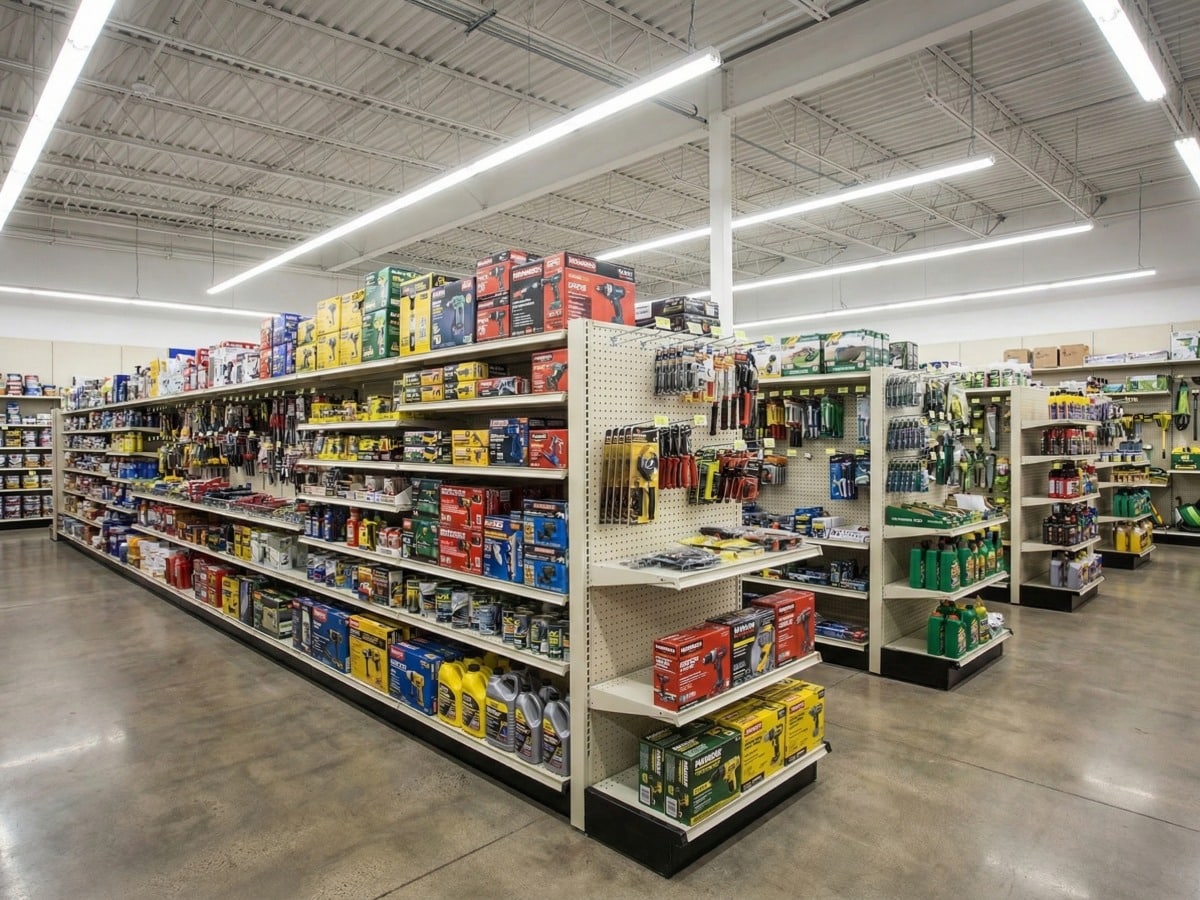
A hardware store's shelving and fixture configuration is more operationally complex than most retail formats. You're stocking everything from tiny fasteners and electrical connectors to full-size tools, bags of concrete, and power equipment — and customers need to be able to find all of it efficiently. The right shelving system, clearly organized and properly labeled, is what makes a hardware store genuinely useful to a customer who's in a hurry and needs a specific part. DISPLAYARAMA's free 2D store layout service can help you plan your fixture configuration before you spend a dollar on shelving.
Gondola shelving forms the backbone of a hardware store's interior — double-sided units down the center aisles, with heavier wall shelving for bulkier items along the perimeter. A hardware store requires more shelving depth than most retail formats to accommodate the density of small SKUs that fill categories like fasteners, plumbing fittings, and electrical supplies. End caps are key promotional and high-margin real estate at the head of every aisle. A well-designed checkout counter with integrated key-cutting station, display cases for high-value small items, and organized service area completes the floor.
| Fixture / Component | Estimated Cost |
|---|---|
| Gondola Shelving (Full Store, Aisle Runs + End Caps) | $15,000 – $40,000 |
| Wall Shelving (Heavy-Duty Perimeter) | $3,000 – $12,000 |
| Pegboard & Hook Display Systems | $2,000 – $6,000 |
| Display Cases (Blades, Batteries, Small High-Value Items) | $1,000 – $5,000 |
| Checkout Counter / Cash Wrap | $1,000 – $4,000 |
| Key-Cutting Machine | $1,500 – $4,000 |
| Signage (Aisle, Department, Exterior) | $2,000 – $8,000 |
| Lighting Upgrades | $2,000 – $8,000 |
| Total Fixtures & Store Setup | $27,500 – $87,000 |
A key-cutting machine deserves special mention as both a service revenue tool and a traffic driver. Key duplication brings customers in on a regular, predictable basis — often multiple times per year — and while the margin per key isn't enormous, the foot traffic generated pays dividends across other categories. It also positions your store as a genuine neighborhood resource rather than just a product destination.
Display cases for high-value small items — quality pocket knives, Swiss army tools, high-end measuring instruments, and premium battery packs — protect inventory while presenting it professionally. Customers buying a $45 premium multi-tool expect to see it presented at least as well as they'd find it at a national chain.
DISPLAYARAMA has been supplying retail fixtures to specialty stores since 1980. We carry gondola shelving, wall shelving, display cases, checkout counters, pegboard systems, and more — everything needed to build a hardware store that's organized, shoppable, and built for the operational demands of the category.
Our team can help you plan your store layout and select the right fixture combination for your space and budget. Call us at 1-800-292-5227 or get your free layout plan below.
Get My Free Store Fixture Layout Plan →Technology, Staffing & Operations
A hardware store carries thousands of SKUs across dozens of product categories — often 10,000–25,000 line items in a mid-size store. Inventory management is not optional here; it's operationally critical. A hardware store without accurate inventory data runs out of fast-moving items without realizing it, overstocks slow-moving items that tie up capital on shelves, and loses contractor customers who need to know immediately whether you have a specific part in stock before making a trip. Purpose-built hardware POS systems like Epicor Eagle, Paladin Data Systems, or cooperative-provided systems handle hardware-specific needs including serialized inventory, special orders, contractor account management, and delivery tracking.
Staffing a hardware store requires more domain knowledge than almost any other retail format. Your best employees will be people who have actually done plumbing, electrical, or carpentry work — because that's what makes a neighborhood hardware store genuinely valuable. A knowledgeable counter person who can diagnose a customer's problem and walk them directly to the solution earns customer loyalty that no national chain can replicate. Budget for competitive wages to attract and retain people with real trade knowledge.
Don't understaff early: A hardware store with excellent inventory but staff who can't answer product questions loses customers to big-box competitors. Knowledge is the core value proposition — staff it accordingly from day one rather than trying to economize on labor in the opening months.
| Technology / Staffing / Operations | Estimated Cost |
|---|---|
| Hardware POS System (Hardware + Software Setup) | $5,000 – $15,000 |
| POS Monthly Software Fee | $100 – $500/mo |
| Inventory Management / Special Order System | Included with most hardware POS |
| Staff Wages (Monthly — Small Store, 3–5 Staff) | $12,000 – $30,000/mo |
| Business Insurance (Annual) | $3,000 – $10,000 |
| Security System / Cameras | $1,500 – $5,000 |
| Website / Online Presence | $500 – $3,000 |
| Marketing / Grand Opening | $2,000 – $8,000 |
| Utilities (Monthly Average) | $800 – $3,000/mo |
| First-Year Technology + Operations | $176,400 – $492,000+ |
Total Startup Cost Summary
When all categories are totaled, opening an independent hardware store in 2026 typically requires $160,000–$250,000 for a lean neighborhood store in a lower-cost market, and $300,000–$550,000 for a properly equipped mid-size community hardware store. Cooperative franchise investment (particularly for Ace Hardware) pushes significantly higher but comes with meaningful operational and purchasing support.
| Expense Category | Estimated Range |
|---|---|
| Licenses, Permits & Business Formation | $1,100 – $6,350 |
| First Month's Rent + Security Deposit | $5,000 – $36,000 |
| Leasehold Improvements / Buildout | $30,000 – $150,000 |
| Opening Inventory | $60,000 – $156,000 |
| Fixtures & Store Setup | $27,500 – $87,000 |
| Technology & POS | $5,500 – $15,500 |
| Working Capital Reserve (3–6 months) | $30,000 – $100,000 |
| Total Estimated Startup Investment (Independent) | $159,100 – $550,850 |
Plan for 12–24 months to profitability. Hardware stores take time to build a loyal contractor and DIY customer base. The first year is often about establishing trust and reputation in the community — customers who discover you have what they need reliably will return consistently. Working capital that covers at least 6 months of fixed operating costs is the standard recommendation, and patience is a genuine competitive requirement in this category.
How to Maximize Revenue
Independent hardware stores that thrive long-term aren't competing with Home Depot on price or selection — they're winning on service, speed, knowledge, and the categories where a specialty focus outperforms a generalist warehouse. Here's how the best operators build profitable, durable businesses.
Lead With Paint & Sundries
Paint is one of the highest-margin categories in hardware retail. A custom paint mixing program with quality brands builds loyalty — once a customer gets their color matched, they come back to the same store for every paint purchase. Paint supplies (brushes, rollers, tape, drop cloths) carry excellent margins and bundle naturally with every paint purchase.
Build a Contractor Account Program
Contractor accounts — dedicated accounts with net-30 terms and volume pricing for local trades — deliver consistent, high-volume sales with much lower customer acquisition cost than retail foot traffic. A local plumber, electrician, or general contractor buying regularly from your account can deliver $30,000–$100,000 in annual revenue from a single relationship.
Offer Tool Rental
Tool rental is a high-margin, high-loyalty service that no big-box store does well at the neighborhood level. Tile saws, carpet stretchers, power washers, post-hole diggers — equipment DIYers need once and won't buy. Rental programs build repeat visits and position your store as a full-service home improvement resource.
Provide Services Big-Box Stores Don't
Key cutting, glass cutting, pipe threading, screen repair, chain cutting, and blade sharpening are all service revenue streams that a neighborhood hardware store can offer profitably. Each service brings customers in the door regularly — and while they're there, they buy other things.
Join a Cooperative
Even if you started as a fully independent store, membership in a hardware cooperative — Ace, Do it Best, or a regional buying group — provides purchasing advantages that compound over time. Better cost of goods, patronage dividends, and collective marketing support improve your margin structure in ways that are difficult to replicate independently.
Invest in Staff Knowledge
Your staff's ability to solve customer problems is your most powerful competitive advantage. Investing in ongoing product training, manufacturer clinics, and incentives for staff who build genuine expertise in plumbing, electrical, or building materials creates a service level that retains customers for life.
Why Your Fixtures Matter
In a hardware store, your fixtures are doing something different than in almost any other retail category — they're organizing a level of SKU complexity that most stores never approach. A mid-size hardware store might carry 15,000 individual SKUs across hundreds of product sub-categories. The fixture system that organizes all of that determines whether customers can find what they need in two minutes or get frustrated and leave. A well-organized hardware store is genuinely useful. A disorganized one, no matter how deep the inventory, sends customers to the internet or the big-box store.
The best-run independent hardware stores treat their fixture layout as a precision tool — constantly refined based on what categories customers ask about most and where traffic naturally flows. Prioritize these when planning your floor:
- Gondola shelving in consistent heights and bay widths — standardization makes restocking faster and keeps the store looking organized even on busy days
- Heavy-duty wall shelving for bulkier items like pipe, lumber accessories, and bagged materials — the perimeter handles your heaviest SKUs
- Pegboard and hook systems for hand tools, small hardware, and packaged goods — the most space-efficient display format for items customers need to see up close
- Display cases for high-value small items — premium pocket knives, measuring tools, and battery packs deserve secure, professional display
- Clear aisle and department signage — a customer who can navigate independently is a customer who shops the whole store rather than grabbing the first item they find
DISPLAYARAMA has been outfitting specialty retail stores with professional-grade display fixtures since 1980. We carry gondola shelving, heavy-duty wall shelving, display cases, checkout counters, pegboard systems, slatwall, and more — everything you need to build a hardware store that handles the operational demands of the category from day one.
Our team can help you plan your store layout and select the right combination of fixtures for your square footage and budget. Bulk pricing available for full store buildouts.
Get My Free Store Fixture Layout Plan →Ready to Fixture Your Hardware Store?
If you're opening a hardware store and need to source shelving and fixtures, start with DISPLAYARAMA's free 2D store layout service — a no-cost resource where our team creates a professional floor plan with specific fixture recommendations for your space. It saves hours of guesswork and gives you a clear picture of your fixture investment before you commit to anything. Request your free layout plan here.
Gondola Shelving
Double-sided freestanding gondola units for your store's interior aisles — the essential fixture for organizing thousands of hardware SKUs across plumbing, electrical, fasteners, and every other category.
Heavy-Duty Wall Shelving
Perimeter wall shelving engineered for heavy hardware inventory — pipe, lumber accessories, bagged materials, and bulk items that need load-bearing capacity beyond standard retail shelving.
Display Cases
Locking glass display cases for premium small items — high-end hand tools, measuring instruments, pocket knives, and battery packs. Professional presentation that protects your most valuable small inventory.
Checkout Counters
Professional cash wrap counters built for hardware retail — designed to handle transaction volume, key-cutting station integration, and the operational demands of a busy store floor.
Slatwall & Pegboard Systems
Flexible slatwall panels and pegboard systems for tools, small hardware packages, and seasonal merchandise — the most space-efficient display format for the density of items a hardware store carries.
Bulk Pricing Available
Outfitting a full hardware store? DISPLAYARAMA offers bulk pricing on shelving and fixtures. The more you order, the more you save. Call 1-800-292-5227 for a custom quote.
DISPLAYARAMA's free 2D store layout service gives you a professional floor plan with specific fixture recommendations for your hardware store — at no cost. It's designed to save you hours of guesswork and give you a clear picture of your fixture investment before you commit. We've been helping specialty retailers design their stores since 1980, and we offer bulk pricing for owners outfitting a full floor.
Submit your space dimensions and store type and we'll put together a custom layout plan with exactly the fixtures that will work for your hardware store.
Get My Free Store Fixture Layout Plan →