

How Much Does It Cost To Open a Liquor Store?
The liquor store category generates over $80 billion in annual revenue in the United States, and for good reason — demand for beer, wine, and spirits is remarkably consistent regardless of economic conditions. While the broader alcohol market has seen modest volume declines in 2025 (total beverage alcohol was down roughly 3% in the first half of the year, with beer, wine, and spirits all posting negative volume), the liquor store as a business model remains one of the more durable and accessible paths in specialty retail. Gross margins between 20–30% and average annual revenue of $500,000 to $2 million for a well-located store make for a compelling opportunity.
But opening a liquor store involves real complexity that most first-time entrepreneurs underestimate. The liquor license is unlike any other business permit — fees range from under $300 to well over $300,000 depending on your state, and in quota-limited markets you may have to wait years for a license to become available. The distinction between control states (where the government controls wholesale or retail distribution) and license states (where private operators can compete freely) changes your entire business model before you've chosen a location.
This guide breaks down every major cost category you'll face when opening a liquor store in 2026 — licensing, real estate, refrigeration, inventory, technology, and the specific compliance requirements that make alcohol retail different from every other product category.
Liquor License & Business Permits
Securing a liquor license is the most unpredictable cost in your entire startup budget — and the most important thing to investigate before committing to anything else. No two states handle alcohol licensing the same way, and fees can vary by an enormous amount even within a single state depending on municipality, license type, and quota availability.
The first critical question is whether your target state is a control state or a license state. In the 17 control states (including Pennsylvania, Utah, Virginia, and others), the state government directly manages wholesale or retail distribution of spirits and sometimes wine — meaning private liquor stores may be prohibited or operate under highly specific rules. In license states, private retailers apply to an Alcoholic Beverage Control (ABC) board for the right to sell. Most entrepreneurs targeting an independent liquor store are looking at license states.
License fees range widely: Idaho charges $750 for a retail liquor license; Illinois charges a flat $750; Tennessee runs $850; Texas varies from $25 for temporary permits to over $17,000 for certain license types. At the high end, California's quota licenses for off-premise liquor sales can sell for $375,000 or more on the private market due to strict caps on availability. Most markets fall somewhere between $300 and $14,000 for a standard off-premise retail license — but always verify with your local ABC board before building any budget assumptions.
Start the license process early: Liquor license applications commonly take 60–180 days to process, require background checks, public notice periods, and in some jurisdictions community hearings where neighbors can object. Don't sign a lease, order inventory, or build out your store until you have a clear path to license approval in hand.
| License / Permit / Filing | Cost Range |
|---|---|
| State Liquor Retail License (Most Markets) | $300 – $14,000/yr |
| State Liquor License (High-Cost / Quota Markets) | $50,000 – $375,000+ |
| Local / Municipal Permit | $100 – $3,000/yr |
| LLC or Corporation Formation | $50 – $500 |
| General Business License | $50 – $500/yr |
| Seller's Permit / Sales Tax License | $0 – $50 |
| Zoning / Occupancy Permit | $100 – $1,000 |
| Signage Permit | $100 – $500 |
| Attorney / Legal Consultation | $500 – $3,000 |
| Estimated Total (Standard License Market) | $1,200 – $22,550 |
Location & Rent
Location is arguably the single most important variable in a liquor store's long-term performance — and it's not as simple as "find a busy street." Customers shopping for alcohol are habitual and convenience-driven. A liquor store positioned near a grocery anchor, in a neighborhood strip mall with easy parking, or on a commuter route outperforms an equally well-stocked competitor in a less convenient spot. The goal is high visibility and easy in-and-out access rather than the absolute highest foot traffic count.
A typical independent liquor store operates in 1,000–5,000 square feet. Smaller neighborhood stores can thrive in 1,000–2,000 sq ft with a focused product selection. Larger stores with extensive wine collections, a beer cave, and a walk-in cooler section need 3,000–5,000 sq ft or more. Retail rents in U.S. shopping centers average approximately $24 per square foot annually nationally, with significant variation by region — Midwestern markets average around $18/sq ft while coastal markets often exceed $30–$50/sq ft.
Check for dry zones: Some municipalities and counties remain partially or fully "dry," restricting or prohibiting alcohol retail sales. Zoning laws may also restrict how close a liquor store can be to a school, church, or another alcohol retailer. Verify both before pursuing any location.
| Location Type | Monthly Rent |
|---|---|
| Small market / rural (1,000–2,000 sq ft) | $1,500 – $4,000 |
| Suburban / mid-size city (2,000–3,500 sq ft) | $3,500 – $8,000 |
| Major metro / high-traffic (3,000–5,000 sq ft) | $7,000 – $20,000+ |
| First-Year Rent Cost (mid-market estimate) | $42,000 – $96,000 |
Most landlords require first month's rent plus a security deposit of 1–3 months upfront. Buildout costs for a liquor store — including electrical upgrades for coolers, plumbing, flooring, and lighting — typically add $15,000–$75,000 depending on the condition of the space and the size of your refrigeration setup.
Equipment & Refrigeration
Cold beer is an expectation, not a premium — and customers buying wine, champagne, and ready-to-drink cocktails increasingly expect those to be cold as well. Commercial refrigeration is one of the largest equipment investments in a liquor store, and also one of the highest ongoing utility costs. The walk-in beer cave format — where customers step inside a large refrigerated room to select cold beer — has become a competitive differentiator in many markets, driving impulse purchases and higher per-visit spend.
Walk-In Coolers & Beer Caves
A mid-size walk-in cooler (10-door) typically runs $3,000–$6,500 for the unit itself, with installation adding $2,000–$5,000. Larger beer cave installations — a dedicated refrigerated room with glass doors — can run $20,000–$60,000 installed. Many operators choose to lease refrigeration equipment rather than purchase outright to reduce their upfront capital requirement.
Shelving & Display Fixtures
Standard 48" commercial shelving units run approximately $1,000–$1,500 each. A fully stocked 2,000 sq ft store with multiple aisle runs, wall shelving, and end cap displays might need 15–25 units, putting shelving alone at $15,000–$35,000. Wine racks, spirits display shelving, and specialty display fixtures add to this total.
Security Equipment
Liquor stores are high-theft environments — bottles are valuable, easily concealed, and highly resalable. A camera system, alarm system, and bottle security tags are standard investments. Basic camera and alarm systems run $2,000–$10,000 installed; more robust commercial systems run higher.
| Equipment Category | Estimated Cost |
|---|---|
| Walk-In Cooler / Beer Cave (Installed) | $5,000 – $60,000 |
| Stand-Alone Glass-Door Coolers | $1,000 – $5,000 each |
| Shelving (Full Store) | $15,000 – $35,000 |
| Wine Racks & Specialty Displays | $2,000 – $8,000 |
| Security Camera System | $1,500 – $8,000 |
| Alarm System (Install) | $500 – $3,000 |
| Bottle Security Tags & Hardware | $500 – $2,000 |
| Shopping Carts, Baskets & Hand Trucks | $500 – $2,000 |
| Total Equipment Budget | $26,500 – $123,000 |
Consider leasing refrigeration: Refrigeration units are expensive to purchase and maintain. Many liquor store owners lease walk-in coolers and glass-door refrigeration units, converting a large capital expenditure into a manageable monthly operating cost — typically $300–$1,000/month depending on unit count and size.
Opening Inventory
Inventory is your single largest upfront expense and the category that most directly shapes your store's identity. A liquor store with sparse shelves, limited selection, or poor category depth loses customers to better-stocked competitors regardless of how good the location is. At the same time, over-buying slow-moving specialty inventory ties up cash and creates shrinkage risk. The goal is depth in your core categories and selective breadth in specialty sections.
Spirits
Spirits carry the best margins in the category — 25–45% gross margin compared to 15–20% for beer — and are the anchor of most liquor store sales floors. Stock the essentials first: vodka, whiskey (bourbon and scotch), rum, gin, and tequila across budget, mid-range, and premium tiers. Opening spirits inventory for a mid-size store typically runs $15,000–$50,000.
Beer
Beer drives foot traffic and repeat visits even at lower margins. A solid opening beer section covers domestic staples, craft favorites, imports, and an expanding selection of RTDs (ready-to-drink cocktails), which grew 20% in revenue in 2025 despite broader category declines. Opening beer inventory runs $8,000–$25,000 depending on store size and cooler capacity.
Wine
Wine margins typically run 15–30% and the category attracts a loyal, higher-spending customer segment. A balanced opening wine selection — covering price points from everyday bottles under $15 to premium selections over $50 — typically requires $8,000–$25,000 in opening inventory.
| Inventory Category | Estimated Cost |
|---|---|
| Spirits (Full Shelf, Multi-Tier) | $15,000 – $50,000 |
| Beer (Domestic, Craft, Import, RTDs) | $8,000 – $25,000 |
| Wine (Domestic + Import Selection) | $8,000 – $25,000 |
| Mixers, Non-Alcoholic & Accessories | $1,500 – $5,000 |
| Snacks, Tobacco & Convenience Items | $1,000 – $4,000 |
| Total Opening Inventory | $33,500 – $109,000 |
Build distributor relationships early: Alcohol must be purchased from licensed wholesale distributors — you cannot buy direct from producers in most states. Negotiate payment terms and volume pricing before opening. Most distributors offer Net-30 terms that can meaningfully improve your cash flow in the first months of operation.
Fixtures, Shelving & Store Setup
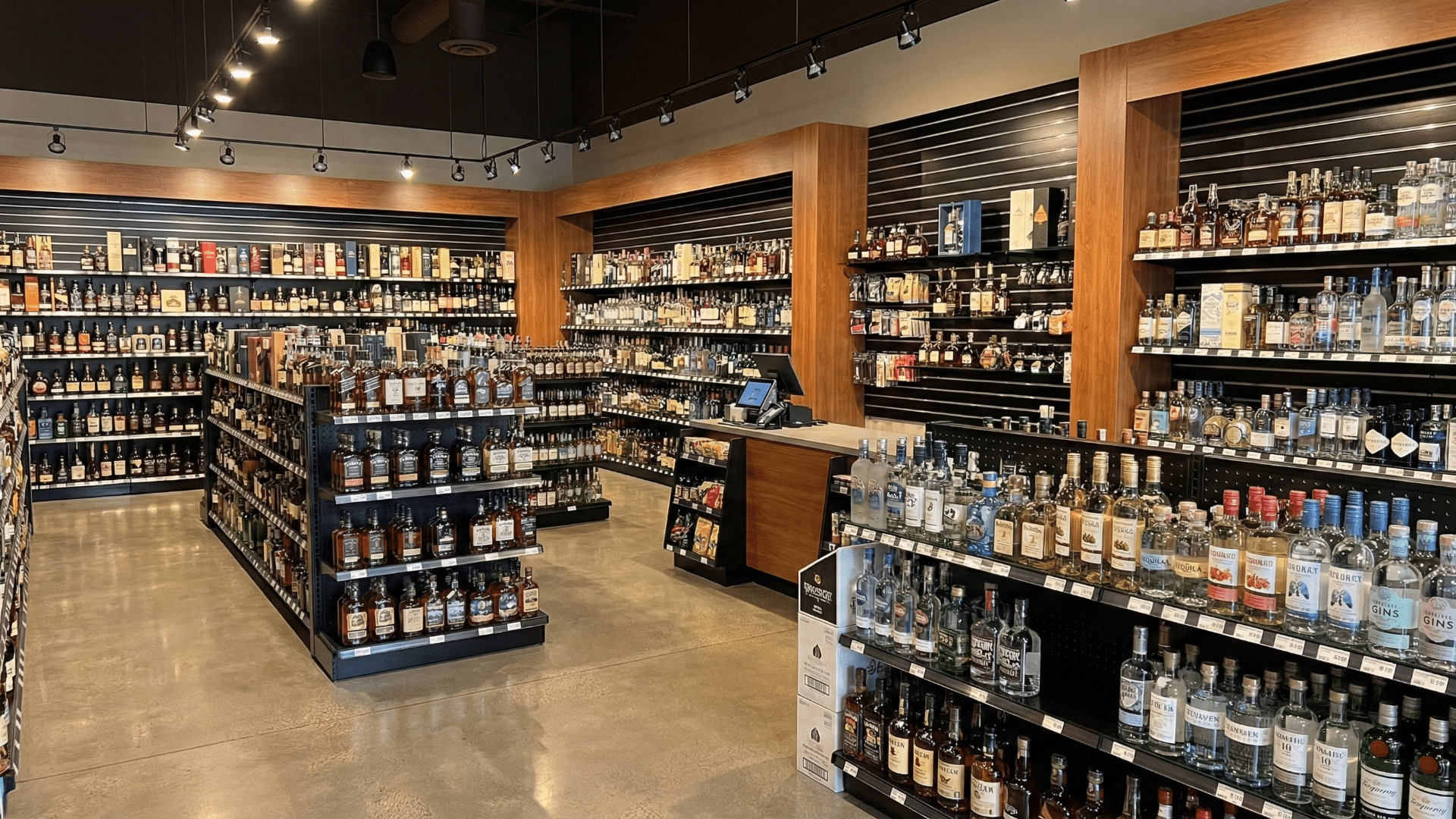
A liquor store's visual merchandising directly drives revenue. Customers often don't walk in knowing exactly what they want — the right store layout, end cap displays, and organized shelving guide them toward higher-margin products and impulse purchases. Placing premium spirits at eye level, creating themed seasonal displays, and positioning mixers and accessories adjacent to spirits significantly increases average basket size. DISPLAYARAMA's free 2D store layout service can help you plan your fixture configuration before you spend a dollar on shelving.
The classic grid layout — straight shelving runs in the middle with perimeter wall shelving and refrigeration at the back — is the proven standard in liquor retail. It creates easy navigation, maximizes shelf space per square foot, and gets customers past your full selection before they reach the coolers. End caps at every aisle termination are your highest-converting promotional real estate and should always feature high-margin or seasonal items.
| Fixture / Component | Estimated Cost |
|---|---|
| Gondola / Aisle Shelving (Full Store) | $10,000 – $30,000 |
| Wall Shelving (Perimeter) | $2,000 – $8,000 |
| Wine Racks & Display Units | $2,000 – $8,000 |
| Checkout Counter / Cash Wrap | $800 – $3,500 |
| Signage (Interior + Exterior) | $1,000 – $5,000 |
| Lighting Upgrades | $1,000 – $5,000 |
| Age Verification ID Scanner | $200 – $800 |
| Total Fixtures & Store Setup | $17,000 – $60,300 |
Wine display deserves dedicated attention. Premium wine customers expect organized, labeled sections — by region, varietal, or price tier — and will bypass a disorganized wine section entirely. A well-organized wine area with proper shelving and clear signage is one of the highest-return investments in a full-service liquor store.
Your checkout counter is the last touch point of every transaction — and in a liquor store, it's also where age verification happens. A professional, organized counter communicates that you run a tight, compliant operation, which matters to customers and to your ABC renewal inspector alike.
DISPLAYARAMA has been supplying retail fixtures to specialty stores since 1980. We carry gondola shelving, wall shelving, wine display units, checkout counters, and slatwall systems — everything needed to build a liquor store that looks professional and moves product efficiently.
Our team can help you plan your layout and select the right fixture combination for your space and budget. Call us at 1-800-292-5227 or get your free layout plan below.
Get My Free Store Fixture Layout Plan →Technology, Insurance & Operations
Running a liquor store requires a POS system purpose-built for alcohol retail, not a generic system. You need integrated age verification to prevent underage sales (a single violation can cost your license), inventory tracking with case-break management (since beer is purchased by the case but sold by the six-pack or single), automated reordering tied to distributor pricing, and compliance reporting for your state ABC board. Platforms like BottlePOS, Cheers POS, WinePOS, and similar alcohol-specific systems are built for this environment. Monthly software costs typically run $50–$200, with hardware running $500–$2,000 upfront.
Insurance for a liquor store requires specific coverage for dram shop liability — a legal exposure unique to alcohol retailers in most states. Dram shop laws can hold a liquor store liable if a customer purchases alcohol and subsequently causes injury or death to a third party. General liability alone is insufficient; you need liquor liability coverage on top of your property and general liability policies. Annual premiums for a full insurance package typically run $2,000–$6,000 for a small-to-mid-size store.
Dram shop liability is real: Most states have dram shop statutes that extend liability to retailers who sell to visibly intoxicated individuals or minors who later cause harm. Staff training on responsible alcohol service — including ID verification protocols — is not just good practice, it's your first line of legal defense. Many carriers require documented training programs as a condition of coverage.
| Technology / Insurance / Operations | Estimated Cost |
|---|---|
| Liquor-Specific POS (Hardware + Setup) | $500 – $2,000 |
| POS Monthly Software Fee | $50 – $200/mo |
| General Liability + Dram Shop Insurance (Annual) | $2,000 – $6,000 |
| Property Insurance (Annual) | $1,000 – $3,000 |
| Website / Online Presence Setup | $500 – $3,000 |
| Staff Responsible Alcohol Service Training | $200 – $1,000 |
| Utilities (Monthly Average) | $500 – $2,500/mo |
| Marketing / Grand Opening | $1,000 – $5,000 |
| First-Year Technology + Operations | $12,750 – $45,400+ |
Total Startup Cost Summary
When all categories are totaled, opening a liquor store in 2026 typically requires $50,000–$100,000 for a lean neighborhood store in a lower-cost market with a moderate license fee, and $150,000–$250,000 for a well-stocked mid-size store with proper refrigeration, fixtures, and working capital. High-cost license markets (California, New York, major metros) push significantly higher.
| Expense Category | Estimated Range |
|---|---|
| Liquor License, Permits & Legal | $1,200 – $22,550 |
| First Month's Rent + Security Deposit | $3,000 – $24,000 |
| Leasehold Improvements / Buildout | $15,000 – $75,000 |
| Equipment & Refrigeration | $26,500 – $123,000 |
| Opening Inventory | $33,500 – $109,000 |
| Fixtures & Store Setup | $17,000 – $60,300 |
| Technology & Operations (Year 1) | $12,750 – $45,400 |
| Working Capital Reserve (3–6 months) | $15,000 – $50,000 |
| Total Estimated Startup Investment | $123,950 – $509,250 |
Don't underestimate working capital. Most new liquor stores take 12–18 months to reach consistent profitability. Fixed costs — rent, insurance, license renewals, staff wages — don't pause while you're building a customer base. Having 3–6 months of operating expenses in reserve when you open is the difference between surviving a slow first quarter and being forced to close with full shelves and a valid license.
How to Maximize Revenue
In a market where overall alcohol volume is softening, the liquor store operators who are growing aren't necessarily selling more bottles — they're selling smarter. Higher-margin products, better customer relationships, and expanded service offerings are what separate the stores posting strong numbers from those watching margins compress. Here's how the best operators are building profitable, durable businesses.
Lead With Premium Spirits
Spirits carry the best margins in the store — 25–45% gross — and premium spirits carry even better margins than standard SKUs. Train staff to confidently recommend step-ups from well brands to premium alternatives. A customer buying a $22 bottle of bourbon can often be guided to a $38 option they'll prefer, with meaningfully better margin on your end.
Embrace RTDs & Emerging Categories
Spirit-based ready-to-drink cocktails grew 20% in revenue in 2025 despite broad category declines. Hemp-infused beverages are a fast-emerging complement in states where legal. These categories attract younger shoppers and carry better margins than domestic beer. Dedicate visible cooler space to them now, before competitors catch on.
Negotiate Volume Pricing
Distributor pricing is not fixed — most suppliers have tiered pricing structures based on case volumes, promotional credits, and time-limited deals. Operators who understand how to buy strategically from distributors routinely achieve cost advantages their competitors don't. Study the pricing structures and build your inventory calendar around promotions.
Build a Customer Loyalty Program
Liquor store customers are habitual. A simple points-based loyalty program builds switching costs and gives you purchase history data to personalize promotions. Customers enrolled in loyalty programs spend measurably more per visit and return significantly more often than non-enrolled customers.
Host Tastings & Events
In-store tastings — wine flights, whiskey pours, spirit brand nights — are low-cost, high-conversion events. Customers who taste a product and enjoy it buy it on the spot at a dramatically higher rate than those who don't. Check your state's tasting permit requirements and build events into your marketing calendar.
Offer Online Ordering & Local Delivery
Online ordering with in-store pickup or local delivery expands your reach beyond walk-in traffic and captures customers who won't make a special trip. Third-party delivery platforms charge 15–30% commission — building your own ordering channel eventually creates a better margin profile and a customer relationship you own.
Why Your Fixtures Matter
In a liquor store, your fixtures are doing more than holding bottles — they're actively guiding purchasing decisions. Customers browsing spirits shelves make choices based on what's at eye level, what's in a featured display, and what's positioned next to complementary products. A store with well-organized, well-lit shelving and purposeful displays earns more per customer visit than an equally stocked store with cluttered, poorly configured shelving.
Slow-moving inventory sitting on the shelf for six months isn't breaking even — it's accumulating carrying costs, tying up capital, and occupying shelf space that should be generating turns. The right fixture configuration, with flexible shelving and clear end cap real estate, makes it easier to rotate, promote, and move inventory efficiently. Prioritize these when setting up your floor:
- Gondola shelving runs organized by category — spirits by type and price tier, wine by region or varietal, beer by domestic/craft/import — so customers can navigate quickly
- Eye-level placement for your highest-margin SKUs in each category — premium spirits at eye level consistently outsell the same bottles on bottom or top shelves
- End cap displays at every aisle termination for seasonal promotions, new arrivals, and bundled pairings — your highest-converting real estate on the floor
- A dedicated wine display area with organized, labeled sections — wine customers are methodical and will walk past a disorganized section rather than ask for help
- A professional checkout counter with ID scanner and visible age verification signage — compliance starts at the point of sale
DISPLAYARAMA has been outfitting specialty retail stores with professional-grade display fixtures since 1980. We carry gondola shelving, wall shelving, wine display units, checkout counters, slatwall systems, and more — everything you need to build a liquor store that looks the part and drives sales from day one.
Our team can help you plan your store layout and select the right combination of fixtures for your square footage and budget. Bulk pricing is available for full store buildouts.
Get My Free Store Fixture Layout Plan →Ready to Fixture Your Liquor Store?
If you're opening a liquor store and need to source shelving and fixtures, start with DISPLAYARAMA's free 2D store layout service — a no-cost resource where our team creates a professional floor plan with specific fixture recommendations for your space. It saves hours of guesswork and gives you a clear picture of your fixture investment before you commit to anything. Request your free layout plan here.
Gondola Shelving
Double-sided freestanding gondola units for your store's interior aisles — the backbone of any liquor store floor, organized by category for easy customer navigation and efficient restocking.
Wall Shelving
Perimeter wall shelving for spirits, wine, and specialty categories — maximizing your store's vertical display space along every wall for a full, well-stocked presentation.
Wine Display Units & Racks
Dedicated wine display fixtures with organized sections by region, varietal, or price tier — the format wine customers expect and the environment that converts browsers into buyers.
Checkout Counters
Professional cash wrap counters built for high-volume retail — organized, compliant-ready, and designed to handle age verification, transaction flow, and point-of-sale hardware efficiently.
Slatwall Systems
Flexible slatwall panels for specialty sections, seasonal promotions, and accessory displays — reconfigurable without new hardware as your product mix and promotional calendar evolve.
Bulk Pricing Available
Outfitting a full store? DISPLAYARAMA offers bulk pricing on shelving and fixtures. The more you order, the more you save. Call 1-800-292-5227 for a custom quote.
DISPLAYARAMA's free 2D store layout service gives you a professional floor plan with specific fixture recommendations for your liquor store — at no cost. It's designed to save you hours of guesswork and give you a clear picture of your fixture investment before you commit. We've been helping specialty retailers design their stores since 1980, and we offer bulk pricing for owners outfitting a full floor.
Submit your space dimensions and store type and we'll put together a custom layout plan with exactly the fixtures that will work for your liquor store.
Get My Free Store Fixture Layout Plan →