
How Much Does It Cost To Open a Music Instrument Store?
The U.S. musical instrument and supplies store industry is projected to reach $6.6 billion in revenue in 2026, continuing a modest but steady growth trajectory fueled by a post-pandemic revival in home music-making, a boom in home studios, surging live performance culture, and a steady stream of new students entering music education at every age. Over 61% of instrument purchases still happen in physical stores, according to market data — a testament to what every musician already knows: you cannot buy an instrument you haven't played.
That fundamental "play before you pay" dynamic is the independent music store's greatest competitive advantage. No algorithm can replicate the experience of picking up a guitar and feeling whether it's the right one. No product page conveys the action of a piano key or the resonance of a violin. The independent music store, staffed by musicians who genuinely know their instruments, serves a customer need that Sweetwater and Amazon can only partially address — and that's why well-run neighborhood music stores continue to thrive even as major chains like Sam Ash have struggled to adapt.
But opening a music instrument store carries real financial complexity. Inventory is the largest cost driver and the highest inventory risk — instruments are high-unit-price, slow-turning items that require careful buying discipline. The store environment requires acoustic treatment and specialized display infrastructure. And lessons and repair services, while not required, are the revenue multipliers that turn a surviving music store into a genuinely profitable community institution. This guide breaks down every major cost category for opening a music instrument store in 2026.
Defining Your Store Concept
Before setting a budget, the most important decision you'll make is what kind of music store you're opening. The startup capital requirement and ongoing economics vary enormously depending on your concept. A niche/specialty store focused on one instrument family — guitars, orchestral strings, pianos — requires a smaller footprint, more targeted inventory, and staff expertise in a defined area. A full-line music store covering guitars, keyboards, band instruments, drums, and pro audio requires 2,500–5,000 sq ft, significantly deeper inventory, and a much larger upfront investment. A lesson-and-retail hybrid — the community music center model — builds recurring lesson revenue alongside retail and is increasingly the most resilient format for independent operators.
The collapse of Sam Ash's brick-and-mortar network in 2024 and the consolidation pressure from dominant online retailers like Sweetwater have clarified the competitive landscape: independent music stores that compete purely on product price are increasingly at a disadvantage. Those that survive and thrive do so by offering services, expertise, community, and the hands-on experience that online retail cannot provide. Build your concept around your differentiators before you choose your square footage.
Lessons are not optional — they're strategic: Music stores with active lesson programs generate recurring, high-margin revenue that stabilizes cash flow during slow retail months. A store with 20 students at $120/month per student earns $2,400/month in near-pure-margin revenue before selling a single instrument. Budget for lesson rooms from day one, not as an afterthought.
| Store Concept | Estimated Startup Range |
|---|---|
| Niche / Single-Category Specialty Store | $30,000 – $80,000 |
| Mid-Size Independent (Multi-Category) | $80,000 – $200,000 |
| Full-Line Community Music Center | $150,000 – $400,000 |
| Large-Format Full-Service Retailer | $300,000 – $500,000+ |
| Key Differentiator for Independent Stores | Lessons + Repair + Community |
The remainder of this guide covers the mid-size independent and community music center model — the most complete and most common startup scenario. Niche specialty stores require proportionally lower investment in most categories.
Licenses, Permits & Business Formation
A music instrument store has a relatively straightforward licensing footprint compared to categories like liquor or pawn. There's no category-specific federal license required for selling instruments. Your primary requirements are standard business formation and retail operating permits. The most important document to obtain early is a resale certificate (seller's permit), which allows you to purchase inventory from manufacturers and distributors without paying sales tax on goods you'll resell — every wholesale account will require this before they open a buying relationship with you.
If you plan to offer instrument repair services — which is strongly recommended — check whether your state requires a service business license separate from your retail license. In some states, repair and alteration services require an additional filing. If you offer music lessons, confirm whether your state classifies lesson-giving as a licensed educational service or simply a standard service offering. Most states treat private music lessons as the latter, but regulations vary.
Used instrument buying requires due diligence: If your store buys used instruments from the public — a common and profitable practice — research your local secondhand dealer permit requirements. Many municipalities require registration as a secondhand dealer, with recordkeeping obligations for items purchased, similar to pawn shops. Check with your city clerk before you make your first used buy.
| License / Permit / Filing | Cost Range |
|---|---|
| LLC or Corporation Formation | $50 – $500 |
| General Business License | $50 – $500/yr |
| Seller's Permit / Resale Certificate | $0 – $50 |
| Zoning / Occupancy Permit | $100 – $1,000 |
| Signage Permit | $100 – $500 |
| Secondhand Dealer Permit (if buying used) | $50 – $500/yr |
| Service / Repair License (if applicable by state) | $50 – $300/yr |
| Attorney / Legal Consultation | $500 – $2,000 |
| Estimated Total | $900 – $5,350 |
Location & Rent
Location strategy for a music store differs from most retail categories. You don't need the highest foot traffic on the busiest street — you need to be findable, accessible, and positioned near your target customer. A store near schools, community music programs, churches, performing arts venues, or dense residential neighborhoods generates more relevant organic traffic than the same store on a premium retail corridor serving the wrong demographic. Music store customers will travel to find you — but only if they know you exist.
Space requirements depend heavily on your concept. A niche guitar shop can operate in 800–1,500 sq ft. A mid-size multi-category store needs 2,000–3,500 sq ft. A full community music center with multiple lesson rooms, a repair shop, and a full retail floor needs 3,000–6,000 sq ft or more. If you include lesson rooms, budget for acoustic isolation between rooms — noise bleed between lessons is both a customer service problem and a potential lease violation issue if your landlord receives complaints.
Check for sound restrictions before signing: Music stores generate noise — instruments being tested, lesson rooms in use, repair equipment running. Before committing to any retail space, verify with your landlord and local zoning authority that musical instrument retail and lessons are permitted. Some shopping centers and mixed-use buildings have noise ordinances that create real operational problems for music stores.
| Store Size / Location Type | Monthly Rent |
|---|---|
| Niche / small (800–1,500 sq ft) | $1,200 – $4,000 |
| Mid-size (2,000–3,500 sq ft) | $3,000 – $8,000 |
| Full community center (3,500–6,000 sq ft) | $5,000 – $15,000+ |
| First-Year Rent Cost (Mid-Size Estimate) | $36,000 – $96,000 |
Buildout for a music store includes standard retail improvements plus music-specific elements: acoustic treatment and soundproofing for lesson rooms ($5,000–$20,000 depending on room count), wall-mounted instrument display systems, electrical work for amplifier demonstrations, and flooring suited to instrument traffic. Total buildout typically runs $20,000–$80,000.
Opening Inventory
Inventory is simultaneously the largest cost and the highest risk in opening a music store. Instruments are expensive, slow-turning, and highly tactile — customers want to play everything before they buy, which means you need physical product on the floor across a range of price points. Gross margins on new instruments typically run 30–50%, which is solid, but instruments are not consumables. A guitar that sits on a stand for 14 months is costing you carrying costs, floor space, and capital. Buying discipline is the most critical skill a music store owner develops.
Guitars & Stringed Instruments
Guitars are the anchor category of most music stores — entry-level acoustics, mid-range electrics, and a few premium pieces to anchor the high end of the floor. Budget $15,000–$40,000 for a solid guitar selection covering acoustic, electric, and bass across beginner through intermediate price points.
Keyboards, Pianos & Electronic Instruments
Keyboards and digital pianos serve a massive beginner market and carry good margins. Note that acoustic pianos require significant floor space, are difficult to demonstrate on a regular retail floor, and carry substantial delivery and tuning costs — most independent stores focus on digital pianos and portable keyboards rather than grand or upright acoustics. Budget $10,000–$30,000 for a keyboard and digital piano selection.
Band & Orchestral Instruments
If you're targeting school band programs — one of the most reliable revenue streams in music retail — you'll need a solid selection of beginner brass, woodwind, and orchestral string instruments, plus a rental program. Budget $10,000–$30,000 for band instrument opening inventory.
Accessories, Strings & Consumables
Accessories — strings, picks, reeds, drumheads, cables, cases, straps, stands, tuners — are the highest-margin, fastest-turning category in the store. These consumables bring customers back regularly and carry margins of 50–70% or better. Budget $5,000–$15,000 for a deep opening accessories selection; this is where you earn reliable repeat revenue.
| Inventory Category | Estimated Cost |
|---|---|
| Guitars & Stringed Instruments | $15,000 – $40,000 |
| Keyboards, Digital Pianos & Synths | $10,000 – $30,000 |
| Band & Orchestral Instruments | $10,000 – $30,000 |
| Drums & Percussion | $5,000 – $20,000 |
| Amplifiers & Pro Audio Equipment | $5,000 – $20,000 |
| Accessories, Strings & Consumables | $5,000 – $15,000 |
| Sheet Music & Method Books | $1,000 – $4,000 |
| Total Opening Inventory | $51,000 – $159,000 |
Start a rental program for school instruments: Band instrument rental programs — where you rent beginner instruments to students with an option to apply rental payments toward purchase — generate consistent monthly recurring revenue and build lasting relationships with school band programs. Contact your local school band directors before opening day. This relationship is often one of the most valuable you'll build.
Fixtures, Display Systems & Store Setup
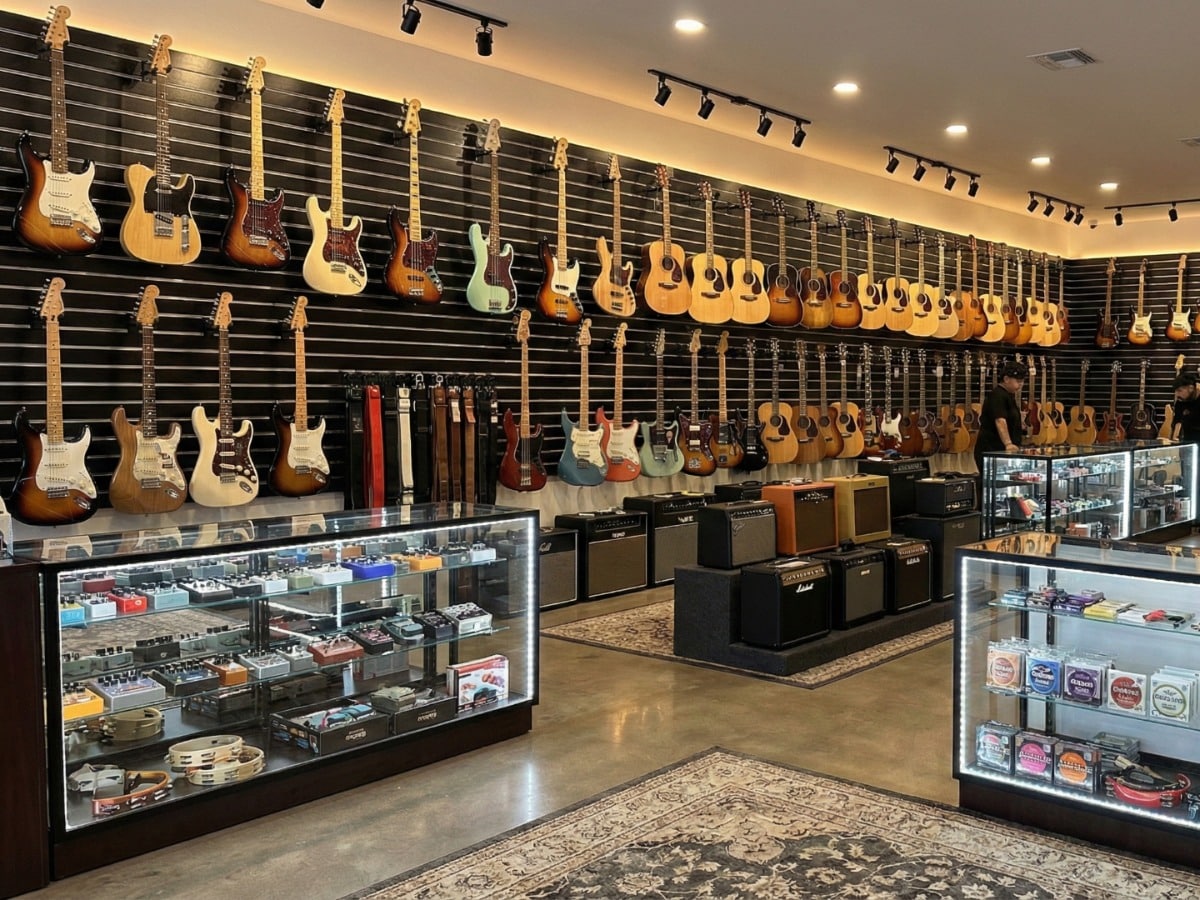
A music store's display environment is genuinely unlike any other retail format. Guitars need to hang on wall mounts or stand in display racks at the right height for customers to grab, play, and replace without staff assistance. Keyboards need to be set up on stands with proper connections and headphones so customers can test them privately. Drums need floor space and a clear path around the kit. Sheet music needs browser-style display racks. Accessories need organized, labeled wall systems or pegboard displays that customers can navigate quickly. DISPLAYARAMA's free 2D store layout service can help you plan your entire fixture configuration before you spend a dollar on shelving or display systems.
The instrument display system is the most unique fixture requirement in a music store. Wall-mounted guitar hangers, floor-standing instrument stands, and secure wall display systems need to hold instruments safely while keeping them accessible for customers to pick up and play. An instrument that can't be easily tried won't be bought — the entire display philosophy of a music store is built around accessibility and playability.
| Fixture / Component | Estimated Cost |
|---|---|
| Wall Guitar Display System (Hangers + Rails) | $1,500 – $6,000 |
| Floor Instrument Stands (Multi-Unit) | $500 – $3,000 |
| Keyboard / Piano Display Stands | $500 – $2,000 |
| Accessory Display (Slatwall, Pegboard, Bins) | $2,000 – $8,000 |
| Sheet Music Display Racks | $500 – $2,000 |
| Display Cases (High-Value Guitars, Vintage, Accessories) | $1,000 – $5,000 |
| Checkout Counter / Cash Wrap | $800 – $3,500 |
| Acoustic Treatment (Lesson Rooms) | $5,000 – $20,000 |
| Signage (Interior Department + Exterior) | $1,000 – $5,000 |
| Amplifier Demo Stations (Wiring + Setup) | $500 – $2,500 |
| Total Fixtures & Store Setup | $13,300 – $57,000 |
Display cases deserve special mention for a music store. Premium guitars, vintage instruments, limited-edition releases, and higher-ticket accessories — quality pedals, high-end tuners, boutique picks — benefit from secure, well-lit display case presentation. A locking glass case communicates that these items are special, which reinforces the price point and discourages casual handling of instruments that require careful treatment.
Acoustic treatment for lesson rooms is a non-negotiable if you plan to offer lessons. Basic acoustic panel installation with proper sound isolation between rooms runs $3,000–$8,000 per room depending on room size and construction. This is a genuine startup cost, not an afterthought — opening lesson rooms without proper acoustic isolation creates noise complaints from neighboring tenants that can threaten your lease.
DISPLAYARAMA has been supplying retail fixtures to specialty stores since 1980. We carry slatwall systems, display cases, checkout counters, pegboard systems, and wall display solutions — everything needed to build a music store environment where instruments are accessible, organized, and presented at their best.
Our team can help you plan your store layout and select the right fixture combination for your space. Call us at 1-800-292-5227 or get your free layout plan below.
Get My Free Store Fixture Layout Plan →Technology, Repair Shop & Operations
A music store's technology stack needs to handle a few things general retail POS systems do poorly: instrument rental program management, consignment tracking for used gear taken in on consignment, serial number tracking for used instrument purchases, and school band account management. Platforms like Music Shop 360, AIMsi (designed specifically for music retail), and Lightspeed Retail all handle music store-specific workflows. Budget $500–$2,500 for hardware and $100–$300/month for software depending on the platform.
A repair shop is one of the highest-return services you can add to a music store. The global instrument repair market was valued at $2.45 billion in 2024 and is growing at a 5.1% CAGR through 2033, driven by the growing installed base of instruments in circulation. Repair generates recurring revenue, high margins, and drives retail attachment (a guitar brought in for a setup often leaves with new strings, a strap, or a case). A basic repair bench setup — tools, parts bins, a workbench — runs $3,000–$10,000. The revenue a skilled repair tech generates can justify their salary independently of retail.
Staff knowledge is your core competitive advantage: The single biggest competitive differentiator for an independent music store against online retailers is a staff of musicians who know what they're talking about. Customers buying their first guitar, parents outfitting a child for band, or a working musician looking for a specific pickup replacement all need informed guidance. Hire musicians, pay them fairly, and invest in their ongoing product knowledge.
| Technology / Repair / Operations | Estimated Cost |
|---|---|
| Music Retail POS (Hardware + Setup) | $500 – $2,500 |
| POS Monthly Software Fee | $100 – $300/mo |
| Repair Shop Setup (Tools, Workbench, Parts) | $3,000 – $10,000 |
| Staff Wages (Monthly — Small Store, 2–4 Staff) | $6,000 – $18,000/mo |
| Business Insurance (Annual) | $2,000 – $6,000 |
| Security System / Cameras | $1,000 – $4,000 |
| Website / Online Presence | $500 – $2,500 |
| Marketing / Grand Opening / Social Media | $2,000 – $8,000 |
| Utilities (Monthly Average) | $500 – $2,000/mo |
| First-Year Technology + Operations | $93,600 – $291,600+ |
Total Startup Cost Summary
When all categories are totaled, opening a music instrument store in 2026 typically requires $50,000–$100,000 for a niche specialty or small independent store and $120,000–$250,000 for a properly equipped mid-size community music store with lesson rooms, a repair bench, and a comprehensive opening inventory. A full-line community music center pushing 4,000+ sq ft can approach $400,000 or more.
| Expense Category | Estimated Range |
|---|---|
| Licenses, Permits & Business Formation | $900 – $5,350 |
| First Month's Rent + Security Deposit | $3,000 – $24,000 |
| Leasehold Improvements / Buildout | $20,000 – $80,000 |
| Opening Inventory | $51,000 – $159,000 |
| Fixtures & Store Setup | $13,300 – $57,000 |
| Technology, POS & Repair Shop | $3,500 – $12,500 |
| Working Capital Reserve (3–6 months) | $20,000 – $75,000 |
| Total Estimated Startup Investment | $111,700 – $412,850 |
Plan for 14–24 months to profitability. Music stores build momentum slowly — school band relationships, lesson enrollment, and the reputation for repair quality all take time to establish. The stores that survive their first two years do so with adequate working capital, disciplined inventory buying (resisting the urge to fill every niche on opening day), and a lesson program that generates stable recurring revenue while retail finds its footing.
How to Maximize Revenue
The music stores that build lasting profitability aren't just instrument retailers — they're community music hubs with multiple revenue streams, recurring income, and deep local relationships that no national chain can displace. Here's how the best independent operators do it.
Build a Lesson Program First
Music lessons generate recurring revenue at margins far exceeding retail. A lesson room running 6 hours of lessons per day at $40/hour generates $240/day, $1,200/week, and over $60,000/year from a single room — primarily teacher-to-student revenue with minimal overhead. Lesson students also buy instruments, accessories, and method books from you regularly.
Establish School Band Relationships
School band programs are the most reliable institutional customer a music store can have. Contact band directors before you open, offer competitive rental program terms, and become the preferred vendor for local schools. A single school district rental program can generate $5,000–$20,000 per year in recurring revenue with strong conversion to retail sales as students progress.
Offer Expert Repair Services
The instrument repair market is growing at 5.1% CAGR and is deeply underserved in many markets. A skilled guitar tech or woodwind repair specialist brings customers in repeatedly — a musician whose guitar is set up perfectly by your shop becomes a loyal customer. Repair also creates natural upsell opportunities: a guitar in for a setup often leaves with new strings, upgraded tuners, or a better strap.
Double Down on Accessories
Strings, picks, reeds, drumheads, cables, and cases are the highest-margin fastest-turning products in the store. A musician buying a $400 guitar is an easy add-on for $20 in strings, a $30 tuner, and a $50 case — tripling the transaction value with accessories that carry 50–70% gross margins. Train every staff member to build the complete setup with every instrument sale.
Host In-Store Events & Clinics
Brand clinics, artist appearances, open mic nights, and student recitals build community while driving traffic and sales. A clinic hosted by a local working guitarist or a manufacturer brand rep draws engaged musicians into your store, exposes them to products they wouldn't have discovered otherwise, and builds the kind of loyalty that generates word-of-mouth for years.
Buy and Sell Used Instruments
Used instrument buying and selling generates margins of 50–150% on items purchased at estate sales, trade-ins, or from individual sellers. Used instruments also attract a price-sensitive customer segment that would otherwise buy online. A well-organized used section signals that your store is a living, active part of the local music community — not just a new-product showroom.
Why Your Fixtures Matter
In a music store, your display environment is the experience — and the experience is what drives the sale. A guitar hanging at the right height on a wall of well-organized instruments invites a customer to reach out and play it. The same guitar in a bin, or stored in its case, doesn't get played and doesn't get sold. The entire retail design philosophy of a music store is built around making instruments accessible, organized, and inviting to touch.
The stores that convert the most browsers to buyers are the ones where customers feel free to explore — pick up a guitar, sit down at a keyboard, try a pair of headphones — without feeling like they might break something or bother a salesperson. Your fixture system either enables or inhibits that freedom. Prioritize these when planning your floor:
- Wall guitar display systems with accessible hangers at reachable heights — every guitar should be easy to take down, play, and return without staff assistance
- Slatwall panels for accessories — organized by category (strings by instrument, picks by gauge, cables by type) so customers can find what they need independently
- Display cases for premium, vintage, or limited-edition instruments and high-value accessories — secure presentation that signals these items are special
- Keyboard demo stations with proper stands, connections, and headphone jacks — customers need to be able to test keyboards privately without generating noise throughout the store
- A clean, organized checkout counter that also displays impulse accessories — picks, tuners, strap locks, and capos at the register add meaningful average transaction value
DISPLAYARAMA has been outfitting specialty retail stores with professional-grade display fixtures since 1980. We carry slatwall systems, display cases, checkout counters, pegboard systems, and wall display solutions — everything you need to build a music store where instruments are accessible, organized, and presented in an environment that invites customers to play.
Our team can help you plan your store layout and select the right combination of fixtures for your square footage and concept. Bulk pricing available for full store buildouts.
Get My Free Store Fixture Layout Plan →Ready to Outfit Your Music Store?
If you're opening a music instrument store and need to source display systems and fixtures, start with DISPLAYARAMA's free 2D store layout service — a no-cost resource where our team creates a professional floor plan with specific fixture recommendations for your space. It saves hours of guesswork and gives you a clear picture of your fixture investment before you commit. Request your free layout plan here.
Slatwall Display Systems
Flexible slatwall panels for accessories, strings, picks, cables, and small instrument gear — organized by category, fully reconfigurable as your product mix evolves, with no permanent construction required.
Display Cases
Locking glass display cases for premium guitars, vintage instruments, fine accessories, and high-value gear — secure presentation that communicates quality and protects your most valuable inventory.
Checkout Counters
Professional cash wrap counters built for music retail — organized workspace for transactions, accessory display at the register, and POS hardware integration in a clean, welcoming environment.
Gondola Shelving
Gondola Shelving for high-density accessory merchandising — ideal for strings, picks, capos, tuners, and small parts organized by category so customers can browse and select independently.
Wall Display Solutions
Wall-mounted display systems for featured products, promotional sections, and brand spotlights — turning your perimeter walls into active merchandising real estate that drives discovery and impulse purchases.
Bulk Pricing Available
Outfitting a full store? DISPLAYARAMA offers bulk pricing on fixtures and display systems. The more you order, the more you save. Call 1-800-292-5227 for a custom quote.
DISPLAYARAMA's free 2D store layout service gives you a professional floor plan with specific fixture recommendations for your music store — at no cost. It's designed to save you hours of guesswork and give you a clear picture of your fixture investment before you commit. We've been helping specialty retailers design their stores since 1980, and we offer bulk pricing for owners outfitting a full floor.
Submit your space dimensions and store type and we'll put together a custom layout plan with exactly the fixtures that will work for your music instrument store.
Get My Free Store Fixture Layout Plan →