
How Much Does It Cost To Open a Sneaker Store?
The U.S. sneaker market was valued at $27.1 billion in 2025 and is projected to grow at a 4.76% CAGR through 2034 — but the real story is cultural, not just financial. Sneakers have completed their transformation from athletic equipment to full-blown cultural currency. They sit at the intersection of sport, fashion, streetwear, collecting, and investment in a way no other product category quite matches. Fifty-seven percent of millennials and Gen Z report wearing sneakers daily for non-athletic purposes, driven by the athleisure trend that has permanently normalized performance footwear as everyday dress. That cultural depth is what makes a well-executed sneaker boutique into something more than a shoe store — it becomes a community institution.
The secondary market adds another layer entirely. The U.S. sneaker resale market is projected to reach $6 billion by end of 2025, with platforms like StockX — valued at $3.8 billion — and GOAT — valued at $3.7 billion — having built sophisticated, global infrastructure around the authentication and trading of sought-after footwear. Nike and Jordan Brand models drove the resale market for years, but the landscape is shifting: ASICS recorded 589% trade growth on StockX in the first half of 2024 and followed it with 71% growth in H1 2025, with the Gel-1130 becoming StockX's best-selling sneaker of the year. Anta posted 1,901% trade growth in 2024. The independent sneaker store that understands these brand heat cycles and stocks accordingly has an advantage the algorithm alone cannot replicate.
This guide gives you a complete breakdown of what it costs to open a sneaker store in 2026 — from the initial concept decision between retail-new, consignment, and resale models to every expense category, the margin reality of each inventory type, and the store design principles that turn browsers into buyers.
Retail New vs. Consignment vs. Resale — Choosing Your Model
Before setting a budget, the most important decision is which type of sneaker business you're building. The three primary models carry different inventory economics, customer bases, and capital requirements — and choosing the wrong one for your market and skills is the leading cause of early failure in sneaker retail.
A retail-new store carries brand-new footwear from authorized wholesale accounts — Nike, Adidas, New Balance, ASICS, and others — at MSRP with standard retail margins. Getting wholesale authorization from the major brands is genuinely difficult: Nike in particular has tightened its authorized dealer network significantly, and most new independents cannot access Nike wholesale accounts without a track record. Gross margins on new footwear run 40–50% on non-Nike brands and can be lower on premium lines. A consignment boutique takes in used and deadstock sneakers from sellers, authenticates them, displays them, and splits the sale price — typically 30–40% to the store, 60–70% to the seller. This model requires essentially no upfront inventory investment but demands rigorous authentication and strong community trust. A resale store buys sneakers outright — from individuals, liquidation, or wholesale — and resells them at a markup. Resale margins on general releases have compressed to 8–15%, but limited collabs and high-demand releases still command 15–25% or more. Many successful independent operators run a hybrid: consignment for high-value pairs, outright purchase for volume, and new authorized product for in-store legitimacy.
Nike wholesale access is genuinely hard for new independents: Nike's authorized retailer program is selective and favors stores with proven retail track records. Many successful sneaker boutiques open without Nike wholesale authorization, building their identity around other brands — New Balance, ASICS, New Balance, Salomon, On Running — before seeking Nike access as the business matures. Don't let Nike authorization be a prerequisite for opening day.
| Store Model | Inventory Margin | Startup Range |
|---|---|---|
| Retail-New (Authorized Wholesale) | 40–50% gross | $80,000 – $250,000 |
| Consignment Boutique | 30–40% of sale | $30,000 – $100,000 |
| Resale / Hybrid (Buy + Consign) | 8–25% per pair | $50,000 – $150,000 |
| Small Basic / Online + Pop-Up | Variable | $10,000 – $40,000 |
| Best Independent Model in 2026 | Consignment + Curated Resale Hybrid | |
The consignment-and-resale hybrid has proven most resilient for independent operators in the current market. It eliminates large upfront inventory risk, builds community trust through the seller relationship, and allows the store to carry sought-after pairs that authorized retail channels never see — including limited drops, rare colorways, and collaborations that are only available on the secondary market.
Licenses, Permits & Business Formation
A sneaker store's licensing footprint is relatively straightforward for standard retail operations. Business formation, a general retail license, and a resale certificate are the core requirements. Your resale certificate is essential before approaching any wholesale supplier or brand distributor, since it allows you to purchase inventory without paying sales tax on goods you'll resell.
If your store buys used sneakers from individuals — standard practice for any consignment or resale operation — research your local secondhand dealer permit requirements. Many municipalities require secondhand dealer registration with recordkeeping obligations for used goods purchased, similar to pawn shops. This applies even when the transactions are sneakers rather than electronics or jewelry. Check with your city's licensing office before you make your first consignment or buy-outright transaction.
Authentication is not a regulated activity — there is no government license required to authenticate sneakers — but it is a reputational and legal liability matter. Selling a counterfeit as authentic exposes you to civil and potentially criminal liability. Build your authentication practices and policies before you open, and train every staff member on them.
| License / Permit / Filing | Cost Range |
|---|---|
| LLC or Corporation Formation | $50 – $500 |
| General Business License | $50 – $500/yr |
| Seller's Permit / Resale Certificate | $0 – $50 |
| Zoning / Occupancy Permit | $100 – $1,000 |
| Signage Permit | $100 – $500 |
| Secondhand Dealer Permit (if buying used) | $50 – $500/yr |
| Trademark / Brand Consultation (optional) | $500 – $2,000 |
| Attorney / Legal Consultation | $500 – $2,000 |
| Estimated Total | $1,350 – $7,050 |
Consignment agreements protect both parties: If you operate a consignment model, a written consignment agreement with every seller is not optional — it's your protection. The agreement should specify the split, the display period, the authentication policy, the liability for loss or damage, and the return process. Have an attorney review your template before using it.
Location & Rent
Sneaker store location strategy is driven by one overriding principle: proximity to the culture. Sneaker boutiques thrive in youth-oriented urban districts, near college campuses, in neighborhoods with strong streetwear and creative communities, and in shopping areas that attract the specific demographic most engaged with sneaker culture — generally 16–40, fashion-aware, and willing to travel for the right store. A sneaker boutique on the right block in the right neighborhood builds organic street-level credibility that no marketing budget can manufacture. The wrong location, however well-designed, simply doesn't attract the culture.
High foot traffic is valuable, but culturally appropriate foot traffic is more valuable. A sneaker boutique in a busy tourist mall serving an older demographic will underperform compared to the same store on a block that skateboarders, artists, and college students pass daily. Research your target customer's actual movement patterns — where they eat, shop, and hang out — before selecting a location.
A typical independent sneaker boutique operates in 600–1,500 square feet. The boutique format intentionally avoids the big-box footwear experience — intimate, curated, knowledgeable — and that philosophy extends to space. A smaller, well-designed boutique with a perfectly chosen selection consistently outperforms a large store with undifferentiated inventory.
| Location Type | Monthly Rent |
|---|---|
| Small boutique — neighborhood / secondary market | $1,500 – $4,000 |
| Mid-size boutique — urban / college area | $3,000 – $8,000 |
| Prime urban street location | $6,000 – $15,000+ |
| Mall inline / shopping center | $3,500 – $10,000+ |
| First-Year Rent (Mid-Size Urban Estimate) | $36,000 – $96,000 |
Buildout costs for a sneaker boutique vary more than most retail categories because the store environment is part of the brand proposition. A basic functional buildout runs $15,000–$40,000. A premium boutique environment with custom shelving, immersive lighting, a signature aesthetic, and high-end finishes can reach $60,000–$100,000. The level of investment should match the price point and positioning of the product you're selling.
Opening Inventory
Inventory strategy is the most consequential financial decision in opening a sneaker store — and the area where the difference between a surviving and thriving business is most visible. The sneaker buyer in 2026 is extraordinarily well-informed: they know current resale prices, they follow brand heat cycles, and they know immediately whether a store is stocking interesting product or just repackaging what they can already find at Foot Locker. Curation is the entire competitive advantage of an independent boutique. Your opening inventory needs to reflect a clear point of view about which brands and models you believe in, not a defensive attempt to cover every category.
New Footwear (Authorized Wholesale)
If you have authorized wholesale accounts, new footwear is your traffic driver and your legitimacy signal. Gross margins run 40–50% on most brands. Nike carries the most brand recognition but is the hardest to access; New Balance, ASICS, Salomon, On Running, and New Balance are all accessible to new independent retailers and represent the brands with the strongest current secondary market heat among collectors. Budget $20,000–$60,000 for a curated new footwear opening inventory.
Consignment & Resale Inventory
For a consignment or hybrid model, your opening "inventory" is partly the relationships you've built before day one — sellers who trust you enough to consign their pairs to your floor. For outright resale purchases, budget $10,000–$30,000 for an opening buy-in across well-researched pairs with strong demand signals. Avoid speculative hype-only pairs as an opening inventory position; they're volatile and illiquid if the heat fades.
Accessories & Sneaker Care (High Margin, Fast Turn)
Sneaker cleaning kits, premium laces, crease protectors, sneaker shields, storage solutions, and deodorizers are high-margin, fast-turning products that complement every footwear transaction. A customer buying a $200 pair who also picks up a $30 cleaning kit and $15 lace pack adds 22% to the transaction at near-pure margin. Budget $3,000–$8,000 for a well-curated accessories opening section.
| Inventory Category | Margin | Opening Budget |
|---|---|---|
| New Footwear (Authorized Wholesale) | 40–50% | $20,000 – $60,000 |
| Consignment Pairs (Seller-Owned) | 30–40% of sale | $0 upfront |
| Resale / Bought-Outright | 8–25% per pair | $10,000 – $30,000 |
| Accessories & Sneaker Care | 45–65% | $3,000 – $8,000 |
| Apparel / Streetwear (optional) | 50–60% | $3,000 – $10,000 |
| Total Opening Inventory Investment | $36,000 – $108,000 |
The resale margin reality has changed: Nike Dunk general releases that once guaranteed easy premiums now carry 8–15% margins due to market saturation — Nike itself cut production on limited Jordan releases by 35% in an attempt to restore exclusivity. Top volume resellers today make $20–$25 per pair on 50–100+ pairs monthly, not $150 per pair on 10. Build your inventory around brands with real current heat, not nostalgia for the 2020–2021 premium environment.
Fixtures, Display Systems & Store Design
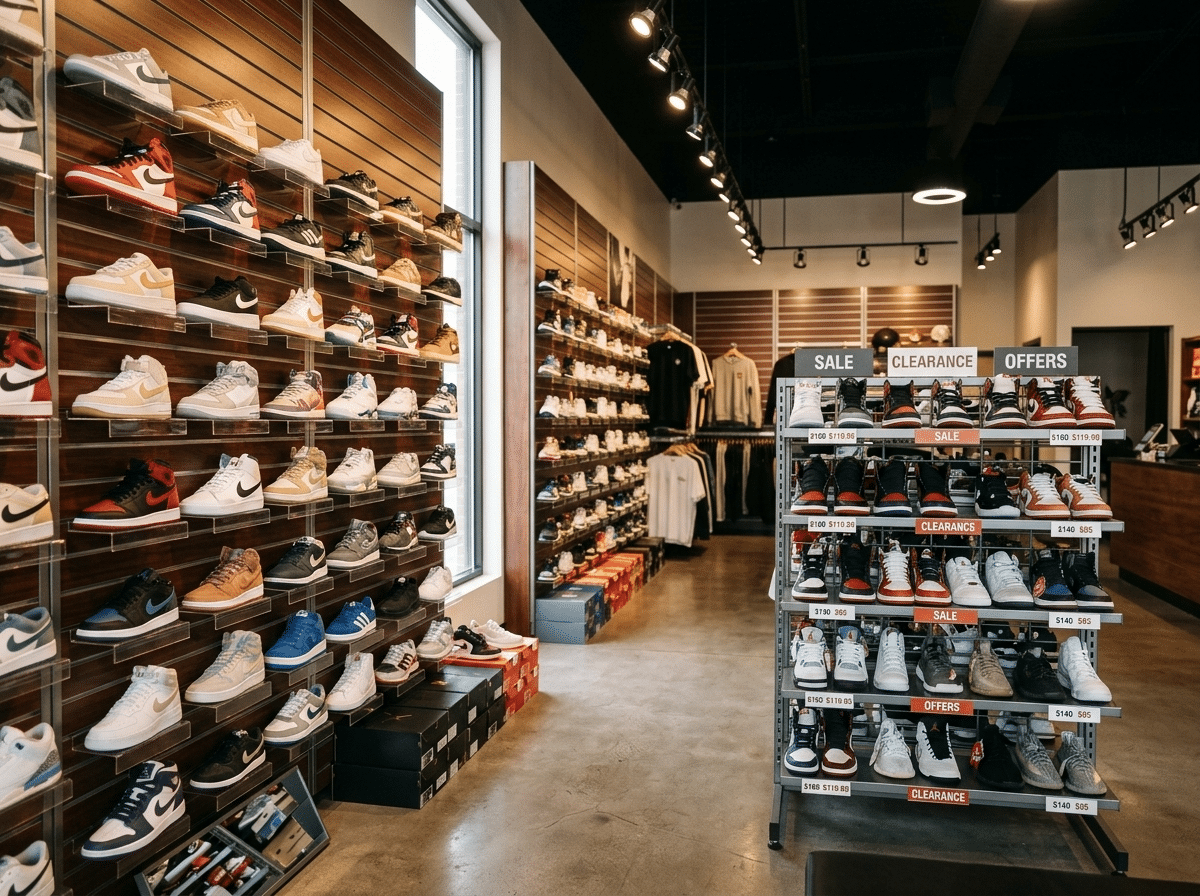
A sneaker boutique's store environment is not decoration — it's brand communication. The customer who walks into a carefully designed sneaker boutique and sees pairs displayed as individual objects of culture, properly lit and presented, understands immediately that this store has a point of view and takes its product seriously. That experience is what separates a boutique from a discount rack and justifies the price premium on the product. DISPLAYARAMA's free 2D store layout service can help you plan your fixture configuration before you spend a dollar on shelving or display units.
The sneaker display approach has a defining characteristic that separates it from general footwear retail: pairs are displayed one per shelf, at eye level or slightly below, like art objects rather than retail product. Wall-mounted floating shelves — evenly spaced, well-lit from above, with just one pair per position — create the gallery aesthetic that defines the premium sneaker boutique format. The physical spaciousness of the display communicates scarcity and intention; it tells the customer these pairs are worth considering individually.
Display cases for the highest-value pairs — limited releases, vintage deadstock, collaboration models — add security and amplify the premium positioning of those specific pairs. A locked glass case presenting a $500 retro Jordan communicates its value in a way that a wall peg never could. Lighting investment in a sneaker store is unusually high-return: proper directional lighting on each shelf position makes every pair look better and significantly elevates the perceived value of the product.
| Fixture / Component | Estimated Cost |
|---|---|
| Wall-Mounted Floating Shelves (Sneaker Display) | $2,000 – $10,000 |
| Display Cases (Premium / High-Value Pairs) | $1,500 – $7,000 |
| Slatwall Panels (Accessories, Laces, Care Products) | $1,000 – $4,000 |
| Seating / Try-On Bench Area | $500 – $3,000 |
| Checkout Counter | $800 – $3,500 |
| Interior Signage & Branding | $1,000 – $5,000 |
| Exterior Signage | $1,000 – $5,000 |
| Lighting (Directional / Track Lighting) | $1,500 – $6,000 |
| Total Fixtures & Store Setup | $9,300 – $43,500 |
A dedicated try-on seating area is a requirement, not a luxury. Sneaker customers need to sit down, try on pairs, and walk around — it's part of the decision process. A boutique that doesn't provide seating loses sales to discomfort. The try-on area also creates natural dwell time, and customers who spend more time in a store buy more product. A simple, well-designed bench area with a clear sightline to the display wall costs $500–$3,000 and earns its cost back quickly.
Consignment operations add a specific fixture need: a backroom or secure storage area for authenticated pairs awaiting display, IMEI-equivalent tracking (shoe condition documentation), and a clear, physically organized system for matching pairs to their consignment records. This doesn't require a large space but does require intentional organization from day one.
DISPLAYARAMA has been supplying retail fixtures to specialty stores since 1980. We carry display cases, wall shelving systems, slatwall panels, checkout counters, and more — everything needed to build a sneaker boutique that presents footwear as the cultural objects they are, and drives the kind of in-store experience that turns browsers into buyers.
Our team can help you plan your layout and select the right fixture combination for your space. Call us at 1-800-292-5227 or get your free layout plan below.
Get My Free Store Fixture Layout Plan →Technology, Authentication & Operations
A sneaker store's technology needs go beyond standard retail POS. Consignment operations require a system that tracks each pair back to its seller, documents condition, logs authentication status, and calculates the correct split at the point of sale. Specialty retail platforms like ConsignCloud, SimpleConsign, and Ricochet are purpose-built for this workflow and are significantly more efficient than adapting a general retail POS. Budget $100–$250/month for a consignment-capable platform plus $500–$2,000 for initial setup and hardware.
Authentication is the single most critical operational competency in any consignment or resale sneaker business. A counterfeit that makes it onto your floor and sells as authentic is a serious legal, reputational, and financial liability. Authentication skills take time to develop — invest in training before you open, learn the tells for the specific models you plan to carry, and consider using established third-party authentication services for any pairs you're uncertain about. Customers who trust your authentication process become loyal, repeat sellers and buyers.
Social media is your primary marketing channel — not optional: Sneaker culture lives on Instagram, TikTok, and YouTube. New arrivals, authentication content, consignment spotlight posts, and behind-the-scenes store content reach your target customer more efficiently than any paid advertising in this category. A consistent posting schedule starting before you open — building anticipation and community — is worth more than a grand opening marketing budget.
| Technology / Authentication / Operations | Estimated Cost |
|---|---|
| Consignment / Retail POS (Hardware + Setup) | $500 – $2,000 |
| POS Monthly Software Fee | $100 – $250/mo |
| Authentication Tools + Training | $200 – $1,000 |
| E-Commerce / Online Store Setup | $500 – $2,500 |
| Staff Wages (Monthly — Small Store, 1–3) | $3,500 – $10,000/mo |
| Business Insurance (Annual) | $1,500 – $4,000 |
| Security System / Cameras | $1,000 – $4,000 |
| Marketing / Grand Opening / Social | $2,000 – $8,000 |
| Utilities (Monthly Average) | $400 – $1,500/mo |
| First-Year Technology + Operations | $67,200 – $205,000+ |
Total Startup Cost Summary
When all categories are totaled, opening a sneaker store in 2026 requires $10,000–$40,000 for a lean small or online-first operation and $50,000–$120,000 for a properly equipped urban boutique with a consignment-hybrid model. A full premium boutique with authorized wholesale accounts, a high-design environment, and a prime urban location can approach $200,000–$250,000 or more.
| Expense Category | Estimated Range |
|---|---|
| Licenses, Permits & Business Formation | $1,350 – $7,050 |
| First Month's Rent + Security Deposit | $3,000 – $30,000 |
| Leasehold Improvements / Buildout | $15,000 – $80,000 |
| Opening Inventory | $36,000 – $108,000 |
| Fixtures & Store Setup | $9,300 – $43,500 |
| Technology, POS & Authentication Tools | $1,200 – $5,500 |
| Working Capital Reserve (3–6 months) | $15,000 – $60,000 |
| Total Estimated Startup Investment | $80,850 – $334,050 |
Year three is the benchmark for sneaker boutique profitability. Most well-run independent boutiques operate near breakeven or with modest losses in year one while building community, seller relationships, and brand identity. By year three, a store with strong curation and community engagement can achieve net margins of 10–20%. The most common failure mode isn't the store concept — it's undercapitalization in the first 12–18 months before the community fully forms around the store.
How to Maximize Revenue
The sneaker boutiques that build durable businesses in 2026 are not trying to compete with Foot Locker on selection or Chewy on price — they're winning on curation, community, authentication trust, and the specific cultural authority that comes from being the store that truly understands sneaker culture in their market. Here's how the best operators build that identity into a profitable business.
Master Emerging Brand Heat Cycles
ASICS recorded 589% trade growth on StockX in H1 2024. Anta grew 1,901%. Salomon posted 53% growth in H1 2025. The independent boutique that spots these trends early and stocks accordingly generates real margins on pairs competitors aren't carrying. Brand heat cycles move fast — monitor StockX trade data and GOAT trending as forward indicators of what's building momentum before it peaks.
Build Consignment Seller Relationships
The consignment model's single greatest asset is the community of sellers who trust you with their pairs. Treat every consignment seller as a long-term relationship, not a single transaction. Pay promptly, communicate clearly, present their pairs well, and they bring better pairs back — and refer other sellers to your floor. The inventory quality of your consignment floor is entirely determined by the quality of your seller relationships.
Sell Sneaker Care & Accessories on Every Transaction
Accessories and sneaker care carry 45–65% gross margins and attach naturally to every footwear purchase. A customer buying a $180 pair who also picks up a cleaning kit ($30), premium laces ($20), and a crease protector set ($20) has added $70 in high-margin revenue to the transaction — a 39% increase with minimal sales effort. Train staff to build the complete care package into the conversation on every sale.
Host Release Events & Community Drop Days
Release events — for limited drops you've secured allocation on — are the single most powerful community-building tool available to a sneaker boutique. They create urgency, generate social media content, build the store's reputation as a legitimate destination for serious buyers, and attract new customers who follow hype drops. Even a well-executed raffle for a modest allocation builds store identity that word-of-mouth alone cannot.
Capitalize on Women's Sneaker Market Growth
Women's sneaker resale market share grew from 1.6% in 2014 to 42.7% in 2022, and the Nike Sabrina silhouette grew 401% on GOAT in 2024 alone. Most sneaker boutiques still under-serve female customers. A thoughtfully curated women's section — not just smaller sizes of men's models, but women-specific drops, colorways, and brands — reaches a growing, underserved, and high-spending segment of the market.
Extend Reach with an Online Channel
An e-commerce channel integrated with your in-store inventory expands your addressable market far beyond your physical trade area. Consignment pairs are particularly well-suited for online listing — high-demand pairs attract buyers from across the country who can't find specific models locally. A Shopify store with integrated inventory management adds 15–20% to revenue for most boutiques that implement it consistently.
Why Your Fixtures Matter
In a sneaker boutique, your fixture environment makes a specific statement about what kind of store you are — and whether the product you're selling deserves to be taken seriously at its price point. Sneakers displayed one pair per shelf, at eye level, with strong directional lighting and clear breathing room between pairs communicate scarcity, intention, and value. The same pairs on crowded racks with inconsistent lighting communicate clearance. Every fixture decision in a sneaker boutique is a brand decision.
The try-on experience is also a fixture design decision. Comfortable seating positioned with a clear sightline to the display wall, an uncluttered floor, and enough physical space to walk and feel the pair are all non-negotiable elements of the sneaker shopping experience. A customer who can't comfortably try on a pair won't buy it. Prioritize these when planning your floor:
- Wall-mounted floating shelves with one pair per position, at eye level — the gallery display format that defines the premium boutique aesthetic and communicates each pair's individual value
- Directional track lighting over display shelves — sneakers are highly visual objects and proper lighting is the single highest-return aesthetic investment per dollar in the store
- Display cases for the highest-value pairs — limited collabs, vintage deadstock, and premium releases deserve the locked-case treatment that signals their significance and protects them from handling
- Comfortable seating and a clear try-on area — the physical space for customers to sit, try, and walk in a pair is not an amenity, it's a conversion requirement
- Slatwall panels for accessories — cleaning kits, laces, sneaker shields, and care products displayed accessibly at the counter or adjacent to the main display wall for natural add-on discovery
DISPLAYARAMA has been outfitting specialty retail stores with professional-grade display fixtures since 1980. We carry wall-mounted shelving systems, display cases, slatwall panels, checkout counters, and more — everything you need to build a sneaker boutique environment where footwear is displayed as the cultural objects they are, and where every fixture decision reinforces your store's identity and credibility.
Our team can help you plan your store layout and select the right combination of fixtures for your square footage and concept. Bulk pricing available for full store buildouts.
Get My Free Store Fixture Layout Plan →Ready to Outfit Your Sneaker Store?
If you're opening a sneaker boutique and need to source display systems and fixtures, start with DISPLAYARAMA's free 2D store layout service — a no-cost resource where our team creates a professional floor plan with specific fixture recommendations for your space. It saves hours of guesswork and gives you a clear picture of your fixture investment before you commit. Request your free layout plan here.
Wall Shelving Systems
Wall-mounted floating shelf systems for the gallery-style one-pair-per-position display format that defines the premium sneaker boutique aesthetic — clean, spacious, and built to present each pair as an individual object worth its price tag.
Display Cases
Locking glass display cases for limited releases, vintage deadstock, and premium collaboration pairs — secure presentation that signals exclusivity and protects your highest-value inventory from handling while making it unmissable.
Slatwall Panels
Flexible slatwall panels for accessories and sneaker care product display — cleaning kits, laces, crease protectors, and storage solutions organized accessibly at the counter or adjacent to the main display for natural add-on discovery.
Checkout Counters
Professional cash wrap counters built for the boutique retail environment — clean, brand-forward workspace for transactions, accessory impulse display, and the authentication documentation process that builds customer trust.
Custom Display Solutions
Need fixtures configured specifically for your store's unique layout, dimensions, or concept? DISPLAYARAMA offers custom display solutions built to your exact specifications for boutiques that need something beyond off-the-shelf.
Bulk Pricing Available
Outfitting a full boutique? DISPLAYARAMA offers bulk pricing on display systems and fixtures. The more you order, the more you save. Call 1-800-292-5227 for a custom quote.
DISPLAYARAMA's free 2D store layout service gives you a professional floor plan with specific fixture recommendations for your sneaker boutique — at no cost. It's designed to save you hours of guesswork and give you a clear picture of your fixture investment before you commit. We've been helping specialty retailers design their stores since 1980, and we offer bulk pricing for owners outfitting a full floor.
Submit your space dimensions and store concept and we'll put together a custom layout plan with exactly the fixtures that will work for your sneaker store.
Get My Free Store Fixture Layout Plan →