

How Much Does It Cost To Open a Beauty Supply Store?
The U.S. beauty and personal care market reached $109.6 billion in 2025 and is projected to grow at a 7.7% CAGR through 2033 — making it one of the most consistently resilient categories in all of consumer retail. The beauty industry's defining characteristic is its recession resistance: even during economic downturns, consumers continue to spend on beauty products, viewing them as accessible luxuries that support self-confidence and wellbeing. The average American spends approximately $85 per month on beauty and grooming products, and that figure has held remarkably steady across economic cycles.
The U.S. beauty supply store industry specifically has grown at a 5.9% CAGR between 2019 and 2024, driven by premiumization — consumers trading up to higher-quality products — and by the booming diversity of the American beauty market. Ethnic hair care, professional-grade color and styling tools, extension and wig categories, and skincare routines that were once considered niche are now mainstream growth drivers. The independent beauty supply store that understands its neighborhood — stocking the right brands for the specific community it serves — consistently outperforms generic mass-market beauty sections in drug stores and supermarkets.
This guide gives you a complete, honest breakdown of what it actually costs to open a beauty supply store in 2026 — every major expense category, the competitive landscape context you need to plan your concept, and the strategies that distinguish thriving independent beauty retailers from ones that struggle to differentiate.
Defining Your Store Concept
The beauty supply category is broad enough to support several distinct store concepts, each with different inventory requirements, customer bases, and startup costs. The most important decision you'll make before setting a budget is which of these models you're building — because they lead to fundamentally different businesses.
A general beauty supply store carries haircare, skincare, cosmetics, nails, and beauty tools for both consumers and salon professionals. This is the most common model and requires the broadest inventory investment. A professional-focused supply store serves licensed cosmetologists and salons with professional-grade color, chemical treatments, tools, and backbar products — typically requiring a cosmetology license verification system but commanding stronger margins and building deeply loyal professional clientele. A specialty or community-focused store concentrates on a specific segment — natural hair, ethnic hair care, K-beauty, clean beauty, extensions and wigs — and serves a defined customer with deep, expert selection that general stores can't match.
The independent beauty supply store's core competitive advantages over big-box retailers and e-commerce are product depth in specific categories, knowledgeable staff, and physical proximity to the customer. A store that stocks every trending mass-market brand also stocked by every grocery store and Target has no differentiation. A store that carries products the customer cannot find anywhere else in a 20-mile radius builds a loyal, repeat customer base that sustains the business through competitive pressure.
| Store Concept | Estimated Startup Range |
|---|---|
| Niche / Specialty Store (Single Category Focus) | $20,000 – $60,000 |
| Mid-Size General Beauty Supply Store | $60,000 – $150,000 |
| Full-Service Beauty Supply (Consumer + Pro) | $100,000 – $250,000 |
| Large Format / Premium Location | $200,000 – $500,000+ |
| Key Competitive Edge for Independents | Curation + Community Fit |
Know your neighborhood before buying inventory: A beauty supply store's success is deeply tied to the specific demographics of its trade area. The products that move fastest in a predominantly Black neighborhood (ethnic hair care, braiding supplies, wigs, edge control) differ from those that dominate in a Korean or Latino community. Research your trade area before placing your opening order.
Licenses, Permits & Business Formation
A general consumer beauty supply store has a relatively uncomplicated licensing footprint. You'll need standard business formation, a retail operating license, and a resale certificate — the most important document to obtain before approaching any wholesale distributor, since it allows you to purchase inventory without paying sales tax on goods you'll resell. Apply for it before your first buying appointment.
If your store plans to sell professional-grade chemical products — relaxers, color, perms, developer — regulations vary by state regarding whether those products can be sold to unlicensed consumers. In some states, professional-only products can only be sold to licensed cosmetologists, which may require you to verify licenses at the point of sale and implement a professional buyer verification process. Research this before building your buying plan. If you're selling nail supplies that include regulated chemicals, your state may also require hazardous materials storage compliance. A quick call to your state's Department of Health or Department of Consumer Affairs clarifies your obligations before you open.
Obtain your wholesale accounts early: The best wholesale beauty distributors — Cosmoprof, Sally Beauty Supply wholesale, local regional distributors — require proof of business formation and a resale certificate before opening an account. Apply for both as your very first step, so you have buying access ready when you need it. Without a distributor account, you're buying at retail prices and cannot run a viable business.
| License / Permit / Filing | Cost Range |
|---|---|
| LLC or Corporation Formation | $50 – $500 |
| General Business License | $50 – $500/yr |
| Seller's Permit / Resale Certificate | $0 – $50 |
| Zoning / Occupancy Permit | $100 – $1,000 |
| Signage Permit | $100 – $500 |
| Professional Product Seller Permit (if applicable) | $50 – $500/yr |
| Hazardous Materials Compliance (if applicable) | $100 – $500 |
| Attorney / Legal Consultation | $500 – $2,000 |
| Estimated Total | $950 – $5,550 |
Location & Rent
Beauty supply store location strategy is driven by two factors above all else: demographic alignment and accessibility. A beauty supply store in a neighborhood whose residents don't match the store's product mix will struggle regardless of foot traffic. A store that stocks exactly the right products for the community it's in — natural hair products in a neighborhood with a strong Black customer base, K-beauty essentials in a Korean-American community, professional salon supplies near a dense cluster of salons — builds loyal, repeat traffic from day one.
Strip malls and neighborhood shopping centers near residential density are the natural home for beauty supply stores. Proximity to hair salons, nail salons, and beauty schools creates natural customer overlap — salon professionals are among the most consistent, high-volume beauty supply customers. A location within walking distance of a beauty school creates a pipeline of new customers who need to build their professional kit from scratch. Visibility and easy parking matter significantly since beauty supply shopping often involves buying multiple products.
A typical independent beauty supply store operates in 1,000–3,000 square feet. Smaller specialty stores run 500–1,500 sq ft. Larger full-service supply stores need 2,500–4,000 sq ft to carry a meaningful depth of inventory across all categories.
| Store Size / Location Type | Monthly Rent |
|---|---|
| Small / niche store (500–1,000 sq ft) | $1,000 – $3,500 |
| Mid-size store (1,000–2,500 sq ft) | $2,000 – $6,000 |
| Full-service store (2,500–4,000 sq ft) | $4,000 – $12,000+ |
| First-Year Rent Cost (Mid-Size Estimate) | $24,000 – $72,000 |
Buildout costs for a beauty supply store are generally moderate compared to categories requiring specialized infrastructure. Standard leasehold improvements — shelving installation, lighting upgrades, a checkout counter, and basic décor — typically run $10,000–$50,000 depending on the condition of the space and the aesthetic level of your concept.
Opening Inventory
Inventory is the largest single expense in opening a beauty supply store and the category that most directly determines whether customers come back. A store with narrow, poorly curated shelves loses customers to competitors. A store with deep, targeted selection in the categories that matter to its specific community earns loyal regulars who spend consistently. The beauty supply store operator who understands their community's specific product preferences — and buys accordingly — has a structural advantage that no amount of marketing spend can replicate.
Hair Care (The Anchor Category)
Hair care is the dominant product category in beauty supply — it accounts for approximately 22% of the global beauty market, and in community-focused supply stores, it represents an even higher share. This includes shampoos, conditioners, styling products, relaxers, natural hair products, edge control, weave care, and braiding supplies. Budget $10,000–$30,000 for a deep, community-appropriate hair care opening inventory.
Hair Extensions, Wigs & Weaves
This is the highest-ticket category in many beauty supply stores and a major differentiator for stores serving communities where protective styles are culturally important. Quality hair extensions and wigs carry strong margins and drive significant per-transaction revenue. Budget $5,000–$25,000 depending on the depth and price points you carry.
Skincare, Cosmetics & Nails
Skincare has become the fastest-growing beauty category, accounting for 32.5% of U.S. beauty and personal care spending in 2025. A well-curated skincare section — particularly brands with strong ethnic skin tone inclusivity and clean formulations — drives repeat purchases and high basket sizes. Budget $5,000–$20,000 for skincare, cosmetics, and nail categories combined.
Tools, Accessories & Professional Products
Blow dryers, flat irons, curling wands, brushes, combs, and professional salon accessories generate solid margins and consistent demand. Professional-grade tools carry premium price points and strong customer loyalty. Budget $3,000–$10,000 for tools and accessories.
| Inventory Category | Estimated Cost |
|---|---|
| Hair Care (Shampoo, Conditioner, Styling, Natural) | $10,000 – $30,000 |
| Hair Extensions, Wigs & Weaves | $5,000 – $25,000 |
| Skincare (Cleansers, Moisturizers, Treatments) | $3,000 – $12,000 |
| Color Cosmetics (Foundation, Lashes, Lip) | $2,000 – $8,000 |
| Nail Supplies (Polish, Gels, Acrylics, Tools) | $1,500 – $5,000 |
| Styling Tools (Dryers, Flat Irons, Curlers) | $3,000 – $10,000 |
| Professional Products (Color, Chemical, Salon) | $3,000 – $10,000 |
| Accessories (Brushes, Combs, Bobby Pins, etc.) | $1,000 – $4,000 |
| Total Opening Inventory | $28,500 – $104,000 |
Get your resale certificate before your first buying appointment. Wholesale beauty distributors require it before opening an account. Without distributor pricing, your cost of goods is too high to operate profitably — you need wholesale access before you can set a price that makes sense for the customer and for your margins.
Fixtures, Shelving & Store Design
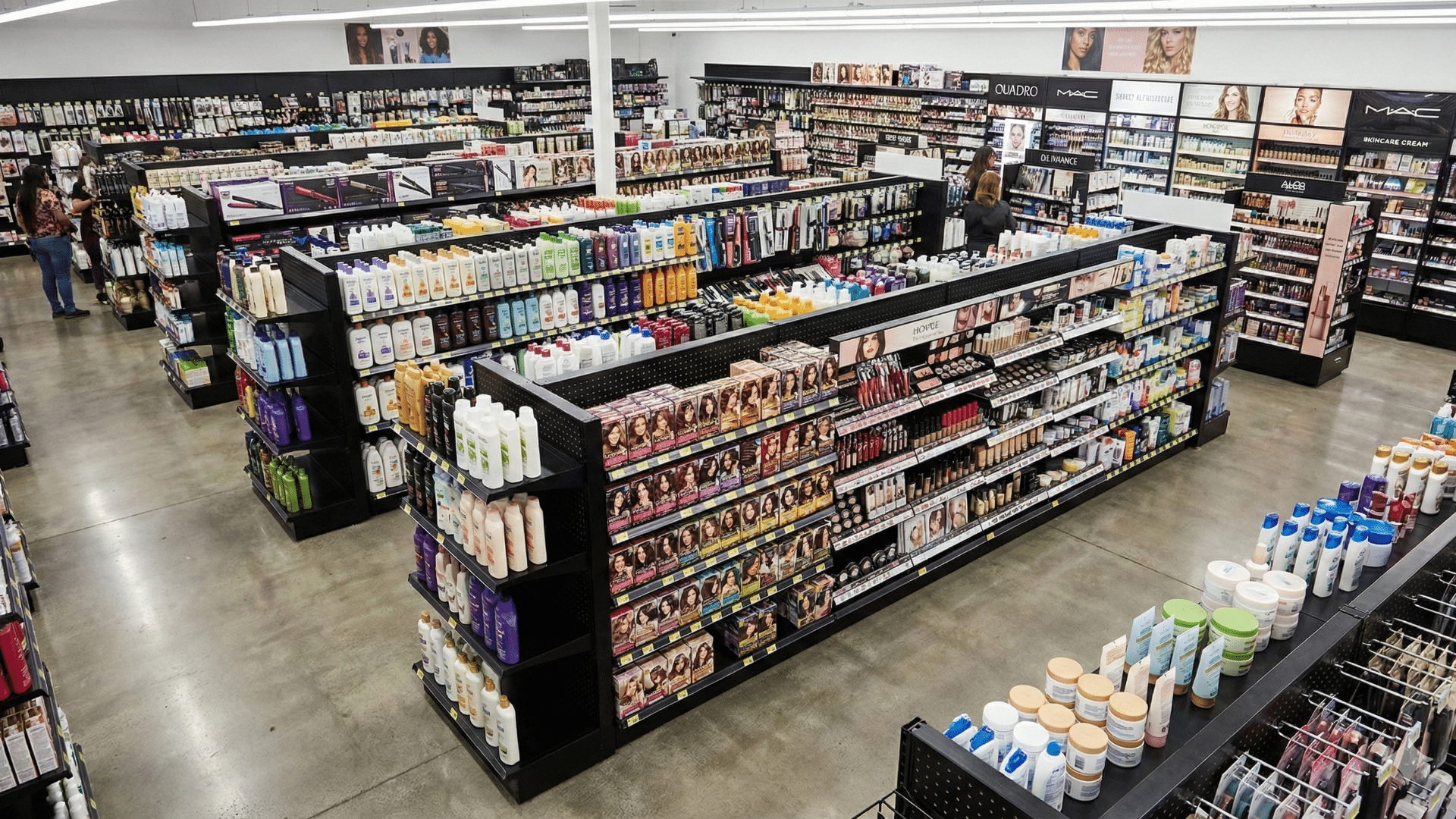
A beauty supply store's fixture configuration needs to accomplish two things simultaneously: maximize the number of SKUs visible on the sales floor, and make them easy enough to find that customers can browse and discover independently without staff assistance on every item. The stores that convert browsers to buyers most effectively are the ones where products are organized logically, labeled clearly, and displayed at the right height to invite inspection. DISPLAYARAMA's free 2D store layout service can help you plan your fixture configuration before you spend a dollar on shelving.
Gondola shelving organized by category — hair care brands by hair type, skincare by concern, cosmetics by product type — is the proven layout standard for beauty supply. Display cases for higher-value items like professional tools, wigs, and quality hair extensions provide both security and an elevated presentation that supports the price point. Slatwall panels offer flexible wall merchandising for seasonal promotions, new arrivals, and accessory categories.
| Fixture / Component | Estimated Cost |
|---|---|
| Gondola Shelving (Aisle Runs + End Caps) | $5,000 – $20,000 |
| Wall Shelving (Perimeter) | $2,000 – $8,000 |
| Slatwall Panels (Flexible Wall Displays) | $1,500 – $5,000 |
| Display Cases (Tools, Wigs, Premium Products) | $1,500 – $7,000 |
| Wig & Hair Extension Display Heads / Stands | $500 – $2,500 |
| Checkout Counter / Cash Wrap | $800 – $3,500 |
| Interior Signage & Category Labels | $500 – $2,000 |
| Exterior Signage | $1,000 – $5,000 |
| Lighting Upgrades | $1,000 – $4,000 |
| Total Fixtures & Store Setup | $13,800 – $57,000 |
Wig and hair extension display is a specialized fixture need that most general retail fixture guides overlook. Wig heads and hair display stands need to be at eye level, well-lit, and organized by style, color, and length so customers can compare options quickly. A well-designed wig display section is one of the most important visual merchandising elements in a beauty supply store that carries this category.
Display cases for styling tools and professional products serve dual purposes: they protect high-value inventory from shoplifting (styling tools and professional color are top targets for retail theft) while presenting these items professionally. A quality flat iron or professional curler in a lit display case looks worth $150. The same product on a peg hook mid-aisle looks like commodity hardware.
DISPLAYARAMA has been supplying retail fixtures to specialty stores since 1980. We carry gondola shelving, slatwall systems, display cases, checkout counters, and wall display solutions — everything needed to build a beauty supply store that's organized, shoppable, and built to move product.
Our team can help you plan your layout and select the right fixture combination for your space and budget. Call us at 1-800-292-5227 or get your free layout plan below.
Get My Free Store Fixture Layout Plan →Technology, Staffing & Operations
A beauty supply store carries hundreds to thousands of individual SKUs across multiple categories, brands, and product types. Inventory management is operationally critical — running out of a customer's favorite brand or product is one of the fastest ways to lose a loyal repeat buyer. A modern retail POS system with integrated inventory tracking, reorder alerts, and sales-by-category reporting lets you manage your product mix based on actual sell-through data rather than gut instinct. Platforms like Lightspeed, Square for Retail, or Shopify POS handle beauty supply needs effectively.
Staffing a beauty supply store requires product knowledge. A customer asking for a recommendation on a shampoo for low-porosity natural hair, a product-safe developer for a at-home highlight, or the right edge control for long-hold braiding styles needs a staff member who actually knows the answer. Knowledgeable beauty advisors build customer loyalty that no loyalty program can replicate. Budget for competitive wages and ongoing product education — manufacturer reps often provide free product training, which is worth taking advantage of.
Build an e-commerce channel early: Online sales accounted for 27.6% of all personal care and beauty transactions in the U.S. per Census Bureau data. A Shopify store integrated with your in-store inventory costs $500–$2,000 to set up and immediately extends your reach beyond walk-in traffic. Customers who discover your community-specific product selection online often become some of your highest-value in-store regulars.
| Technology / Staffing / Operations | Estimated Cost |
|---|---|
| POS System (Hardware + Setup) | $500 – $2,000 |
| POS Monthly Software Fee | $79 – $250/mo |
| E-Commerce Website Setup | $500 – $2,500 |
| Staff Wages (Monthly — Small Store, 1–3 Staff) | $4,000 – $12,000/mo |
| Business Insurance (Annual) | $1,500 – $5,000 |
| Security System / Cameras | $1,000 – $4,000 |
| Marketing / Grand Opening / Social Media | $2,000 – $8,000 |
| Utilities (Monthly Average) | $300 – $1,200/mo |
| First-Year Technology + Operations | $60,378 – $192,150+ |
Total Startup Cost Summary
When all categories are totaled, opening a beauty supply store in 2026 requires $30,000–$60,000 for a lean niche or specialty store and $80,000–$150,000 for a properly stocked mid-size general beauty supply store. A full-service store with a comprehensive inventory across all categories and a premium location can approach $250,000 or more.
| Expense Category | Estimated Range |
|---|---|
| Licenses, Permits & Business Formation | $950 – $5,550 |
| First Month's Rent + Security Deposit | $2,000 – $18,000 |
| Leasehold Improvements / Buildout | $10,000 – $50,000 |
| Opening Inventory | $28,500 – $104,000 |
| Fixtures & Store Setup | $13,800 – $57,000 |
| Technology & POS Setup | $1,000 – $4,500 |
| Working Capital Reserve (3–6 months) | $15,000 – $50,000 |
| Total Estimated Startup Investment | $71,250 – $289,050 |
Inventory discipline is everything in beauty supply. The operators who struggle are almost always ones who opened with too many SKUs across categories they didn't understand well, tied up capital in slow-moving stock, and couldn't fund reorders of the fast-selling products customers kept asking for. Start deep in the categories your community actually buys, build from there, and track sell-through religiously from day one.
How to Maximize Revenue
The beauty supply stores that build durable businesses aren't competing on price with Sally Beauty or Amazon. They're winning on community fit, product curation, expert staff, and the specific products their neighborhood can't find anywhere else. Here's how the best independent operators build profitable, loyal customer bases.
Own a Specific Category Deeply
The most successful independent beauty supply stores have a category where they're simply the best option in the market — natural hair, professional color, extensions, K-beauty, clean beauty. Deep selection in one category you understand well builds a loyal customer base that travels past competitors to reach you. Breadth without depth loses to Amazon every time.
Build Relationships with Local Salon Pros
Professional cosmetologists are among the highest-value beauty supply customers — they buy consistently, in volume, and they refer their clients. Offer professional pricing tiers, flexible payment terms for established pros, and early access to new arrivals. A single busy stylist can bring $5,000–$15,000 per year in consistent supply purchases.
Leverage Social Media for Discovery
Beauty is one of the most social-media-driven purchase categories in retail. Instagram and TikTok haul videos, product demonstrations, and "what I found at my local beauty supply" content have driven massive sales for small independent stores. A consistent posting schedule showcasing new arrivals, product tutorials, and community-specific content builds organic reach that paid advertising can't replicate at the same efficiency.
Carry Exclusive or Hard-to-Find Brands
27.6% of beauty purchases happen online — but customers will go out of their way for products they can't easily find elsewhere. Stocking emerging brands, import-only products, or professional-only lines that aren't available in the mass market creates genuine destination shopping that drives both foot traffic and word-of-mouth.
Implement a Loyalty Program
Beauty supply customers are habitual — when they find a store that stocks their favorites, they return consistently. A points-based loyalty program builds switching costs and gives you purchase data to personalize promotions. Customers enrolled in loyalty programs spend measurably more per visit and return significantly more often than non-enrolled customers.
Host Beauty Education Events
In-store demos, product launch events, natural hair workshops, and manufacturer brand nights drive traffic, build community, and expose customers to products they wouldn't have discovered otherwise. Events also generate social media content and word-of-mouth that keeps your store top of mind for the community it serves.
Why Your Fixtures Matter
In a beauty supply store, fixtures are your silent merchandising team. With hundreds to thousands of SKUs on the floor, the way products are organized, displayed, and labeled determines whether customers find what they're looking for — or leave frustrated. A well-organized store with clear category signage, logical product grouping, and properly deployed display cases earns more per customer visit than an identical store with cluttered, disorganized shelving, regardless of how similar the inventory is.
Beauty supply customers often visit with specific products in mind, but impulse purchases and brand discoveries happen when the store environment makes browsing easy and comfortable. End caps loaded with new arrivals, promotional bundles, and seasonal items are among the highest-converting real estate in a beauty supply store. Prioritize these when planning your floor:
- Gondola shelving organized by product category and then by hair type, concern, or brand — customers should be able to navigate your store without staff assistance for routine purchases
- Display cases for styling tools, professional products, and premium accessories — both security against theft and a visual signal that these items are worth their price point
- Wig and hair extension display stands at eye level with clear labeling by style, color, length, and hair type — this category requires dedicated, purposeful display to convert browsers to buyers
- Slatwall panels for flexible wall displays — seasonal promotions, new brand arrivals, and featured categories can be rotated without permanent construction
- A professional checkout counter with impulse items at the register — lip products, travel sizes, accessories, and single-use treatments increase average transaction value on every purchase
DISPLAYARAMA has been outfitting specialty retail stores with professional-grade display fixtures since 1980. We carry gondola shelving, slatwall systems, display cases, checkout counters, and wall display solutions — everything you need to build a beauty supply store where products are organized, protected, and displayed to drive sales from day one.
Our team can help you plan your store layout and select the right combination of fixtures for your square footage and budget. Bulk pricing available for full store buildouts.
Get My Free Store Fixture Layout Plan →Ready to Outfit Your Beauty Supply Store?
If you're opening a beauty supply store and need to source shelving and fixtures, start with DISPLAYARAMA's free 2D store layout service — a no-cost resource where our team creates a professional floor plan with specific fixture recommendations for your space. It saves hours of guesswork and gives you a clear picture of your fixture investment before you commit. Request your free layout plan here.
Gondola Shelving
Double-sided freestanding gondola units for your store's interior aisles — the backbone of any beauty supply floor, organized by category for fast customer navigation and efficient daily restocking.
Slatwall Systems
Flexible slatwall panels for wall display — ideal for accessories, new arrivals, seasonal promotions, and any category that benefits from reconfigurable merchandising without permanent construction.
Display Cases
Locking glass display cases for styling tools, professional products, and premium accessories — security and presentation combined, protecting your most theft-prone inventory while making it look exactly as valuable as it is.
Wall Shelving
Perimeter wall shelving for high-volume categories — haircare, skincare, and cosmetic brands organized by product type across your full back and side walls, maximizing vertical display capacity.
Checkout Counters
Professional cash wrap counters built for beauty retail — organized for fast transaction flow, with display space for impulse accessories, travel sizes, and single-use products that increase average basket value.
Bulk Pricing Available
Outfitting a full beauty supply store? DISPLAYARAMA offers bulk pricing on shelving and fixtures. The more you order, the more you save. Call 1-800-292-5227 for a custom quote.
DISPLAYARAMA's free 2D store layout service gives you a professional floor plan with specific fixture recommendations for your beauty supply store — at no cost. It's designed to save you hours of guesswork and give you a clear picture of your fixture investment before you commit. We've been helping specialty retailers design their stores since 1980, and we offer bulk pricing for owners outfitting a full floor.
Submit your space dimensions and store type and we'll put together a custom layout plan with exactly the fixtures that will work for your beauty supply store.
Get My Free Store Fixture Layout Plan →