 Skip to content

No products in the cart.
How Much Does It Cost To Open a Hobby Shop?
$56.5B U.S. Hobby & Toy Store Revenue (2026)
$44K–$151K Typical Startup Range Before Buildout
+12.9% Bandai Namco Toys & Hobby Sales Growth (FY2026)
~90% Share of Model Trains & Hobby Products Made in China
IBISWorld expects U.S. hobby and toy stores to bring in about $56.5 billion in 2026, a 1% rise that ends five years of slow decline. Inside that number, the model hobby side has real momentum. Bandai Namco's Toys and Hobby business grew sales 12.9% in its fiscal year ending March 2026, helped by strong Gundam results, and the company opened its first U.S. Gundam Base store near Chicago in December 2025, with more locations following in 2026.
A hobby shop is a different business from a toy store or a game store. Your customers build, run and repair things: RC cars and trucks, model railroads, plastic kits like Gunpla, rockets and drones. They come back every week for parts, paint, glue and advice, and the shop that has the right part on the wall the day something breaks earns a customer for years.
This guide covers every major cost of opening a hobby shop in 2026, from distributor accounts and opening inventory to parts walls, display cases and the reserves you need while the business grows. Every range comes from current industry sources, published startup estimates and owners who have done it.
First Decision
What Kind of Hobby Shop Are You Building?
The single biggest driver of your budget is how many hobbies you try to cover. A shop focused on one category, such as plastic model kits or a single RC brand, opens with a fraction of the inventory a full-line store needs. A shop that covers trains in several scales, RC cars and aircraft, kits, paints and tools needs deep stock in every category before customers trust it as their go-to store.
| Store Concept | Estimated Startup Range |
|---|---|
| Small hobby & model shop (one or two niches) | $26K – $94K |
| Full-line hobby shop (trains, RC, kits, supplies) | $50K – $250K |
| RC shop with an on-site track | Retail base + track space |
| Hobby shop franchise (HobbyTown) | $280K – $620K |
The small-shop range is the sum of ZenBusiness's itemized startup costs for a hobby and model shop, which leave out operating reserves. Published guides for full-line train and hobby stores land between $50,000 and $250,000, with inventory alone ranging from $20,000 to $100,000. Third-party summaries of HobbyTown's franchise disclosure put total investment at about $280,000 to $620,000, and HobbyTown asks franchisees to have $150,000 to $200,000 in liquid assets.
An on-site RC track adds a lot of floor space. One operator planning a 1/10-scale indoor track budgeted about 4,000 square feet for the track and 2,500 more for pit tables, and owners repeatedly warn that race fees alone rarely cover the rent. The track works when it feeds a busy parts counter.
Start narrow: Focusing on one strong category can cut opening inventory from more than $50,000 for a diversified store to under $15,000. Add a second hobby once the first one pays the rent.
Step 1
Licenses, Permits & Dealer Accounts
Form your business first: LLC filing fees run from $35 in Montana to $500 in Massachusetts, with Florida at $125 and Texas at $300. Sales tax permits are free in most states, though a few charge up to $100. Add a local business license and a certificate of occupancy for the space.
Hobby shops carry a few products your fire marshal will care about. Lithium polymer (LiPo) RC batteries, nitro fuel and spray paints all have storage rules, so ask your local fire authority what applies before you stock them. Many shops keep LiPo packs in fire-resistant charging safes or cabinets, which are sold with fire ratings of around 90 minutes.
Dealer accounts cost nothing to open, but manufacturers want to see a real store. Horizon Hobby, which distributes brands such as Arrma, Losi, Axial and E-flite, asks U.S. retailers to submit business information and store photos. Traxxas expects a state business license and a federal tax ID with its dealer application. Walthers serves model railroad shops through its wholesale team, and Bluefin is the official U.S. distributor for Bandai Hobby kits, including Gunpla.
| License / Permit | Cost Range |
|---|---|
| LLC formation (state filing fee) | $35 – $500 |
| Sales tax / seller's permit | $0 – $100 |
| Local business license | $50 – $400 |
| Certificate of occupancy | $100 – $400 |
| Manufacturer & distributor dealer accounts | $0 (approval required) |
| Typical Total | $185 – $1,400 |
Get the storefront first: Many RC brands will not approve a home-based seller. Plan on signing your lease and taking store photos before your largest dealer accounts are approved, and build that delay into your opening date.
Step 2
Location & Rent
Hobby shops are destination stores. Customers drive in for a specific part or kit, so easy parking matters more than mall foot traffic. If you sell RC, a nearby parking lot or open area where customers can test a truck after a repair is a real advantage, and space for a build table or workbench gives kit and train customers a reason to stay.
CBRE reported average U.S. retail asking rent of $24.79 per square foot per year in the second quarter of 2026. Here is what a 2,000-square-foot hobby shop costs at different rent levels.
| Market Type | Est. Monthly Base Rent (2,000 sq ft) |
|---|---|
| Lower-cost market (~$16/sq ft/yr) | ~$2,670 |
| National average (~$24.79/sq ft/yr) | ~$4,130 |
| Premium center in a strong metro (~$35/sq ft/yr) | ~$5,830 |
Expect to pay first and last month's rent up front, which ZenBusiness puts at $3,000 to $10,000 for a hobby shop. If the space needs work, Terrapin's 2026 buildout data puts basic retail improvements at $40 to $90 per square foot and mid-tier work at $90 to $180. A second-generation retail space that only needs lighting and paint can come in closer to ZenBusiness's $2,000 to $15,000 estimate for a hobby shop's buildout and lighting.
Location insight: Look for a unit with a back room. RC repairs, kit assembly and battery charging all need workspace that stays out of the selling floor.
Step 3
Opening Inventory & Margins
Opening inventory for a hobby shop commonly runs $15,000 to $50,000, and it is the largest line in most budgets. Margins vary a lot by category. Buying through distributors typically leaves room for gross margins in the 40% to 50% range on supplies and accessories, while ready-to-run vehicles, radios and electronics sell for much thinner margins, according to RC retailers. Many planning models assume an overall gross margin of about 40%.
RC Cars, Trucks & Aircraft
Ready-to-run vehicles bring customers in, but parts keep them coming back. Every crash creates a need for arms, gears, tires and bearings, so a deep parts wall for the brands you carry matters more than a wide selection of vehicles. Horizon Hobby publishes a minimum advertised price policy that limits how low prices can be advertised online, which helps independent shops compete.
Model Trains
Train customers buy by scale, so choose your focus, usually HO and N, before you stock rolling stock, track, scenery and structures. Walthers and Celerant launched an integration in January 2025 that lets hobby retailers import the Walthers catalog and automate purchase orders, which makes it easier to keep a large catalog in stock.
Model Kits, Gunpla & Supplies
Plastic kits, paints, glues and tools are steady sellers. Gunpla in particular has caught on in the U.S., and Bandai Spirits announced a new factory in 2025 to keep up with worldwide demand. Kits pair naturally with paint, tools and build nights.
Tariffs
The Hobby Industry Coalition estimates that about 90% of model trains and other hobby products are made in China, and tariffs on Chinese imports reached as high as 145% in the spring of 2025. Prices have moved repeatedly since, so keep reorder quantities flexible and watch distributor price updates closely.
| Inventory Economics | Typical Figure |
|---|---|
| Planning gross margin (overall) | ~40% |
| Supplies & accessories bought through distributors | ~40% – 50% |
| Average transaction | $30 – $100 |
| Single-niche opening inventory | Under $15K |
| Opening Inventory | $15K – $50K |
Inventory discipline: Stock deep on the parts and supplies your customers need every week, and shallow on big-ticket vehicles and train sets until you know what sells. A shop that is always out of the right part loses customers to online sellers fast.
Step 4
Fixtures & Store Design
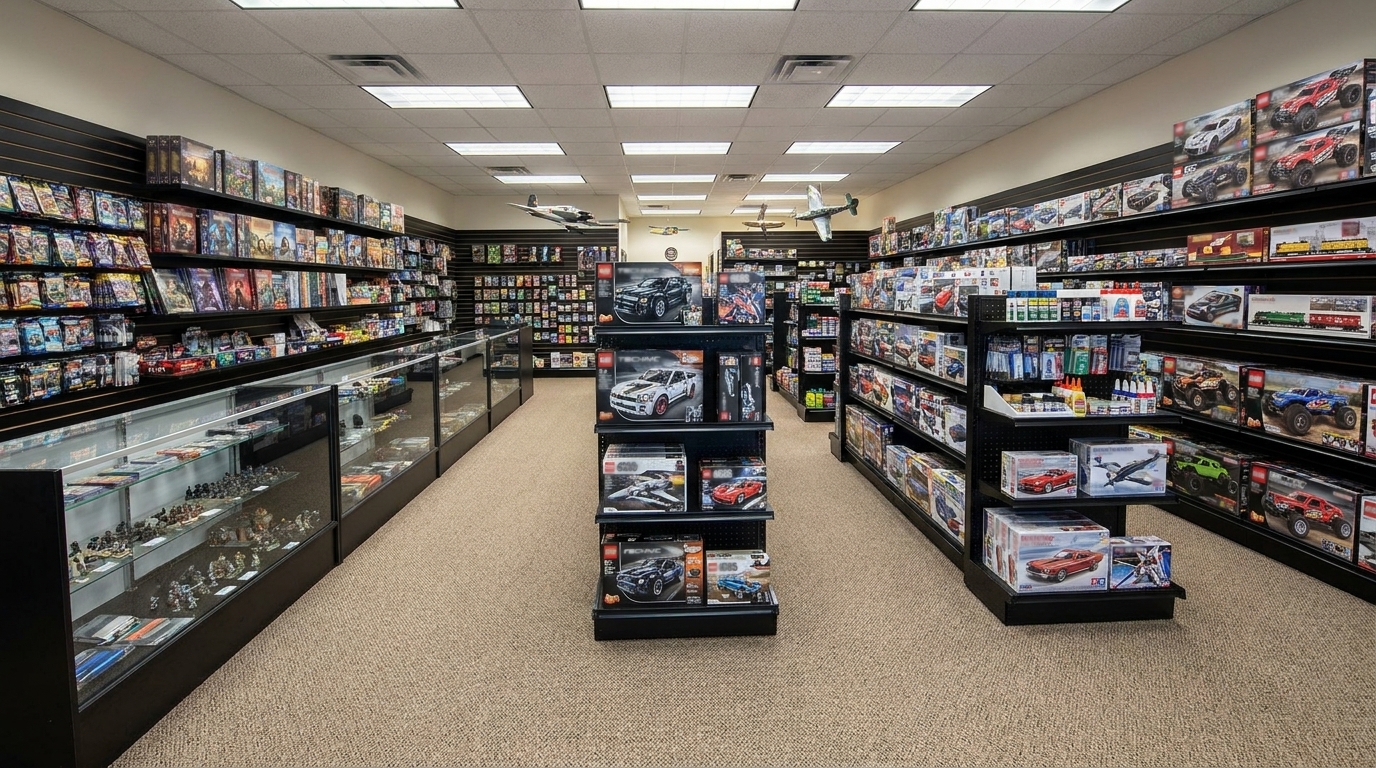
Hobby shops sell thousands of small, carded parts, so most of their walls are hooks. Slatwall panels with slatwall hooks organize RC parts by brand and model, and you can add shelves for paints and glues anywhere on the wall. Kit boxes and train sets stack best on a gondola wall shelving run, and slatwall-backed double-sided gondolas create aisles with shelves on the bottom and hooks above.
Locked glass display cases protect radios, motors and finished builds, and a wall display case shows off painted kits and locomotives. Using current DISPLAYARAMA pricing, the core fixtures for a 2,000-square-foot hobby shop run roughly $5,000 to $8,700.
| Fixture | Estimated Cost |
|---|---|
| 6–10 slatwall panels (4'x8', parts wall) | $522 – $990 |
| 200–400 slatwall hooks | $95 – $361 |
| Gondola wall run, 4–7 sections (kits & trains) | $1,454 – $2,460 |
| 1–2 slatwall-backed double-sided gondolas | $1,046 – $2,091 |
| 2–3 glass display cases (48") | $540 – $891 |
| 1 wall display case (finished builds) | $540 – $1,092 |
| 48" glass-front checkout counter | ~$397 |
| 3-tier feature table | ~$399 |
| Estimated Fixture Package | $5,000 – $8,700 |
DISPLAYARAMA Plan Your Hobby Shop Floor Before You Buy
DISPLAYARAMA has supplied retail fixtures since 1980, from Grade A slatwall and hooks to gondola shelving and glass display cases. Send us your floor dimensions and we will map out your parts wall, kit shelving, cases and counter so everything fits.
Prefer to talk through your space? Call us at 1-800-292-5227.
Get My Free Store Fixture Layout Plan → Step 5
Technology, Staffing & Operations
A hobby shop's POS has to handle a huge catalog of small parts. Square for Retail Plus costs about $49 per location per month, and hobby-focused systems such as Celerant can import distributor catalogs like Walthers' directly. ZenBusiness puts POS hardware and setup at $1,000 to $2,500.
Staffing is where hobby shops win or lose. Retail salespeople earn a median of $17.03 per hour according to the Bureau of Labor Statistics, but your best hire is someone who can diagnose a stripped gear or recommend the right airbrush. Plan for signage, grand-opening marketing and insurance in your first-year budget too.
| Technology / Operations | Estimated Cost |
|---|---|
| POS system & hardware | $1,000 – $2,500 |
| Exterior signage | $1,000 – $4,000 |
| Marketing & grand opening | $1,000 – $3,000 |
| Business insurance (first premium) | $500 – $1,500 |
| Total | $3,500 – $11,000 |
Full Picture
Total Cost To Open a Hobby Shop
Adding up each category, a 2,000-square-foot hobby shop typically needs about $44,000 to $151,000 before buildout. The operating reserve is the line new owners most often underestimate. With rent of roughly $2,700 to $5,800 per month and one to two employees at the BLS median wage, three to six months of operating cash comes to roughly $17,000 to $70,000.
| Cost Category | Estimated Range |
|---|---|
| Licenses, permits & formation | $185 – $1,400 |
| First & last month's rent | $3,000 – $10,000 |
| Opening inventory | $15,000 – $50,000 |
| Slatwall, shelving, cases & fixtures | $5,000 – $8,700 |
| Technology & operations | $3,500 – $11,000 |
| Operating reserve (3–6 months) | $17,000 – $70,000 |
| Buildout & lighting (if needed) | $2K – $15K, or $40 – $180 per sq ft |
| Total Before Buildout | ~$44K – $151K |
Independent Hobby Shop ~$44K–$151K RC, trains, kits & supplies
Full-Line Destination Store $50K–$250K Deep stock in every category
Franchise (HobbyTown) $280K–$620K Brand, buying power, support
Timeline to profitability: ZenBusiness estimates 12 to 24 months for a hobby shop to break even, with average annual revenue of $150,000 to $500,000 for stores with strong community programs and specialty inventory. One planning model for a larger shop projected a first-year loss of $96,000, which is why reserves matter. Retail overall holds up well, with 58.3% of new retail establishments still open after five years according to the Bureau of Labor Statistics.
Running the Business
How Hobby Shops Grow Revenue
Online sellers can match the price of a kit, but they cannot fix a truck on a Saturday morning or show a beginner how to weather a boxcar. The shops that last sell expertise along with the product.
01
Own the Parts Wall
Parts sell every week, carry better margins than vehicles, and bring customers back each time something breaks. Stock parts for every vehicle you sell.
02
Offer Repairs & Setup
Bench repairs, upgrades and setup for new customers earn labor revenue and sell the parts that go into each job.
03
Host Build Nights
Gunpla, scale model and train build nights fill slow evenings and sell paint, tools and the next kit. Contests give builders a reason to show off their work in your cases.
04
Run Bash & Race Days
RC events build a local community. Treat them as a way to sell parts, not a profit center, since owners report that race fees alone rarely cover the rent.
05
Favor MAP-Protected Lines
Brands with minimum advertised pricing, such as Horizon Hobby's lines, keep online discounts in check so you can compete on service instead of price.
06
Take Pre-Orders
Limited kits and new locomotive runs sell out fast. Pre-orders lock in demand before you buy and bring customers back into the store at pickup.
Store Design
Why Your Fixtures Matter
A hobby shop lives or dies on whether customers can find the exact part they need. A parts wall organized by brand and model, with clear labels and hooks that stay full, turns a ten-minute search into a two-minute sale and makes your shop the place people trust before they ever check online.
Fixtures also sell the hobby itself. A lit case of finished builds, a train running above the counter or a display of the newest RC trucks shows beginners what is possible and gives your regulars something new to talk about.
- Slatwall with hooks for RC parts, bearings, tires and carded accessories
- Gondola wall shelving with adjustable steel shelves for kit boxes and train sets
- Slatwall-backed gondolas for aisles of paint, glue and tools
- Locking glass cases for radios, electronics and finished builds
- Feature tables near the entrance for new arrivals and pre-order pickups
DISPLAYARAMA Display Fixtures Built For Hobby Shops
From Grade A slatwall and hooks to heavy-duty gondola shelving and glass display cases, DISPLAYARAMA carries the fixtures hobby shops need, with bulk pricing for full store openings.
See fixtures selected for hobby shops, or call 1-800-292-5227 to talk with our team.
Shop Hobby Shop Fixtures → FAQ
Opening a Hobby Shop: Common Questions
How much does it cost to open a hobby shop?
A 2,000-square-foot hobby shop typically costs about $44,000 to $151,000 before buildout, including inventory, fixtures, technology and three to six months of reserves. A small shop focused on one or two niches can open for less, while full-line stores that cover trains, RC and kits can reach $250,000, and a HobbyTown franchise runs about $280,000 to $620,000.
Is a hobby shop profitable?
It can be, but margins vary by category. Many planning models assume about a 40% overall gross margin. Parts, supplies and accessories usually earn more, while ready-to-run vehicles, radios and electronics earn less. Repairs, events and a deep parts wall are what make the numbers work.
How long does it take a hobby shop to break even?
ZenBusiness estimates 12 to 24 months. Keep three to six months of operating expenses in reserve, since the first year often runs at a loss while you build a regular customer base.
How much inventory does a hobby shop need to open?
Opening inventory commonly runs $15,000 to $50,000. A shop focused on a single category, such as plastic model kits or one RC brand, can open with under $15,000, while a diversified store can need more than $50,000.
Do I need a storefront to become an RC dealer?
Usually, yes. Horizon Hobby asks for business information and store photos with a dealer inquiry, and Traxxas expects a state business license and federal tax ID with its dealer application. Owners report that major RC brands rarely approve home-based sellers.
Where do hobby shops buy their inventory?
Most buy from a mix of manufacturers and distributors. Horizon Hobby and Traxxas supply RC, Walthers is a major model railroad wholesaler, and Bluefin is the official U.S. distributor for Bandai Hobby kits, including Gunpla.
How do tariffs affect hobby shops?
The Hobby Industry Coalition estimates about 90% of model trains and other hobby products are made in China, so tariffs flow directly into wholesale prices. Keep reorder quantities flexible and watch distributor price updates.
Should my hobby shop have an RC track?
Only if you have the space and the parts business to support it. One operator's plan for an indoor 1/10-scale track called for about 4,000 square feet plus 2,500 for pit tables, and owners warn that race fees alone rarely cover the rent. A track works best as a way to sell parts.
What fixtures does a hobby shop need?
Most hobby shops use slatwall with hooks for RC parts and accessories, gondola wall shelving for kit boxes and train sets, glass display cases for electronics and finished builds, and a checkout counter. A starter fixture package for a 2,000-square-foot shop runs about $5,000 to $8,700.
Shop Fixtures
Outfit Your Hobby Shop
With your budget in place, the next step is planning where your parts wall, shelving, cases and counter go. These are the fixtures most hobby shops open with, and our team will fit them to your floor plan with a free layout.
Slatwall Panels
Grade A slatwall with hooks and shelves builds parts walls you can reorganize every time you add a new brand.
Gondola Shelving
Heavy-duty steel shelving with adjustable shelves holds kit boxes, train sets and RC vehicles along walls and aisles.
Glass Display Cases
Locking cases protect radios and electronics and show off finished builds, starting under $300.
Display Tables
Tiered tables at the entrance feature new arrivals, pre-order pickups and staff builds.
Checkout Counters
Glass-front counters anchor your register and keep small, high-value parts in view and secure.
Bulk Pricing Available
Outfitting a full store? DISPLAYARAMA offers bulk pricing on fixtures. Call 1-800-292-5227 for a custom quote.
DISPLAYARAMA Not Sure What Fixtures You Need? Start Here. It's Free.
DISPLAYARAMA's free 2D store layout service gives you a professional floor plan with specific fixture recommendations for your hobby shop at no cost, from your parts wall to your display cases. We have been helping retailers design their stores since 1980, and we offer bulk pricing for owners outfitting a full floor.
Send us your space dimensions and store type, and we will put together a custom layout plan with the fixtures that fit your hobby shop.
Get My Free Store Fixture Layout Plan →